How to Accurately Assess the Value of Costume Jewelry
Learn how to assess the true value of costume jewelry by identifying vintage markers, material grades, and designer hallmarks for accurate appraisals.
The Misconception of 'Worthless' Fashion Pieces
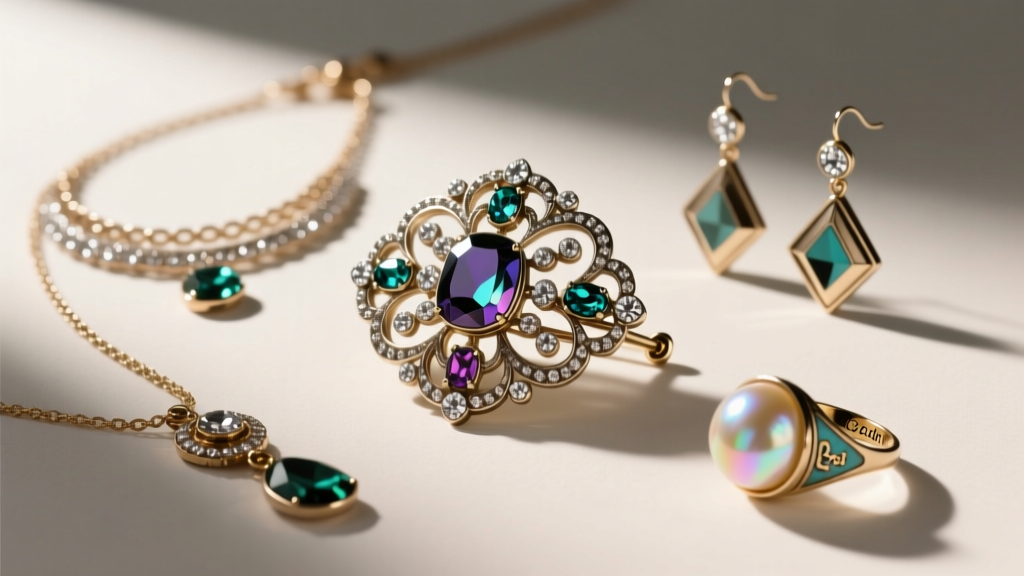
For decades, the term 'costume jewelry' was synonymous with disposable, low-tier accessories meant to mimic fine jewelry for a fraction of the cost. However, the archival fashion market has completely rewritten this narrative. As we navigate the style landscape of 2026, understanding the value of costume jewelry requires a shift in perspective. Today, pieces from mid-century design houses, Art Deco innovators, and avant-garde 1980s runways are highly sought after by collectors and museums alike. The value is no longer dictated by the intrinsic melt value of the metals or the carat weight of the stones, but rather by provenance, craftsmanship, historical significance, and material ingenuity.
Whether you are thrifting, inheriting a family collection, or looking to invest in archival fashion, accurately appraising these pieces requires a keen eye for specific historical markers and material failure modes. This guide will equip you with the exact frameworks used by vintage jewelry dealers to separate mass-produced trinkets from highly valuable collectibles.
Key Drivers of Costume Jewelry Valuation
Unlike fine jewelry, where a diamond's 4Cs dictate the baseline price, costume jewelry valuation relies on a matrix of designer provenance, era-specific construction techniques, and the survival condition of delicate materials.
1. Designer Provenance and Hallmarks
The most significant multiplier for the value of costume jewelry is the maker. Houses like Miriam Haskell, Trifari, Coro, Schiaparelli, and Chanel command premium prices. However, identifying the era of the hallmark is crucial. For instance, Trifari used a simple 'K' mark in the 1920s, evolved to 'Trifari' with a crown over the 'T' in the 1930s, and later added the copyright symbol (©) in the mid-1950s after a landmark copyright lawsuit. Pieces bearing the earliest, rarest hallmarks often fetch 30% to 50% more on the secondary market.
2. Material Composition Beyond the Base
While costume jewelry lacks precious gems, the specific synthetic and base materials used are critical to its appraisal. According to historical archives documented by the Gemological Institute of America (GIA), early 20th-century designers utilized groundbreaking synthetic materials that are now rare and highly regulated.
- Bakelite and Celluloid: Popular in the 1920s and 30s, Bakelite (polyoxybenzylmethylenglycolanhydride) is heavy, produces a deep 'clunk' when tapped against glass, and emits a distinct formaldehyde odor when rubbed vigorously or exposed to hot water. Authentic carved Bakelite bangles can range from $300 to over $2,000.
- Rhodium Plating: During the platinum craze of the 1930s, high-end costume makers like Trifari used rhodium plating over base metals. Rhodium is a precious metal that resists tarnish. If a 1930s piece still retains its bright, untarnished silver-toned finish, it is likely rhodium-plated, significantly boosting its value.
- Aurora Borealis (AB) Rhinestones: Introduced by Swarovski in 1956 in collaboration with Christian Dior, AB stones feature an iridescent micro-coating. Pieces featuring early, high-quality AB stones are highly prized by mid-century collectors.
Value Assessment Matrix: Era and Hardware Indicators
Hardware and clasp types are some of the most reliable ways to date a piece, which directly impacts the value of costume jewelry from a specific era. Use this matrix to cross-reference your findings.
| Era / Style | Key Materials | Hardware / Clasp Indicators | Estimated Market Value (USD) |
|---|---|---|---|
| 1920s Art Deco | Celluloid, early rhinestones, pot metal | Trombone clasps, simple C-clasps, no safety catches | $150 - $800+ |
| 1940s Retro / Jelly Belly | Lucite, sterling silver (due to metal rationing) | Locking C-clasps, sterling hallmarks on backs | $400 - $2,500+ |
| 1950s Mid-Century | AB rhinestones, faux pearls, gold-tone alloys | Rollover safety clasps, copyright (©) symbols | $75 - $450 |
| 1980s Designer / Gripoix | Poured glass, heavy gold-plated brass, faux baroque pearls | Chanel/CC interlocking stamps, seasonal year codes | $800 - $5,000+ |
Practical Appraisal: How to Inspect Your Pieces
To accurately determine the value of costume jewelry, you must conduct a physical inspection focusing on structural integrity and stone condition. Aesthetic flaws that might be polished out of fine jewelry can render a costume piece nearly worthless.
The Loupe Test: Prongs vs. Glue

Always inspect the stone settings with a 10x jeweler's loupe. High-value vintage costume jewelry features stones that are prong-set or bezel-set into the metal, just like fine jewelry. Mass-produced, lower-tier pieces often rely on adhesive glue. If you see yellowed, brittle glue seeping out from under a rhinestone, the piece is likely from a lower-tier manufacturer or has suffered severe environmental damage, drastically reducing its resale value.
The Foil-Back Failure Mode
Most vintage rhinestones are 'foil-backed'—a thin layer of metallic paint or foil applied to the back of the glass to increase light refraction. Moisture is the ultimate enemy of foil-backed stones. If a piece was worn frequently and exposed to sweat or humidity, the foil will oxidize, turning the stones black or cloudy. Expert insight: A missing or blackened stone in a rare Trifari 'Alfred Philippe' design will drop the value by 40% to 60%, as sourcing period-correct, matching replacement stones is notoriously difficult.
The Magnet and Weight Tests
Carry a strong neodymium magnet. While some vintage pot metal (zinc alloys) is non-magnetic, many cheaper later alloys contain iron or steel and will stick to a magnet, indicating a lower-tier origin. Additionally, high-end vintage pieces from houses like Miriam Haskell or Dior have a substantial, heavy hand-feel due to the thick layers of gold plating and dense brass bases. Lightweight, flimsy pieces are typically indicative of 1970s mass-production and hold minimal collector value.
When to Restore vs. When to Sell As-Is
A common mistake among amateur collectors is attempting to clean or restore valuable archival pieces, inadvertently destroying their patina and historical integrity. According to vintage jewelry conservation guidelines highlighted by Christie's Jewelry Department, original condition is paramount.
'Never use ultrasonic cleaners or harsh chemical dips on vintage costume jewelry. These methods will instantly strip the delicate gold wash, dissolve the adhesive holding faux pearls together, and ruin the iridescent coating on early rhinestones.'
If a piece requires re-stringing (common for Miriam Haskell or Chanel faux pearl sautoirs), the cost of professional archival restringing using silk thread and period-correct spacers can range from $150 to $300. Only invest in this restoration if the piece's verified market value exceeds $800. For lower-tier pieces, selling 'as-is' to a restoration hobbyist is the most financially sound strategy.
Final Thoughts on Building a Valuable Collection
Assessing the value of costume jewelry is an exercise in historical archaeology. By looking past the lack of precious metals and focusing on the innovation of materials, the precision of the stone settings, and the rarity of the designer hallmarks, you can uncover extraordinary value in unexpected places. As the fashion industry continues to embrace circularity and archival styling, the market for pristine, historically significant costume jewelry will only continue to appreciate. Arm yourself with a loupe, a magnet, and a deep understanding of 20th-century design eras, and you will never overlook a masterpiece disguised as a mere accessory.