Eisenberg Costume Jewelry: Material Properties & Value Guide
Explore the metallurgy, Austrian crystals, and plating properties of vintage Eisenberg costume jewelry to authenticate and value your pieces.

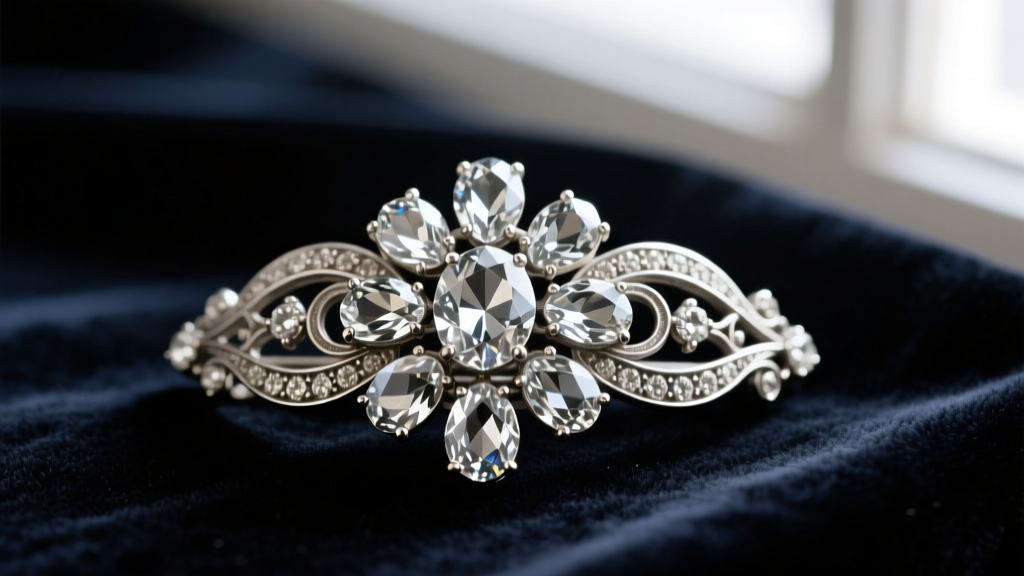
In the hierarchy of vintage fashion accessories, Eisenberg costume jewelry occupies a rare echelon. Originally launched in the 1910s as a promotional line for the Eisenberg & Sons clothing company, the jewelry became so wildly popular that it eclipsed the garments themselves. By the 1930s, Eisenberg had pivoted entirely to jewelry production, establishing a legacy defined by uncompromising material quality. For collectors and appraisers in 2026, understanding the specific metallurgical and gemological properties of these pieces is essential for authentication, valuation, and preservation.
Unlike mass-market costume jewelry that relied on cheap stampings and glued glass, Eisenberg utilized premium base metals, heavy precious metal plating, and precision-set Austrian crystals. This guide dissects the material science behind the brand, offering a definitive framework for identifying genuine articles and understanding their enduring market value.
The Metallurgy of Eisenberg: Sterling Silver vs. White Metal Alloys
The base metal composition of Eisenberg jewelry is the primary chronological indicator of its production era. The brand underwent a distinct metallurgical shift driven by global conflicts and supply chain constraints.
The Sterling Silver Era (1930s–1945)
Pieces produced between the early 1930s and the end of World War II were predominantly cast in 925 sterling silver. Due to the weight and density of sterling, these early brooches and dress clips possess a substantial, luxurious heft. During this period, pieces were often unmarked or bore the hallmark 'Eisenberg Original' in block letters. The use of sterling provided a non-reactive, highly polishable foundation that resisted the severe pitting common in lesser alloys.
The White Metal and Pot Metal Transition (Post-1945)
Following WWII, silver shortages and rising costs forced a transition to white metal alloys, commonly referred to in the trade as 'pot metal' or 'white brass.' These alloys were primarily zinc-based, often alloyed with tin, lead, and antimony to lower the melting point and improve casting fluidity. While heavier than aluminum, these zinc alloys are inherently brittle and prone to internal stress fractures over decades of thermal cycling. Post-war pieces are typically marked 'Eisenberg Ice' or simply 'E' in a cartouche.
According to valuation archives at Kovels, the transition from sterling to white metal is a critical pricing inflection point. Pre-1945 sterling Eisenberg pieces consistently command a 40% to 60% premium over identical designs cast in post-war white metal alloys, assuming equal condition.
Optical Properties: The Austrian Rhinestone Standard
The defining characteristic of Eisenberg costume jewelry is its exceptional brilliance, achieved through the exclusive use of top-tier Austrian rhinestones, primarily sourced from Swarovski and specialized glasshouses in Wattens and Bohemia.
Refractive Index and Lead Oxide Content
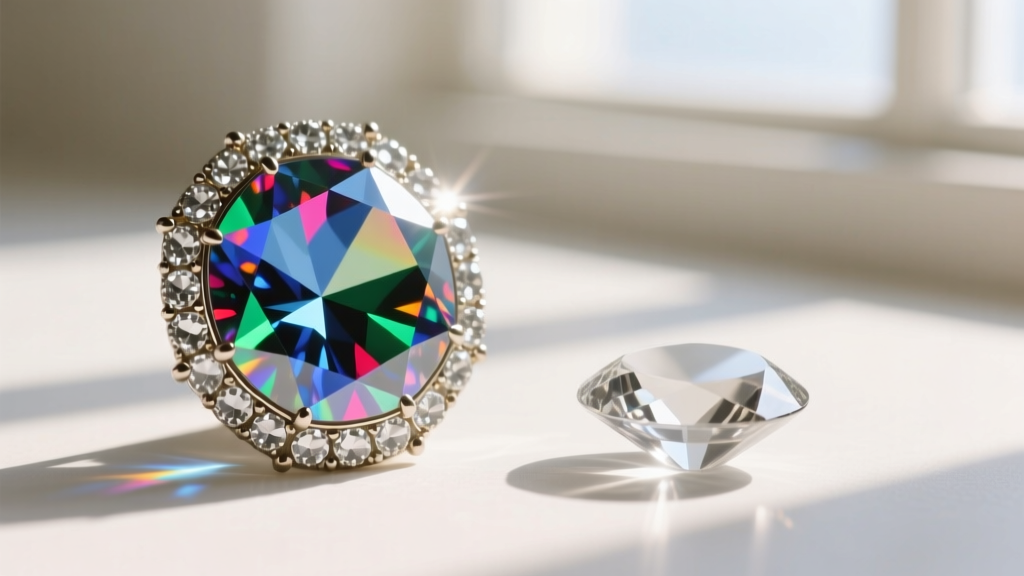
Vintage Eisenberg stones are lead glass. Historically, these crystals contained between 30% and 32% lead oxide (PbO). According to gemological data from the Gemological Institute of America (GIA), this high lead content elevates the refractive index (RI) of the glass to approximately 1.65–1.70, closely mimicking the optical dispersion of natural diamonds (RI 2.42). This is what gives vintage Eisenberg stones their signature 'fire' and heavy, glass-like tactile feel.
In contrast, modern environmental regulations have forced a shift to lead-free crystals. Swarovski's modern 'Advanced Crystal' contains less than 0.009% lead, resulting in a lower RI of roughly 1.52. When comparing a vintage Eisenberg piece to a modern designer replica, the vintage stones will exhibit noticeably sharper facet junctions and deeper spectral dispersion under direct halogen or LED lighting.
Material Comparison: Eisenberg vs. Modern Jewelry Tiers
To contextualize the quality of vintage Eisenberg, it is helpful to compare its material specifications against contemporary fashion and demi-fine tiers available in the 2026 market.
| Material Property | Vintage Eisenberg (Sterling Era) | Modern Designer Costume (e.g., Chanel) | Modern Demi-Fine (e.g., Mejuri) |
|---|---|---|---|
| Base Metal | 925 Sterling Silver | Brass / Bronze Alloys | Recycled Sterling Silver |
| Stone Composition | 32% PbO Austrian Glass | Leaded / Lead-Free Crystal | CZ / Lab-Grown Diamonds |
| Plating | Heavy Rhodium (1.0+ microns) | Gold/Ruthenium Flash (0.2 microns) | 14k/18k Gold Vermeil (2.5 microns) |
| Stone Setting | Hand-built Metal Prongs | Adhesive / Glue | Cast-in-place / Prong |
| Expected Lifespan | 100+ Years (with care) | 5–15 Years | 20–50 Years |
Plating Durability: Rhodium and Gold Wash
Eisenberg rarely left its base metals bare. The brand was renowned for its thick, mirror-finish rhodium plating over both sterling silver and white metal. Rhodium, a platinum-group metal, is exceptionally hard and highly reflective.
Vintage Eisenberg rhodium plating typically measures between 0.75 and 1.5 microns in thickness. This is substantially thicker than the 0.1 to 0.3-micron 'flash' plating used on mid-century mass-market jewelry. However, because rhodium is brittle, pieces that have been subjected to mechanical stress (such as the hinges of dress clips or the pin stems of brooches) often exhibit micro-cracking. When the underlying white metal is exposed to atmospheric sulfur and moisture, it oxidizes, creating a dark, crusty patina that can bleed through the rhodium fissures.
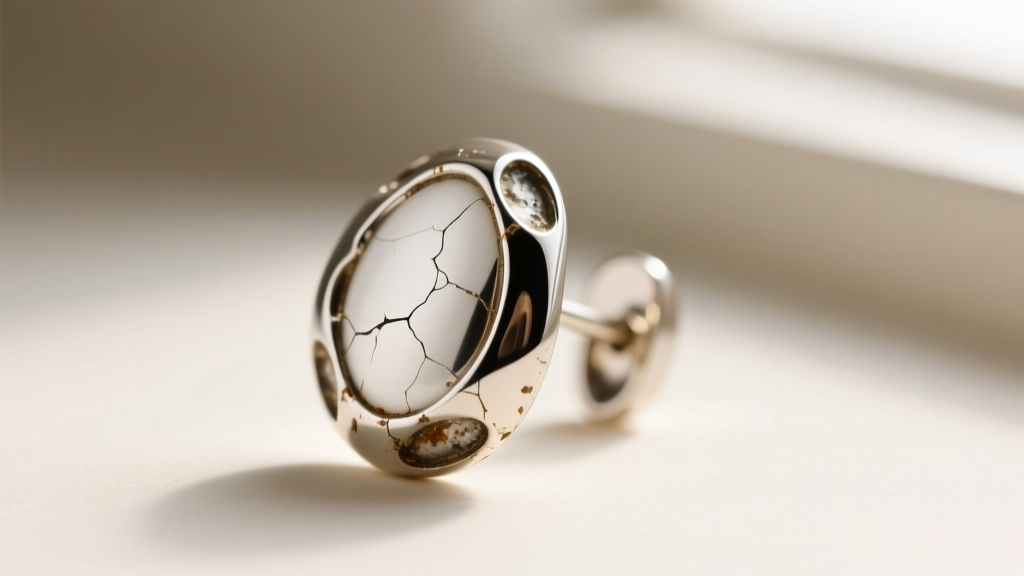
Gold-washed Eisenberg pieces are significantly rarer. These typically feature a 14k or 18k gold wash over a sterling base, primarily produced in the late 1940s and 1950s. The gold layer on these pieces is usually less than 0.5 microns thick, meaning high-wear areas (like clasp mechanisms) frequently show through to the silver substrate.
Authentication Through Material Diagnostics
The secondary market is saturated with counterfeit Eisenberg pieces. Authenticating these items requires moving beyond hallmarks—which are easily forged—and examining the physical construction and material behaviors.
- The Prong Test: Genuine Eisenberg stones are exclusively set in hand-built, folded metal prongs. If you examine the reverse of a brooch and see glue residue, or if the stones are held by flat, stamped metal tabs without distinct folded prongs, the piece is a forgery or a lower-tier contemporary brand.
- Weight and Acoustic Resonance: Sterling silver Eisenberg pieces have a distinct, dense weight. When gently tapped with a wooden stylus, sterling emits a high-pitched, sustained 'ping.' Zinc-based pot metal produces a dull, flat 'thud' due to its lower acoustic resonance and internal porosity.
- Clasp Mechanisms: Pre-1940s pieces frequently utilize 'trombone' clasps or simple C-catches without safety catches. By the 1950s, Eisenberg adopted the modern roll-over safety clasp. A piece marked 'Eisenberg Original' (a 1930s mark) featuring a modern roll-over safety clasp is an immediate red flag for a franken-piece or outright fake.
Preservation Protocols for Vintage Alloys and Glass
Preserving the material integrity of Eisenberg jewelry requires strict adherence to specific chemical and mechanical boundaries. The high lead content in the rhinestones makes them highly susceptible to etching from acidic or alkaline cleaners.
Never use ultrasonic cleaners. The high-frequency cavitation will fracture the vintage glass along microscopic internal fault lines and strip the rhodium plating from the white metal base. Furthermore, avoid commercial silver dips; the thiourea compounds in these solutions will permanently cloud the facets of Austrian rhinestones.
For routine maintenance, use a soft, untreated microfiber cloth. For heavier soil, a solution of distilled water and a pH-neutral, non-ionic surfactant (such as conservation-grade Orvus WA Paste) applied with a soft sable brush is the safest method. Dry immediately with compressed air to prevent moisture from seeping beneath the stone settings, which can trigger rapid oxidation of the underlying white metal alloys.


