Ancient Celtic Jewelry: Metallurgy, Torcs & Repoussé Techniques
Explore the metallurgy and crafting techniques of ancient Celtic jewelry, from La Tène torcs to cast bronze brooches and enamel inlay methods.

The Metallurgical Foundation: Alloys of the Hallstatt and La Tène Periods
To truly understand ancient Celtic jewelry, one must look past the mystical knotwork and examine the rigorous metallurgical engineering that defined the Iron Age. Modern metallurgical analysis in 2026 continues to reveal that Celtic smiths were not merely artists, but master chemists who manipulated alloy ratios to achieve specific mechanical properties. According to the World History Encyclopedia, the transition from the Hallstatt period (c. 800–450 BCE) to the La Tène period (c. 450–1 BCE) marked a significant evolution in both design complexity and material science.
Bronze, the foundational alloy of early Celtic adornment, was rarely a simple mix. Hallstatt bronze typically featured a copper-to-tin ratio of 88:12. This specific 12% tin content is the metallurgical sweet spot: it provides a Vickers hardness of approximately 150 HV, allowing for deep casting and work-hardening without crossing the 15% threshold where the alloy becomes dangerously brittle. When working with precious metals, Celtic jewelers frequently utilized electrum—a natural or artificially created alloy of gold and silver. The Snettisham Great Torc, for instance, is crafted from an electrum alloy containing roughly 40% silver, which not only conserved rare gold but also increased the tensile strength of the neck-ring, allowing it to withstand the immense torque required during the twisting process.
Engineering the Torc: Tension, Twisting, and Terminals
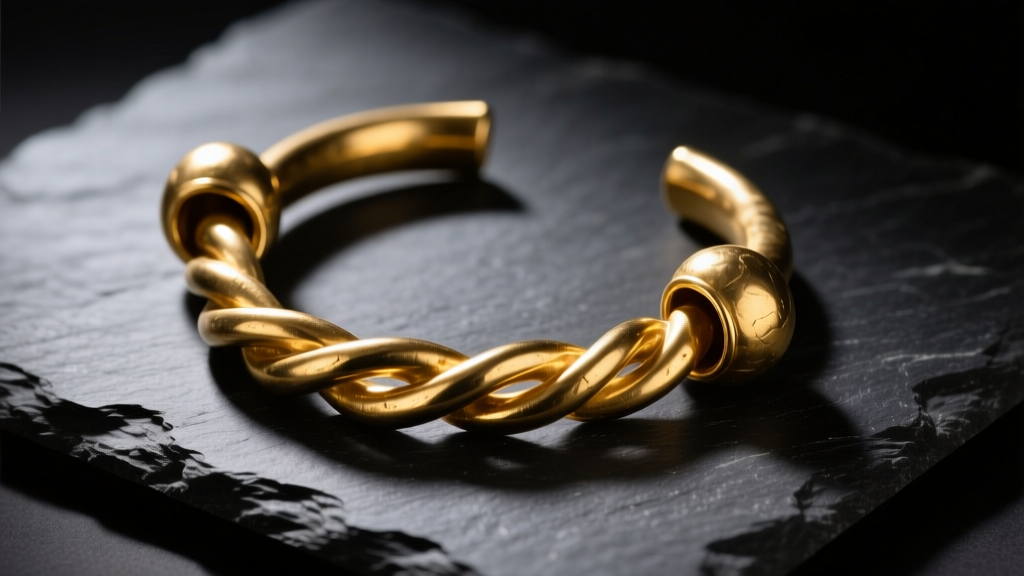
The torc remains the most iconic piece of ancient Celtic jewelry, yet its construction represents a massive engineering challenge. Creating a fluted, twisted torc from a solid bar of gold or bronze requires a profound understanding of thermodynamics and metal fatigue. A master smith would first cast or forge a bar with a square, octagonal, or star-shaped cross-section. To twist a 10mm thick gold bar without snapping it, the metal must be annealed.
Smiths heated the metal to a dull cherry red (approximately 700°C for gold alloys, higher for bronze) and allowed it to cool, relieving internal crystalline stresses. The twisting was performed while the metal was in a plastic state. If twisted cold, the metal would work-harden, develop micro-fractures, and ultimately shear. The mathematical precision required to maintain an even pitch across the entire circumference of the neck-ring, while leaving the terminal ends perfectly straight and untwisted, speaks to the use of specialized jigs and immense physical leverage.
Terminal Construction: The Lost-Wax Method
The terminals of high-status torcs were rarely forged from the same bar as the hoop. Instead, they were hollow-cast using the cire perdue (lost-wax) technique. This reduced the overall weight of the jewelry, preventing the torc from pulling uncomfortably on the wearer's neck. The hollow terminals were then attached to the twisted hoop via mechanical interlocking—where the straight end of the twisted bar was inserted into the hollow terminal and secured with a hidden internal pin—or through early forms of brazing, using a lower-melting-point copper-gold solder to fuse the components without melting the intricate cast details of the terminal faces.
Surface Decoration: Repoussé and Champlevé Enameling
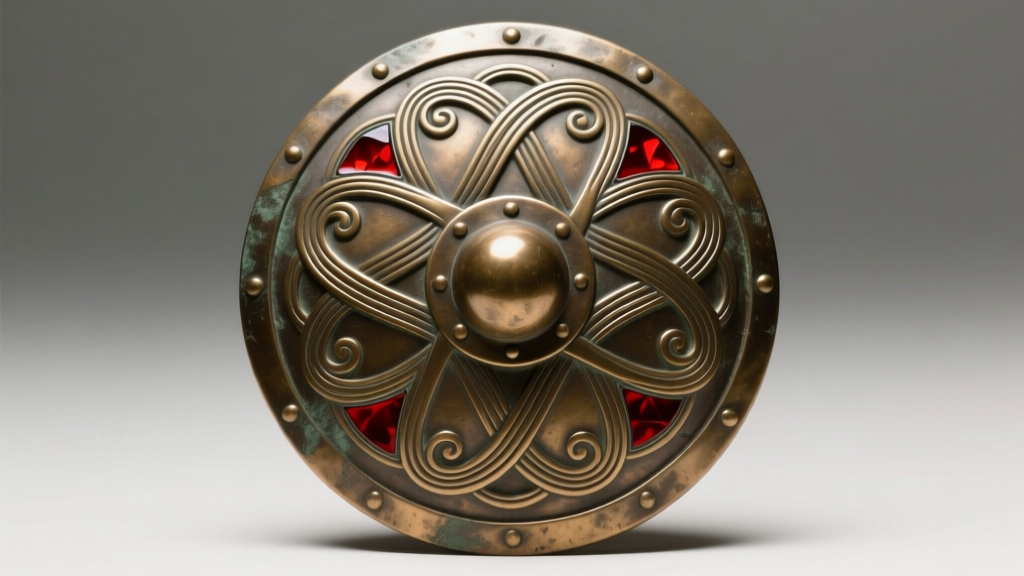
The fluid, asymmetrical, and organic curvilinear motifs of the La Tène style required advanced surface manipulation techniques. Repoussé, the process of hammering the reverse side of a metal sheet to create a raised relief design on the front, was executed using specialized iron and bronze punch tools over a bed of warm pitch. The pitch—a mixture of pine resin, tallow, and plaster—provided a yielding yet supportive surface that prevented the thin metal (often less than 1mm thick) from buckling or tearing under the hammer's force.
Perhaps the most technically demanding decorative technique was the application of opaque red enamel, a hallmark of later Celtic and Insular metalwork. What is commonly called "enamel" in this context is actually an opaque red lead-silica glass frit. The Celtic champlevé method involved carving deep recesses into the bronze or silver base metal. The glass frit, ground into a fine powder, was packed into these recesses and fired in a kiln at approximately 750°C. This temperature is critical: it is high enough to melt and fuse the glass (which has a lower melting point due to lead oxide flux), but low enough to prevent the bronze base from warping or melting.
The brilliant, blood-red color was achieved through a complex chemical reaction. The glass contained copper oxide, and during the firing process, the kiln atmosphere had to be carefully controlled. A reducing atmosphere (oxygen-starved) forced the copper to precipitate out of the glass matrix as microscopic cuprite (Cu2O) nanoparticles, which scatter light to produce the signature opaque red. If the kiln was too oxygen-rich, the copper would remain in solution, resulting in a translucent green or blue glass instead.
Technical Specifications: Ancient Originals vs. Modern Master Replicas
For collectors and historians, understanding the differences between surviving ancient artifacts and high-end modern reproductions is essential. The table below outlines the technical specifications typically found in museum-grade ancient Celtic jewelry compared to premium contemporary replicas crafted by master jewelers today.
| Specification | Ancient Original (c. 200 BCE) | Premium Modern Replica (2026) |
|---|---|---|
| Base Metal Purity | 18k-20k Gold (Electrum common) | 22k or 24k Gold (Pure) |
| Bronze Alloy | 88% Cu / 12% Sn (often with lead impurities) | 90% Cu / 10% Sn (Silicon bronze for durability) |
| Enamel Composition | Lead-silica glass with cuprite | Lead-free vitreous enamel (cadmium-selenium red) |
| Wire Gauge (Filigree) | 0.4mm - 0.8mm (drawn through bone/iron plates) | 0.2mm - 0.5mm (precision diamond-drawn) |
| Clasp Mechanism | Tension fit, hook-and-loop, or pin | Hidden neodymium magnetic locks or bayonet clasps |
Authentication and Wearability in the 21st Century
When acquiring ancient Celtic jewelry or commissioning a historically accurate reproduction, provenance and structural integrity are paramount. Original Iron Age pieces are exceptionally rare and are almost exclusively held in institutions like The British Museum or the National Museum of Ireland. Any "original" torc or brooch offered on the private market without ironclad, documented provenance predating the 1970 UNESCO convention should be treated with extreme skepticism, as the market is saturated with high-quality 19th and 20th-century revivalist pieces.
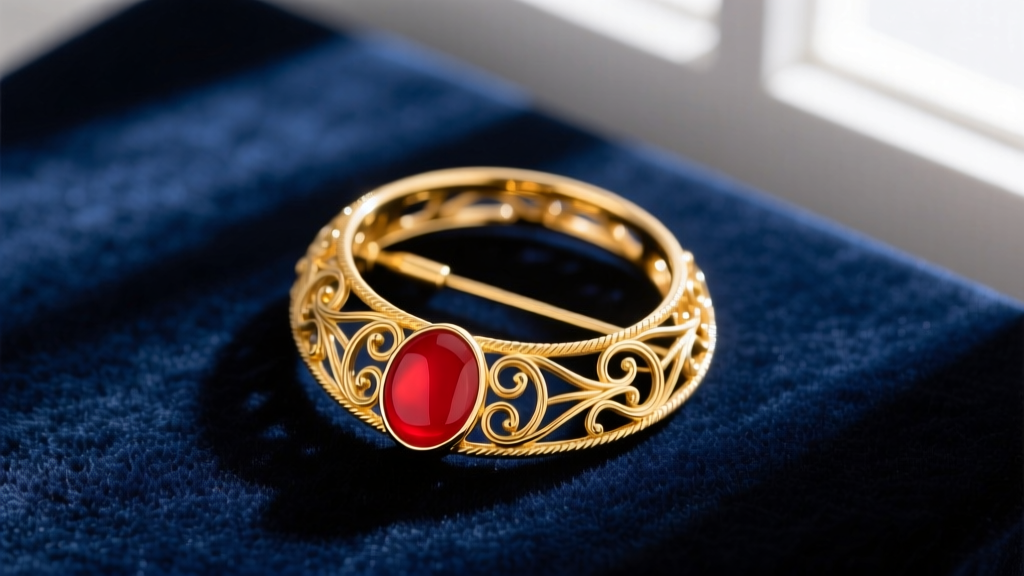
For those commissioning modern reproductions for daily wear, specific adjustments must be made to ancient designs. Original Celtic penannular brooches relied on a simple pin-and-ring tension mechanism that frequently failed, leading to lost garments and lost jewelry. A modern master jeweler will integrate a secondary security chain or a modern locking pin clutch while maintaining the visual authenticity of the La Tène aesthetic. Furthermore, while ancient smiths often left the interiors of torcs rough and unpolished to save time and material, a modern piece intended for skin contact must be meticulously polished and deburred to prevent micro-abrasions on the neck.
Finally, pay close attention to the gauge of the wire used in filigree work. Ancient Celtic wire was created by hammering strips of metal and pulling them through progressively smaller holes in iron or bronze draw-plates, resulting in wire that was often slightly uneven and rarely thinner than 0.4mm. If a reproduction features perfectly uniform 0.15mm machine-drawn wire, it immediately betrays its modern origins. True expertise in ancient Celtic jewelry lies not just in replicating the swirling, labyrinthine patterns of the La Tène style, but in honoring the physical limitations and brilliant workarounds of the Iron Age smiths who forged them.


