Beyond the Japanese Word for Jewelry: Troubleshooting Authenticity
Learn what the Japanese word for jewelry means and troubleshoot common authentication issues with Mokume Gane, Akoya pearls, and hallmarks.

The Linguistic Divide: Why Searching the 'Japanese Word for Jewelry' Fails
Many Western collectors and vintage buyers begin their sourcing journey on Japanese proxy sites or estate auctions by simply searching the japanese word for jewelry. However, this direct translation approach often leads to a minefield of misidentified goods, mass-produced fashion pieces, and outright counterfeits. The core issue lies in linguistic nuance. The modern loanword Juerii (ジュエリー) generally refers to Western-style, mass-market, or contemporary commercial jewelry. If you are hunting for authentic, artisan-crafted Japanese heritage pieces, using Juerii will bury you in synthetic resin and base-metal catalog items.
To troubleshoot your search queries and authenticate your finds, you must pivot to traditional terminology. Terms like Hōseki (宝石 - gemstones), Kōgei (工芸 - traditional crafts), or specific material names like Mokume Gane (木目金) and Shakudo (赤銅) will connect you with genuine artisan listings. As of 2026, the secondary market for Japanese heritage jewelry has surged, making it critical to look past the basic vocabulary and understand the metallurgical and gemological markers of authenticity.
Troubleshooting Mokume Gane: Laminated vs. Etched Fakes
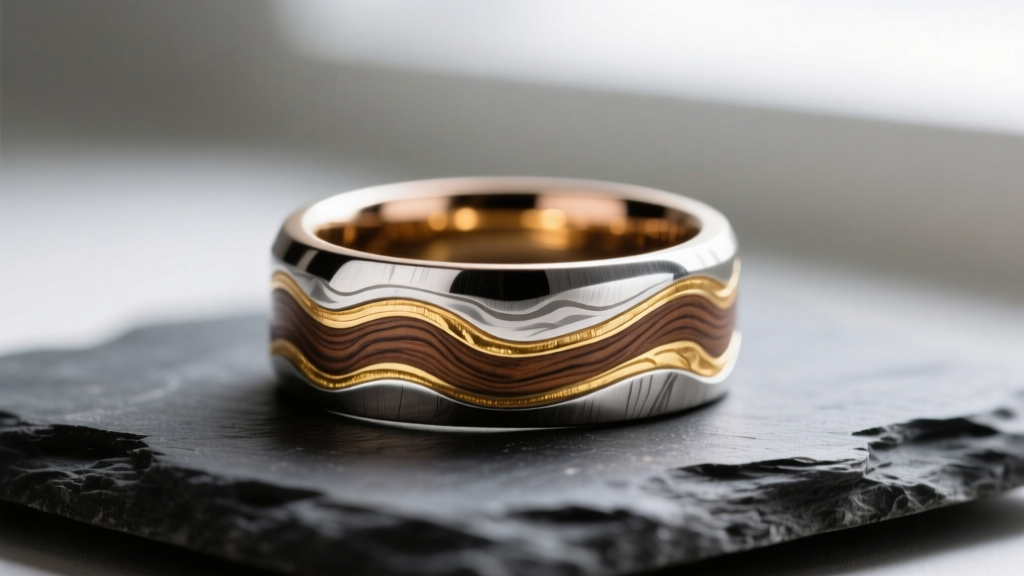
Mokume Gane, translating to 'wood grain metal,' is a legendary Japanese metalworking technique developed in the 17th century for sword fittings. Today, it is highly prized in fine jewelry. Unfortunately, the market is saturated with photo-etched and laser-engraved fakes designed to deceive buyers who only know the aesthetic but not the engineering.
The Metallurgical Reality of Authentic Pieces
True Mokume Gane is created by fusing alternating sheets of precious metals and traditional Japanese alloys under immense heat and pressure. The billet is then carved, forged, and rolled to reveal the internal layers. The two most critical traditional alloys you must know are:
- Shakudo: An alloy of 95% copper and 5% gold. When treated with a boiling rokusho solution (copper acetate and copper sulfate), it develops a rich, dark blue-black patina.
- Shibuichi: An alloy of 75% copper and 25% silver. It patinates to a beautiful, soft olive-grey or silver-grey hue.
According to The Metropolitan Museum of Art, the mastery of these specific copper-based alloys and their chemical patination is what defines historical Japanese metalwork. Fakes rarely use these alloys because copper-based metals oxidize quickly and require expert chemical handling.
The Troubleshooting Test
To verify a piece, examine the shank of a ring or the edge of a pendant under a 10x jeweler's loupe. Authentic Mokume Gane features a continuous, three-dimensional grain that wraps seamlessly around the edges and interior of the metal. If the 'woodgrain' pattern abruptly stops at the edges, or if the surface is perfectly flat with recessed, uniform lines, you are looking at a laser-etched or photo-etched fake. Furthermore, authentic pieces will show microscopic variations in layer thickness, whereas etched fakes exhibit mathematically uniform grooves.

Hallmark Headaches: Decoding Japanese Metal Stamps
Unlike the United Kingdom or France, Japan does not have a strict, government-mandated assay and hallmarking system for precious metals. This absence of standardized state hallmarks is a massive troubleshooting hurdle for international buyers who expect to see official purity stamps alongside maker's marks.
The Pt900 Phenomenon
One of the most reliable indicators of genuine Japanese fine jewelry is the prevalence of Pt900 (90% platinum, 10% palladium or ruthenium). While Western markets heavily favor Pt950, Japanese jewelers historically prefer Pt900 for intricate diamond and gemstone settings. The 10% alloy provides superior springiness and tensile strength for the ultra-delicate prong settings favored in Japanese design, preventing the prongs from bending and dropping stones—a common failure mode with softer Pt950.
| Stamp / Mark | Meaning | Troubleshooting Insight |
|---|---|---|
| Pt900 / PT900 | 90% Platinum | Highly indicative of authentic Japanese domestic market (JDM) jewelry. Verify with a specific gravity test if unsure. |
| SV925 | Sterling Silver | Common in both authentic and fake pieces. Look for accompanying maker's marks like 'GORO'S' or 'TADY & KING' to verify JDM origin. |
| K18 / 18K | 18 Karat Gold | Japanese stamping often puts the 'K' before the number. 'K18WG' denotes 18k White Gold. |
| No Stamp | Unverified Purity | Pre-1970s vintage Japanese pieces often lack stamps. Require XRF (X-ray fluorescence) testing before purchasing high-value estate lots. |
The Akoya Pearl Trap: Origin vs. Processing
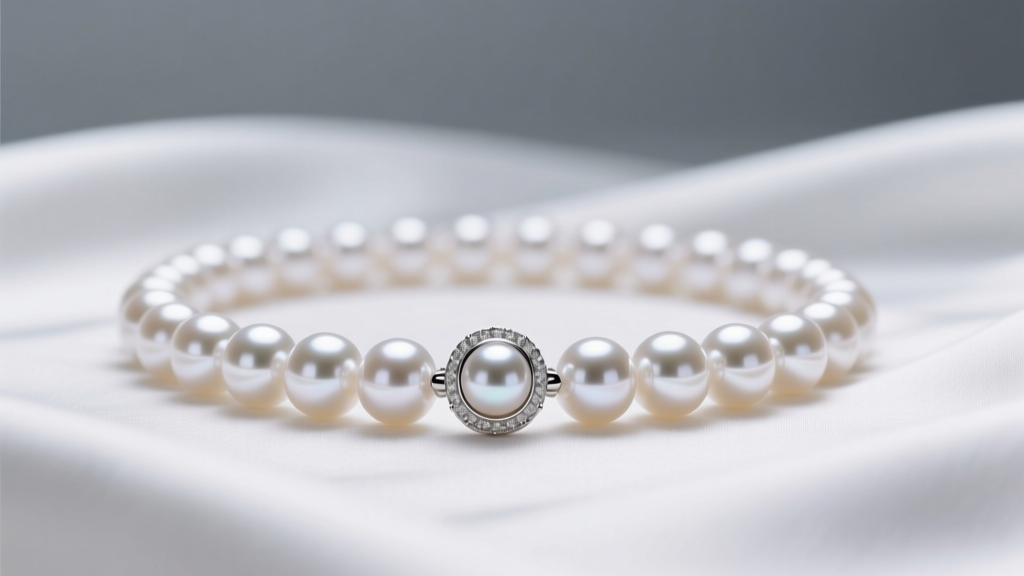
When buyers search for Japanese pearl jewelry, they are usually hunting for the legendary Akoya pearl. However, the modern pearl market is rife with geographical laundering. As noted by the Gemological Institute of America (GIA), a vast majority of 'Japanese' Akoya pearls are actually cultivated in China, harvested, and then shipped to Japan merely for sorting, bleaching, and stringing. This allows them to be legally exported with 'Made in Japan' certificates, despite not being genuinely Japanese-cultivated.
Troubleshooting Nacre and Luster
To ensure you are buying top-tier, authentically processed Japanese Akoya pearls, you must troubleshoot the grading and nacre thickness. The highest recognized grade is Hanadama (flower pearl). However, the term is unregulated in Western markets, meaning any seller can print 'Hanadama' on a cheap certificate.
The Fix: Only accept Hanadama pearls accompanied by a certificate from the Pearl Science Laboratory of Japan (PSL). The PSL strictly mandates that a pearl must have a nacre thickness of at least 0.4mm on each side of the bead nucleus to achieve this grade. If a seller cannot provide a PSL report, use a gemological endoscope or optical coherence tomography (OCT) scan to verify the nacre thickness yourself. Thin-nacre pearls (under 0.2mm) will peel and degrade within a few years of regular wear.
Troubleshooting Urushi Lacquerware (Maki-e) Jewelry
Another highly sought-after Japanese craft is Maki-e (sprinkled picture), where gold or silver powder is dusted onto wet Urushi (toxicodendron vernicifluum) tree sap. In the 2026 vintage market, polyurethane and epoxy resins are frequently passed off as authentic Urushi.
The Thermal Test: Authentic Urushi is incredibly heat-resistant and thermally insulative. If you touch a piece of real lacquerware to your cheek or lip, it will feel warm or neutral, almost like wood. Synthetic resins and epoxies will immediately feel cold to the touch, much like plastic or glass. Additionally, examine the gold dust under magnification; authentic Maki-e features irregular, hand-sprinkled metal flakes suspended at varying depths within the translucent lacquer layers, whereas fakes use uniform, machine-printed gold foil trapped under a single layer of clear epoxy.
Actionable Checklist for Verifying Japanese Estate Pieces
Before finalizing a purchase from a Japanese estate auction or vintage dealer, run the piece through this strict troubleshooting protocol:
- Verify the Terminology: Did the listing use specific craft terms (Kōgei, Maki-e, Mokume Gane) rather than just the generic japanese word for jewelry?
- Inspect the Prongs: If it is a gemstone ring, check for the Pt900 stamp and examine the delicate, springy tension of the prongs.
- Loupe the Grain: Ensure Mokume Gane patterns wrap continuously over the edges without laser-etching uniformity.
- Demand Lab Reports: For Akoya pearls, reject any 'Hanadama' claims that lack a PSL certificate verifying 0.4mm+ nacre.
- Check the Patina: For Shakudo or Shibuichi pieces, look for the deep, chemical oxidation that cannot be replicated by simple liver of sulfur treatments used on Western silver.
Conclusion
Translating the japanese word for jewelry is merely the first step in a complex authentication journey. By shifting your focus from basic vocabulary to the metallurgical realities of Shakudo, the structural advantages of Pt900, and the strict gemological standards of PSL-graded Akoya pearls, you can successfully navigate the secondary market. True appreciation of Japanese jewelry requires looking past the surface and understanding the centuries of chemical and structural engineering that define its heritage.


