How to Vet Indian Fashion Jewelry Online and Avoid Fakes
Learn how to troubleshoot common pitfalls when shopping for Indian fashion jewelry online. Spot fake Kundan, avoid toxic alloys, and ensure perfect fits.

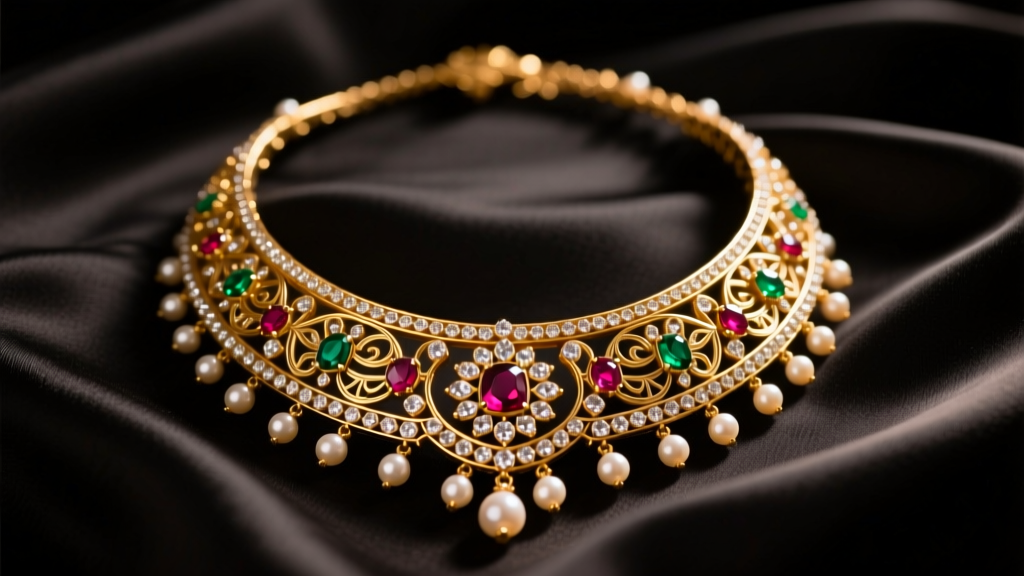
The Hidden Dangers of Cross-Border Jewelry E-Commerce
The global appetite for South Asian aesthetics has exploded, making it easier than ever to buy indian fashion jewelry online. However, as we navigate the e-commerce landscape in 2026, the proliferation of AI-generated listing photos and drop-shipped inventory has created a minefield for consumers. What is marketed as 'heritage craftsmanship' is frequently mass-cast pot metal, synthetic glue, and lead-laden brass.
Troubleshooting these purchases requires a shift from passive browsing to active material vetting. Whether you are shopping for a wedding lehenga set or everyday oxidized silver jhumkas, understanding the metallurgical and gemological realities of traditional Indian jewelry is the only way to protect your wallet and your skin.
Troubleshooting Material Misrepresentation: Kundan, Polki, and Meenakari
The most pervasive issue when buying ethnic jewelry on global marketplaces is the blatant misuse of heritage terminology. Sellers routinely slap legacy terms onto cheap synthetic alternatives.
The 'Kundan' and 'Polki' Illusion
According to the Gemological Institute of America (GIA), true Polki refers to uncut, unfaceted natural diamonds. Kundan, conversely, is not a stone at all; it is the highly refined 24k gold foil used to secure the stones into a lac (natural resin) base.
The Problem: 95% of 'Kundan' sets sold online for under $150 are actually glass or cubic zirconia (often termed 'American Diamond') set into brass using synthetic epoxy, then gold-plated.
The Fix: Before purchasing, demand a macro-video from the seller. True Kundan settings will show microscopic irregularities in the gold foil pressing. If the 'gold' around the stone looks like a perfectly uniform, shiny liquid metal, it is modern electroplating over synthetic glue. Furthermore, ask the seller directly: 'Is the base metal brass or gold, and is the adhesive lac or epoxy?' A reputable seller will provide transparent answers.
Meenakari: Enamel vs. Resin
Traditional Meenakari involves fusing colored glass powder to metal at high temperatures. Online 'fashion' Meenakari is almost exclusively cold enamel (a tinted epoxy resin). Cold enamel chips easily and degrades under UV light. To troubleshoot this, check the item weight. True glass-enamel on a silver base is noticeably heavier and feels cold to the touch, whereas resin on brass feels lightweight and warms quickly.
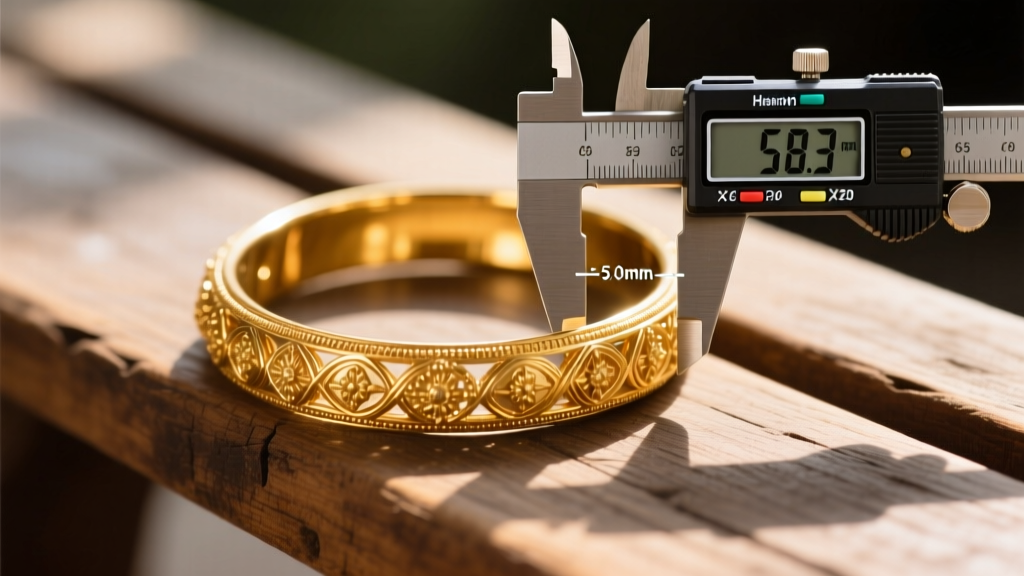
Sizing Nightmares: The Bangle and Nath Metric Divide
Nothing results in more returns and frustration than sizing errors. Indian jewelry utilizes entirely different measurement systems than Western standards, particularly for rigid bangles and nose rings (naths).
Decoding the Indian Bangle Fraction System
In the US and EU, bangles are often measured by inner circumference in millimeters. In India, bangles are sized by their inner diameter in inches and fractions. A 'Size 2-8' does not mean 28mm; it means 2 and 8/16 inches (2.5 inches). Buying the wrong size means the bangle either won't pass over your knuckles or will slide off dangerously.
| Indian Size (Inches/Fractions) | Inner Diameter (mm) | US/EU Approx. Circumference (mm) | Fit Profile |
|---|---|---|---|
| 2-4 (2.25') | 57.1 mm | 179 mm | Extra Small / Petite |
| 2-8 (2.50') | 63.5 mm | 199 mm | Small / Standard |
| 2-10 (2.625') | 66.6 mm | 209 mm | Medium |
| 2-12 (2.75') | 69.8 mm | 219 mm | Large |
| 2-14 (2.875') | 73.0 mm | 229 mm | Extra Large |
Pro-Tip: Always measure your hand's widest knuckle spread with a flexible tailor's tape, not just your wrist, to ensure the rigid bangle can actually slide on.
Nose Ring (Nath) Gauge Confusion
Traditional Indian naths are often heavier and thicker than Western nostril studs. While a standard Western nostril piercing is usually 20G (0.8mm) or 18G (1.0mm), traditional screw-style Indian naths are frequently crafted in 16G (1.2mm) or even 14G (1.6mm) to support the weight of the dangling chains. Always verify the exact millimeter gauge with the seller before ordering, or you risk tearing your piercing.
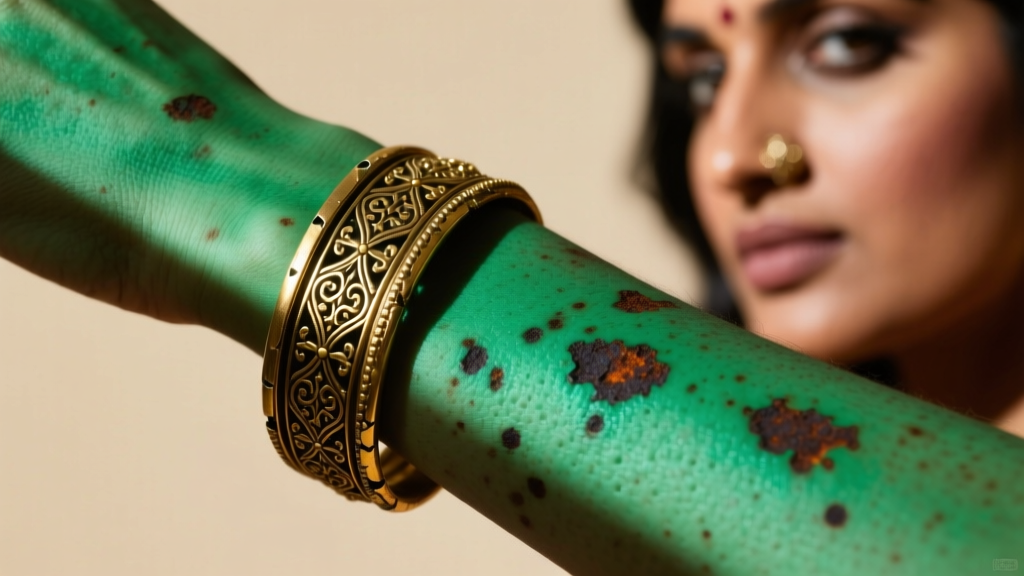
Allergic Reactions and the Toxic Alloy Threat
The base metal is where cheap online jewelry poses actual health risks. To keep costs low, unverified manufacturers use 'white metal' or 'pot metal' alloys that contain dangerous levels of lead, cadmium, and nickel.
The Cadmium and Lead Problem
Under regulations like California's Proposition 65, jewelry must contain less than 300 parts per million (ppm) of cadmium and strict limits on lead. Independent lab tests frequently reveal that unbranded, ultra-cheap ethnic fashion jewelry imported without proper customs vetting can contain upwards of 10,000 ppm of these toxic heavy metals. When the gold plating wears off and the metal mixes with sweat, these toxins absorb directly into the skin.
How to Vet the Base Metal
When browsing for indian fashion jewelry online, filter out listings that use vague terms like 'metal alloy' or 'white metal'. Instead, look for explicit material guarantees:
- Lead-Free Brass: The industry standard for high-quality fashion pieces. It takes gold plating well and is generally hypoallergenic.
- 92.5 Sterling Silver (Vermeil): The safest bet for sensitive skin. Ensure the listing specifies 'silver base' and not 'silver-toned'.
- Surgical Steel Base: Increasingly common in 2026 for oxidized 'German Silver' or 'Tribal' styles, offering excellent durability and hypoallergenic properties.
For deeper insights into hallmarking and metal purity standards, refer to the guidelines established by the Bureau of Indian Standards (BIS), which governs precious metal assays.
Tarnish, Stone-Fall, and Shipping Trauma
A major troubleshooting headache is receiving a piece with missing stones or severe tarnish right out of the box. This is usually a result of shipping conditions, not just poor manufacturing.
The Heat Vulnerability of Lac
If you buy authentic or semi-authentic Kundan, the stones are held in place by natural lac (tree resin). Lac has a relatively low melting point. If your package sits in a hot delivery truck or on a sun-baked porch during summer transit, the lac softens, and the stones shift or fall out entirely.
The Fix: If ordering during warm months, request that the seller use insulated packaging or ship via expedited, climate-controlled courier. Upon arrival, immediately inspect the settings. If stones are loose, do not use superglue (which will cloud the glass and ruin the foil). Take it to a local jeweler who specializes in resin or traditional setting repairs.
Oxidized Silver Tarnish
'Oxidized silver' is a staple of Indian boho-chic fashion. However, the black patina is a surface treatment (usually silver sulfide). When shipped in non-sealed polybags across humid ocean freight routes, the underlying brass can corrode, causing the black finish to flake off in ugly green patches. Always ask sellers if their oxidized pieces are sealed with a clear anti-tarnish lacquer coating.
Your Pre-Purchase Vetting Checklist
Before clicking 'Checkout' on any marketplace, run the listing through this troubleshooting matrix:
The Green Light Checklist:
1. Base metal is explicitly listed as Lead-Free Brass, Copper, or 925 Silver.
2. Bangle sizes are provided in both Indian fractions and exact inner millimeters.
3. The seller provides unedited, non-AI-generated macro photos of the stone settings and clasp.
4. The listing specifies 'cold enamel' if the price is under $100, showing honest marketing.
5. Reviews contain user-uploaded photos showing the jewelry after 3+ months of wear.
By applying these rigorous troubleshooting standards, you can safely navigate the vast digital bazaars, ensuring that the beautiful cultural pieces you bring into your collection are safe, accurately represented, and built to last.


