Sourcing Authentic Indian Jewelry in DC: An Expert Technical Guide
Discover where to source authentic Indian jewelry in DC. Our expert guide covers 22k gold hallmarking, Polki authentication, and top regional jewelers.

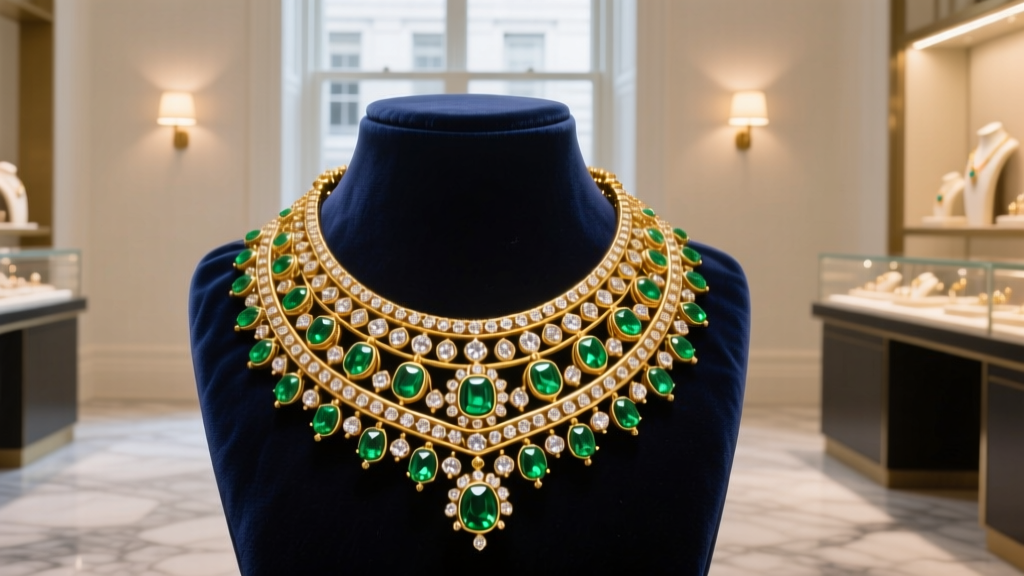
The Metallurgy of Heritage: 22k vs. 18k Gold Alloys
When evaluating traditional Indian jewelry in DC, the first technical hurdle for collectors and buyers is understanding gold purity and alloy metallurgy. Authentic heritage pieces, particularly those originating from Rajasthan or Gujarat, are predominantly crafted in 22-karat gold. According to the World Gold Council, 22k gold consists of 91.67% pure gold and 8.33% alloy metals (typically silver, copper, and zinc). This specific alloy ratio yields a Vickers hardness (HV) of approximately 90-110, providing the malleability required for intricate Jadau settings while maintaining enough structural integrity to hold heavy gemstone clusters.
However, if you are sourcing contemporary Indian-inspired diamond jewelry from boutiques in downtown Washington D.C. or Bethesda, you will frequently encounter 18-karat gold (75% purity). 18k gold possesses a higher Vickers hardness (120-150 HV), making it technically superior for securing modern brilliant-cut diamonds via prong or pavé settings. A knowledgeable jeweler will always advise against setting high-tension modern diamond cuts in 22k gold due to the risk of prong deformation and stone loss over time.
Authentication Frameworks: Decoding BIS Hallmarks
The proliferation of imported heritage jewelry in the D.C. metro area necessitates strict authentication protocols. The gold standard for verifying Indian gold is the Bureau of Indian Standards (BIS) hallmark. When examining a piece at a Fairfax or Merrifield corridor jeweler, you must look for the laser-engraved or stamped BIS mark, which guarantees the precious metal's purity.
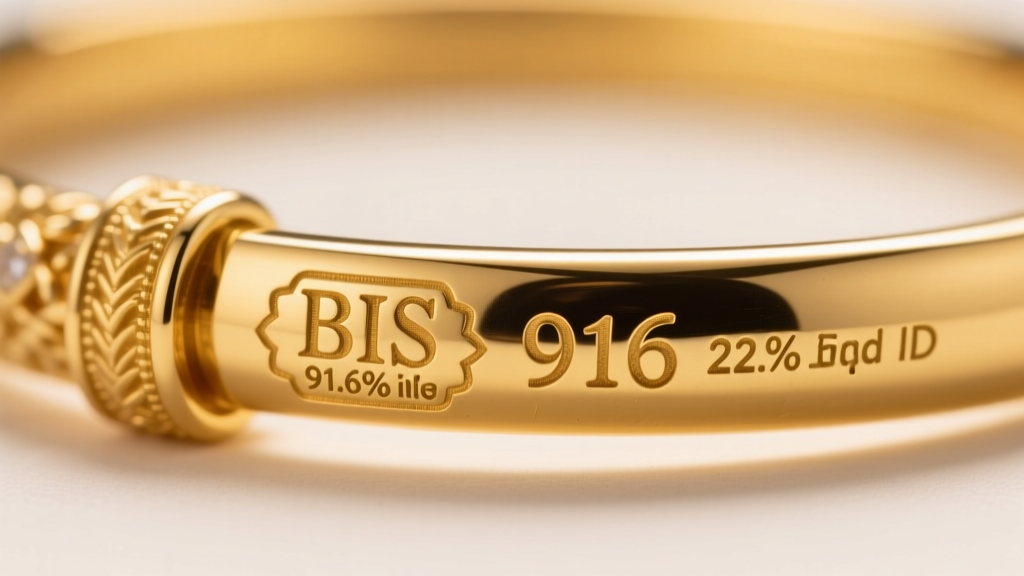
As detailed by the Bureau of Indian Standards, a complete hallmark comprises specific technical identifiers. Use a 10x triplet loupe to verify these components on the clasp or inner shank of the piece:
| Component | Technical Description | Example for 22k Gold |
|---|---|---|
| BIS Logo | Official triangular standard mark | Triangle with dot |
| Purity Grade | Fineness in parts per thousand | 916 (for 22k) or 750 (for 18k) |
| Assaying Centre | Unique ID of the testing laboratory | Alphanumeric code |
| Jeweler ID | Unique identification of the manufacturer | Logo or alphanumeric code |
If a local D.C. retailer cannot produce a BIS certificate or the physical hallmark is missing on imported vintage pieces, demand an independent X-ray fluorescence (XRF) spectrometer test to verify the 91.6% gold content before completing a high-value transaction.
Polki and Kundan: Optical Physics and Foil Backing
Uncut diamond (Polki) and glass/stone (Kundan) settings represent the zenith of Indian ceremonial jewelry. Differentiating natural Polki from synthetic alternatives requires an understanding of optical physics and traditional setting techniques. Natural Polki diamonds have a lower refractive index (RI of 2.41) compared to modern brilliant cuts because they lack precision faceting. To compensate, master artisans use a technique called 'varak', placing a highly reflective silver or gold foil backing behind the uncut stone to bounce light back through the table.
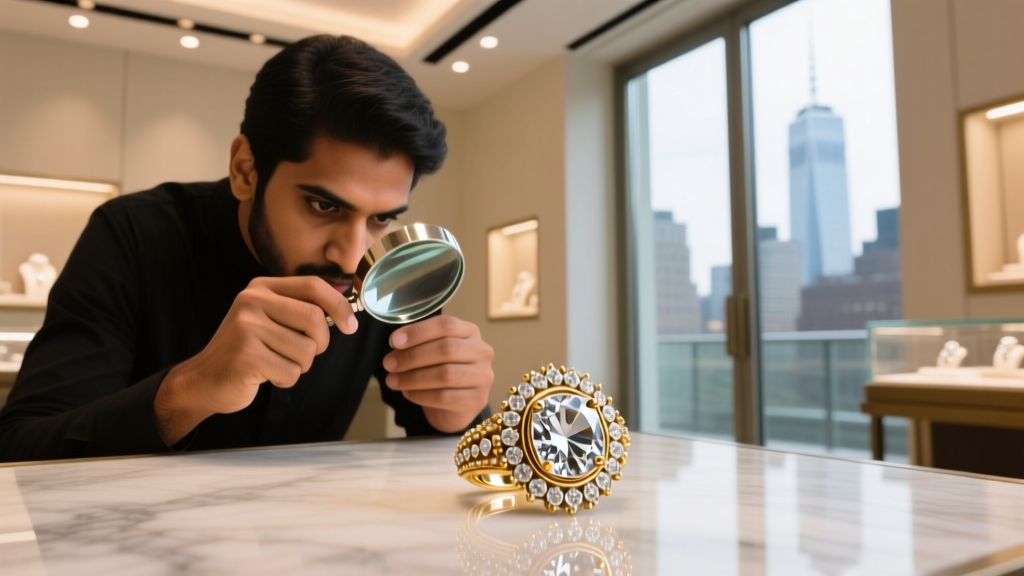
According to gemological guidelines from the Gemological Institute of America (GIA), synthetic Polki is often made from high-lead glass or quartz, which lacks the natural inclusions and growth lines visible under 20x magnification. When sourcing Polki necklaces in the D.C. area, inspect the edges of the stones. Natural Polki will show slight asymmetry and natural cleavage planes, whereas glass imitations will exhibit conchoidal fracturing or mold marks. Furthermore, ensure the foil backing is sealed with natural lac (lacquer); modern epoxy seals can trap moisture, leading to foil oxidation and a cloudy appearance within 12 to 18 months.
Sourcing in the D.C. Metro: Regional Hubs & Specializations
The Washington D.C. metropolitan area offers distinct geographic hubs for sourcing regional Indian jewelry, each with specific technical specializations:
- The Fairfax & Merrifield Corridor (Route 50): This is the primary hub for heavy, traditional 22k bridal sets and temple jewelry. Jewelers here maintain direct supply chains with manufacturing hubs in Chennai and Hyderabad. Expect high inventory volumes of South Indian Vaddanam (waist belts) and Manga Malai necklaces, characterized by high-relief repoussé work.
- Bethesda & Potomac: Boutiques in this corridor specialize in contemporary fusion pieces, often blending 18k gold with uncut diamonds and rose-cut sapphires. The technical focus here is on ergonomic lightweight Jadau designs suited for daily wear, utilizing advanced CAD/CAM wax modeling before hand-finishing.
- Downtown D.C. (Dupont Circle & Georgetown): Here you will find high-end bespoke ateliers focusing on museum-quality antique reproductions. These jewelers specialize in Meenakari (enameling) and Jaali (filigree) work, often sourcing vintage components from estate sales to integrate into new structural frameworks.
Pricing Metrics: Deconstructing the Making Charge
Unlike Western fine jewelry, which is often priced as a flat retail markup, authentic Indian jewelry in DC is priced using a transparent, component-based formula. Understanding this formula is critical for negotiation and appraisal. The standard pricing equation is:
Total Price = (Gold Weight × Daily Market Rate) + (Gemstone Weight/Carat Cost) + Making Charges + Hallmarking/Certification Fees
The 'Making Charge' (labor cost) is where technical complexity dictates value. For simple casted bangles, making charges range from 8% to 12% of the gold value. However, for handcrafted Jadau or intricate Meenakari pieces requiring hundreds of hours of artisan labor, making charges can legally and ethically range from 25% to 45%. Always request an itemized invoice that separates the raw gold weight from the gemstone weight, as unscrupulous sellers may weigh the piece with stones included and charge the gold rate for the gemstone weight.
Ultrasonic Cleaning Warnings for Meenakari Enamel
A critical failure mode for Indian jewelry owners in the D.C. area is the improper use of ultrasonic cleaners. Many local commercial cleaners default to ultrasonic baths for diamond and gold jewelry. However, if your piece features Meenakari (traditional vitreous enamel) on the reverse or hidden galleries, ultrasonic frequencies (typically 35-45 kHz) will cause micro-fractures in the enamel glass. The cavitation bubbles generated in the bath will physically chip the enamel away from the gold substrate, resulting in irreversible damage. Always instruct your jeweler to use only mild, non-ionic surfactants and soft-bristle brushes for any Indian heritage piece featuring enamel, lac, or foil-backed Polki settings.


