Mastering Men's Jewelry Style: A Step-By-Step Capsule Guide
Learn how to elevate your men's jewelry style with our step-by-step guide to building a versatile, high-quality capsule collection for any outfit.

The Philosophy of the Men's Jewelry Capsule
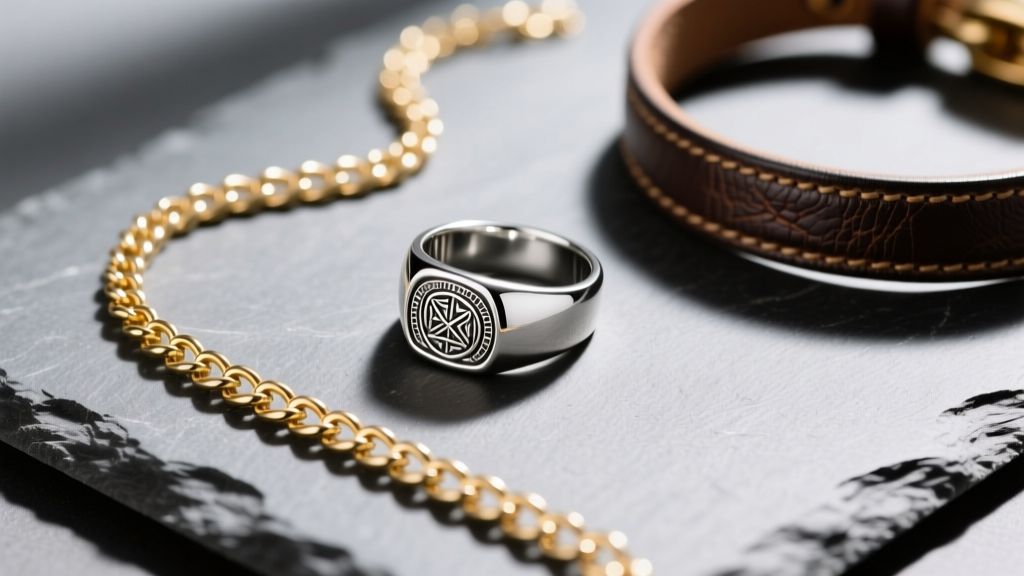
Developing a refined men's jewelry style is rarely about accumulating as many pieces as possible; it is about intentional curation. The most stylish men treat their accessories like a capsule wardrobe. A capsule collection relies on a core foundation of versatile, high-quality pieces that can be mixed, matched, and layered regardless of the season or occasion. By focusing on material integrity, precise proportions, and cohesive metal tones, you eliminate the guesswork from your daily routine.
Building this foundation requires moving away from fast-fashion alloys and trend-chasing novelties. Instead, we must look at exact gauge sizes, metal hardness scales, and anatomical proportions. This step-by-step guide will walk you through engineering a permanent jewelry rotation that elevates your personal aesthetic without overwhelming your outfit.
Step 1: Selecting Your Core Metals and Skin Tone Match
The first rule of a cohesive men's jewelry style is establishing a dominant metal tone. While mixing metals has become more acceptable in contemporary styling, a foundational capsule should lean heavily into one primary color family to ensure every piece works together seamlessly.
| Metal Type | Skin Tone Match | Durability (Mohs) | Avg. Price Range |
|---|---|---|---|
| 925 Sterling Silver | Cool / Olive | 2.5 - 3.0 | $40 - $150 per piece |
| 14k Yellow Gold | Warm / Deep | 3.5 - 4.0 | $250 - $800+ per piece |
| Grade 23 Titanium | Neutral / All | 6.0 | $60 - $200 per piece |
| Tungsten Carbide | Neutral / All | 8.5 - 9.0 | $30 - $120 per piece |
According to the Gemological Institute of America (GIA), understanding the alloy composition of your metals is critical for longevity. For example, 14k gold contains 58.3% pure gold, making it significantly more resistant to daily wear and scratching than 18k or 24k gold. For rings that endure high impact, Grade 23 Titanium (Ti 6Al-4V ELI) offers aerospace-level strength at a fraction of the weight of steel, while Tungsten Carbide provides ultimate scratch resistance, though it can shatter under extreme blunt force.
Step 2: The Essential Rings (Sizing and Profiles)
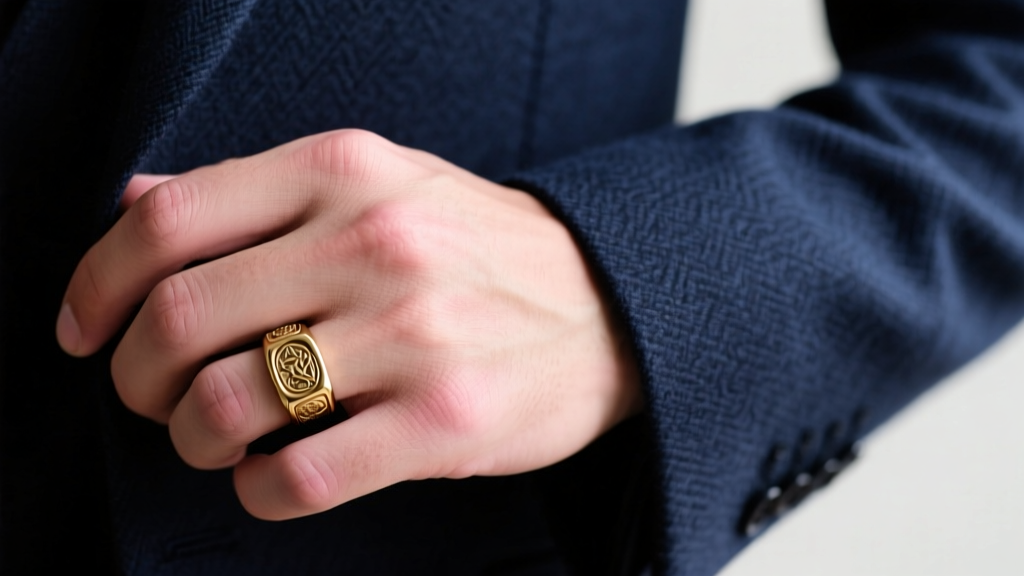
Rings are the most visible anchors in a men's jewelry style rotation. A proper capsule requires two distinct ring archetypes: the minimalist band and the statement signet.
Proportions and Widths
The width of your ring must correspond to the size of your hand and fingers. A common mistake is wearing overly thick bands on slender fingers, which creates a top-heavy, unbalanced look.
- Slender Fingers (Sizes 6-8): Opt for band widths between 4mm and 5mm. This maintains elegance and prevents the knuckle from being engulfed.
- Average Fingers (Sizes 9-10): A 6mm band provides a masculine presence without looking like a novelty prop.
- Larger Fingers (Sizes 11+): 7mm to 8mm widths offer the necessary visual weight to balance the hand's proportions.
The Comfort Fit Imperative
Always purchase rings with a "comfort fit" interior. Unlike standard fit rings that have a flat inner surface, comfort fit bands feature a slightly domed interior, reducing the surface area in contact with the skin. This allows for better air circulation and prevents the ring from catching on the knuckle during temperature-induced swelling.
Step 3: Chain Layering and Length Proportions
Necklaces offer the most real estate for self-expression, but they are also where most men fail. The secret to mastering chain layering lies in the "Two-Inch Rule" and understanding clasp mechanics.

The Two-Inch Rule
Never layer chains of the same length. Tangling is inevitable, and the visual effect is muddy. To create a cascading effect that draws the eye downward, maintain a minimum two-inch gap between each chain.
- The Anchor (18 inches): Sits at the collarbone. Best reserved for a lightweight 2mm rope or box chain, perhaps holding a small, subtle pendant (under 15mm).
- The Core (20-22 inches): Rests mid-chest. This is the workhorse of your men's jewelry style. A 3mm to 5mm Cuban link or Figaro chain shines here, worn standalone or over a crewneck sweater.
- The Statement (24+ inches): Hits the sternum. Reserved for heavy, standalone pieces (6mm+ width) worn over streetwear or open-collar shirts.
Clasp Mechanics
The clasp is the weakest point of any chain. Avoid spring-ring clasps on anything wider than 2mm; their internal springs fail easily. Upgrade to lobster clasps for chains up to 5mm, and demand box clasps with double safety latches for heavy Cuban links. According to jewelry manufacturing standards documented by the GIA's precious metals education, a secure clasp mechanism is just as vital as the metal purity itself in preventing catastrophic loss.
Step 4: Wristwear Mechanics (Bracelets and Watches)
Your wrist is a high-traffic zone. When integrating bracelets into your men's jewelry style, your watch must act as the anchor. The golden rule of wrist stacking is material contrast and hardness management.
The Mohs Hardness Stack
If you wear a stainless steel watch (Mohs hardness of roughly 4.0 to 4.5), stacking it directly against a Tungsten Carbide bracelet (Mohs 8.5) will result in the bracelet acting like sandpaper, permanently scuffing your watch case. Instead, use buffer materials:
- Watch: Stainless Steel Diver.
- Buffer: A woven leather wrap or vulcanized rubber bead bracelet.
- Accent: A 925 Sterling Silver or 14k Gold cuff (worn slightly looser to sit below the leather buffer).
This layered approach introduces texture (leather/rubber) while protecting your horological investment from metal-on-metal friction.
Step 5: Earring and Piercing Fundamentals
For men exploring earrings, subtlety and precise gauge sizing are paramount. The standard men's lobe piercing is typically done at 20 gauge (0.81mm) or 18 gauge (1.02mm). If you are looking at cartilage piercings (like the helix or tragus), the standard is 16 gauge (1.29mm).
When selecting studs, keep the diameter between 3mm and 5mm. A 4mm black onyx or diamond stud in a bezel setting offers a sharp, masculine edge without catching on clothing or headphones. Avoid long, dangling earrings or oversized hoops for a foundational capsule; stick to geometric studs or small, thick-gauge huggie hoops (10mm-12mm diameter) that hug the earlobe tightly.
Maintenance and Patina Management
A capsule collection requires maintenance to retain its intentionality. Sterling silver will naturally oxidize and develop a patina when exposed to sulfur in the air and skin acidity. While some appreciate this vintage look, a polished capsule requires a monthly routine.
- Ultrasonic Cleaning: Use an ultrasonic cleaner with a mild solution of warm water and dish soap for chains and rings without porous gemstones (like turquoise or opals). The high-frequency waves dislodge sebum and dead skin trapped in chain links.
- Polishing Cloths: Invest in treated jeweler's cloths (impregnated with micro-abrasives) to restore the high-polish finish to silver and gold bands. Never use paper towels, as their wood-pulp fibers will introduce micro-scratches to high-karat gold.
Conclusion
Mastering your men's jewelry style is an exercise in restraint and material science. By building a capsule collection grounded in correct proportions, skin-tone-appropriate metals, and an understanding of physical durability, you transform accessories from mere decorations into integral components of your personal uniform. Start with the core—a perfectly sized band, a mid-weight chain, and a textural bracelet—and let your collection evolve organically from a place of quality, not quantity.


