The Ultimate Mens Hand Jewelry Buying Guide (2026)
Discover what to look for in mens hand jewelry. Our 2026 buying guide covers metal grades, ring fits, bracelet clasps, and styling rules.

The Evolution of Mens Hand Jewelry in 2026
The landscape of mens hand jewelry has shifted dramatically over the last decade. What was once restricted to the symbolic confines of wedding bands, class rings, and luxury watches has evolved into a robust category of daily self-expression. In 2026, the modern man is no longer just wearing jewelry for milestones; he is curating a daily uniform that balances heritage craftsmanship with contemporary minimalism. Whether you are exploring signet rings, stacking bands, or heavy chain bracelets, understanding the structural and material nuances of these pieces is critical. This buying guide strips away the marketing fluff and focuses on the metallurgical facts, ergonomic fits, and proportional rules you need to make informed purchases.
Decoding Metal Grades: What Actually Lasts?
When investing in mens hand jewelry, the metal grade dictates not only the price but the piece's longevity, scratch resistance, and maintenance requirements. According to the Gemological Institute of America (GIA), pure 24k gold is far too soft for daily wear, which is why it is alloyed with metals like copper, zinc, and silver to increase durability.
For rings and bracelets meant for everyday use, 14k gold (58.5% pure gold) remains the gold standard in 2026. It offers an optimal balance of rich color and structural integrity. While 18k gold (75% pure) provides a deeper, more saturated yellow hue, it is significantly more prone to scratching and deformation—a crucial factor if you work with your hands or lift weights regularly.
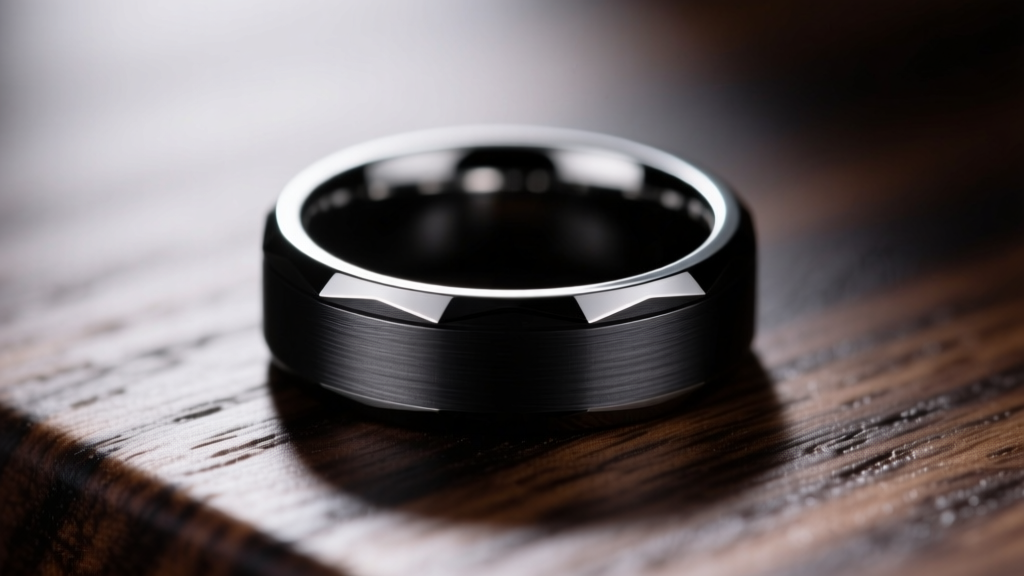
Alternative metals have also dominated the market. Tungsten carbide boasts a Mohs hardness of 8.5 to 9, making it virtually scratch-proof. However, its extreme brittleness means it can shatter under blunt force impact and cannot be resized or cut off in a medical emergency. Aerospace-grade titanium (Ti-6Al-4V), on the other hand, offers an incredible strength-to-weight ratio and is entirely hypoallergenic, making it ideal for men with sensitive skin or metal allergies.
| Metal Type | Mohs Hardness | Pros | Cons | Avg. Price Range |
|---|---|---|---|---|
| 14k Yellow Gold | 3.5 - 4.0 | Classic hue, resizable, holds value | Scratches over time, requires polishing | $400 - $1,200+ |
| Platinum (950) | 4.0 - 4.5 | Hypoallergenic, develops a patina, extremely durable | Heavy, expensive, shows scuffs easily | $800 - $2,500+ |
| Tungsten Carbide | 8.5 - 9.0 | Scratch-proof, retains polish permanently, affordable | Cannot be resized, shatters under impact | $150 - $400 |
| Titanium (Grade 5) | 6.0 | Lightweight, hypoallergenic, highly corrosion-resistant | Difficult to resize, limited traditional finishes | $200 - $600 |
Rings: Sizing, Profiles, and Stone Settings
The architecture of a ring is just as important as its exterior design. The interior profile dictates how the ring feels during prolonged wear. The two primary profiles are standard fit and comfort fit (often called court fit). Standard fit rings have a flat interior, which can trap moisture and feel restrictive. Comfort fit rings feature a domed interior that allows air circulation and slides over the knuckle with less friction. As noted by jewelry educators at Blue Nile, comfort fit is highly recommended for men with larger knuckles, though it typically requires ordering a half-size down compared to a standard fit band.
Signet Rings vs. Minimalist Bands
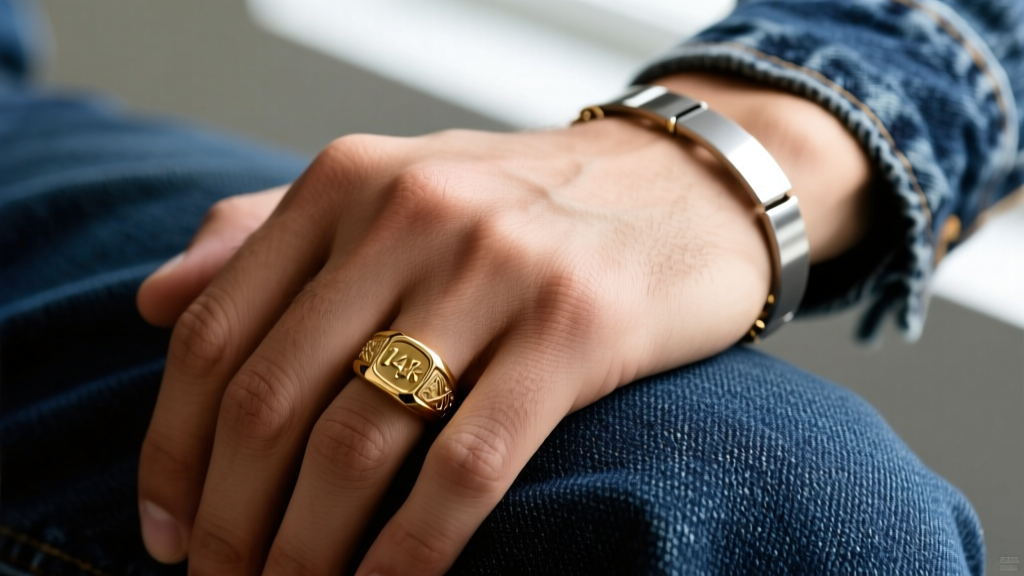
Signet rings have experienced a massive resurgence, transitioning from aristocratic seal-bearers to modern style anchors. When buying a signet ring, pay close attention to the face thickness. A face thinner than 2mm will feel flimsy and is prone to bending, while a face between 3mm and 5mm provides a satisfying, premium weight. If your signet features a gemstone like onyx, lapis lazuli, or black spinel, always opt for a bezel setting rather than prongs. Prong settings elevate the stone, making it highly susceptible to chipping against door frames and steering wheels.
Minimalist bands, ranging from 2mm to 4mm in width, are the cornerstone of the modern stacking trend. When stacking, mix textures rather than just piling on identical polished bands. Combine a hammered finish band with a high-polish signet to create visual depth without looking overly ostentatious.
Bracelets and Cuffs: Clasps and Gauge Thickness
Bracelets introduce movement and kinetic energy to mens hand jewelry, but they are also the most prone to mechanical failure due to the stress placed on their clasps. The gauge (thickness) of a chain bracelet dictates its formality and durability. For a subtle, everyday piece that slips easily under a dress shirt cuff, a 4mm to 5mm chain is ideal. For a statement piece meant to be worn over a t-shirt or casual button-down, an 8mm to 10mm gauge provides the necessary visual weight.
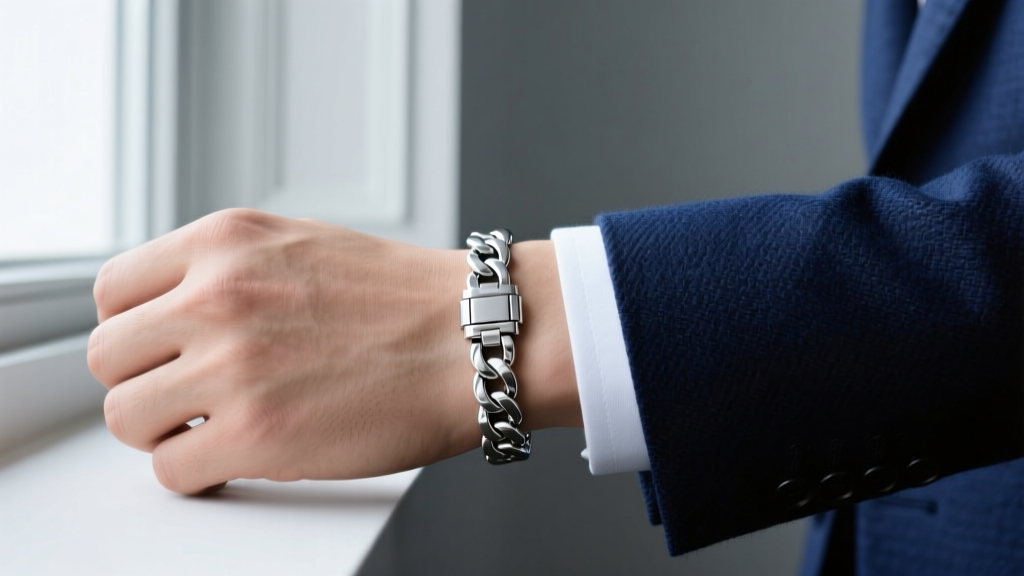
The clasp is the weakest link in any bracelet. Lobster clasps are secure but can be frustrating to operate with one hand. Toggle clasps offer a rugged, masculine aesthetic and are easy to fasten, but they require precise sizing; if the chain is too loose, the toggle bar can slip through the ring and result in a lost piece. For heavy chains (over 50 grams), the only acceptable clasp is a box clasp equipped with a figure-eight safety catch. This mechanism locks the tongue into a grooved box and features a secondary wire catch that prevents the bracelet from falling off if the primary lever is accidentally depressed.
Proportions and Styling: The Rule of Balance
The most common mistake men make when buying hand jewelry is ignoring their own physical proportions. Jewelry should complement your frame, not overwhelm it.
- Hand and Finger Size: Men with thick, broad fingers should avoid bands under 4mm, as they will look disproportionately small and delicate. Opt for 6mm to 8mm widths. Conversely, men with slender fingers should stick to 3mm to 5mm bands to avoid the appearance of wearing oversized, clunky hardware.
- Wrist Circumference: A bracelet should ideally measure 0.5 to 1 inch larger than your actual wrist circumference. This allows for natural drape and movement. A bracelet that sits flush against the skin looks restrictive and uncomfortable.
- Metal Mixing: The outdated rule of matching all your metals is dead. In 2026, mixing a yellow gold signet ring with a silver or steel chain bracelet creates a layered, curated look. The key to successful mixing is balancing the visual weight—if you wear a heavy gold ring, anchor it with a slightly thicker steel bracelet on the opposite wrist.
According to master jewelers and bespoke stylists, the biggest mistake men make is prioritizing high-karat gold or intricate micro-pave settings for daily-wear rings, leading to premature deformation and lost stones. True luxury in mens jewelry lies in robust, unpretentious construction.
Final Verdict: Building a Core Collection
Building a versatile collection of mens hand jewelry requires a strategic approach. Do not buy ten mediocre pieces; invest in three exceptional ones. Start with a well-proportioned 14k gold or platinum signet ring that features a subtle, personalized engraving on the interior or a matte-textured face. Follow this with a 5mm to 6mm sterling silver or white gold chain bracelet featuring a secure box clasp. Finally, secure a durable, comfort-fit band in an alternative metal like forged titanium or brushed tungsten for active days. By prioritizing material integrity, ergonomic profiles, and proportional harmony, your jewelry will not only survive daily wear but develop a rich, personal patina that tells your story over time.


