Art Deco Jewelry Identification and Value: A Material Guide
Master Art Deco jewelry identification and value by analyzing era-specific materials like platinum, Bakelite, and calibré-cut gems in our expert guide.

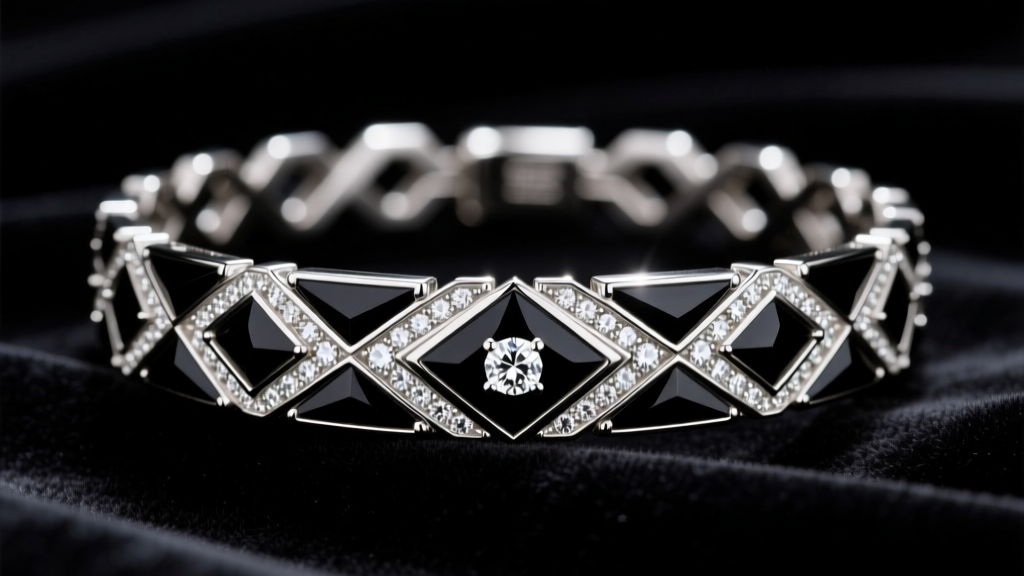
The roaring twenties and the streamline thirties birthed an era of design that remains the pinnacle of collectible vintage adornment. However, as the market matures, mastering art deco jewelry identification and value requires moving beyond superficial geometric patterns and filigree motifs. True authentication and precise valuation hinge on a microscopic understanding of the materials used between 1920 and 1939. In today's sophisticated vintage market, distinguishing between period-correct platinum and later white gold, or identifying early phenolic resins versus modern reproductions, is the dividing line between a $500 costume piece and a $50,000 haute joaillerie investment.
This comprehensive material guide dissects the metallurgical, gemological, and synthetic properties that define authentic Art Deco jewelry, providing collectors and appraisers with a scientific framework for evaluation.
The Precious Metals: Platinum vs. White Gold
The quintessential Art Deco metal is platinum. Its unparalleled strength allowed jewelers to create the impossibly delicate, lace-like filigree and secure the era's prominent calibré-cut gemstones without bulky prongs. However, the high cost of platinum during the Great Depression forced a shift toward white gold, creating a critical divergence in identification and value.
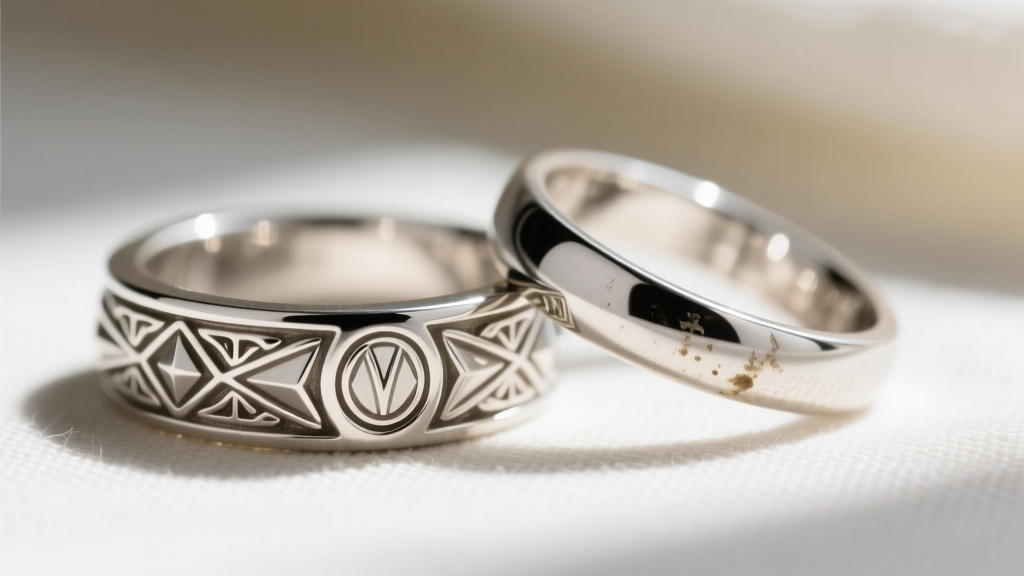
Metallurgical Properties and Hallmarks
Authentic 1920s platinum was typically alloyed with 10% iridium or ruthenium to increase workability while maintaining a natural, cool white luster. When examining a piece, look for specific hallmarks:
- American Marks: "PLAT", "PT", or "900" (indicating 900 parts per thousand platinum).
- French Marks: The tête de chien (dog's head) punch, mandatory for 950 platinum post-1902, often found on the exterior of the shank or bail.
- British Marks: The orb and cross, accompanied by "950".
Conversely, 18k white gold (an alloy of yellow gold mixed with nickel, palladium, or silver) was patented in 1912 but saw mass adoption in the late 1920s and 1930s. Because white gold naturally possesses a faint yellowish-gray tint, it was heavily rhodium-plated. Over decades, rhodium wears away, revealing the warm undertone—a dead giveaway that separates it from the naturally white, non-tarnishing patina of aged platinum. According to the experts at Lang Antique Jewelry University, a piece constructed entirely of platinum will command a 30% to 50% premium over an identical design cast in white gold, simply due to the rarity of the metal and the superior, labor-intensive craftsmanship it necessitated.
The Specific Gravity Test
For unmounted or loosely mounted pieces, specific gravity (SG) testing is non-destructive and definitive. Platinum has an SG of approximately 21.45, making it remarkably heavy for its size. 18k white gold sits around 15.5. If a bulky, solid Art Deco cocktail ring feels surprisingly light in the hand, it is highly likely to be a mid-century or modern white gold reproduction rather than a 1920s platinum original.
Synthetic and Carved Stones: The Bakelite & Celluloid Divide
Art Deco was not exclusively about precious gems; it was an era that embraced the machine age and industrial materials. The vibrant, carved plastics used in costume jewelry are highly collectible today, but accurate identification is fraught with pitfalls due to modern resin fakes.
Bakelite (Phenolic Resin) vs. Celluloid
Bakelite, invented by Leo Baekeland in 1907, became a staple of 1930s Art Deco costume jewelry due to its ability to be carved into bold, geometric shapes and dyed in rich, opaque colors (like the prized "apple juice" yellow or deep aubergine). Celluloid, an earlier plastic, was lighter, more fragile, and highly flammable.
| Property | Bakelite (Phenolic) | Celluloid | Modern Lucite/Acrylic |
|---|---|---|---|
| Weight & Sound | Heavy, dense; produces a deep "clack" when tapped | Lightweight; produces a hollow, high-pitched click | Medium weight; sharp, plastic click |
| Simichrome Test | Polish turns bright yellow/mustard on a Q-tip | No color change | No color change |
| Hot Water Odor | Smells sharply of formaldehyde/carbolic acid | Smells of camphor or pine | Odorless |
| Seams & Mold Lines | Hand-carved; tool marks visible under 10x loupe | Often molded; visible seam lines | Seamless or highly uniform mold lines |
Expert Tip: Never use the "hot pin test" on suspected Art Deco plastics. Not only does it permanently damage the piece and destroy its value, but if the material is celluloid, it can literally ignite. Rely on the Simichrome polish test and the hot water sniff test instead.
Gemstone Properties and the Calibré Revolution
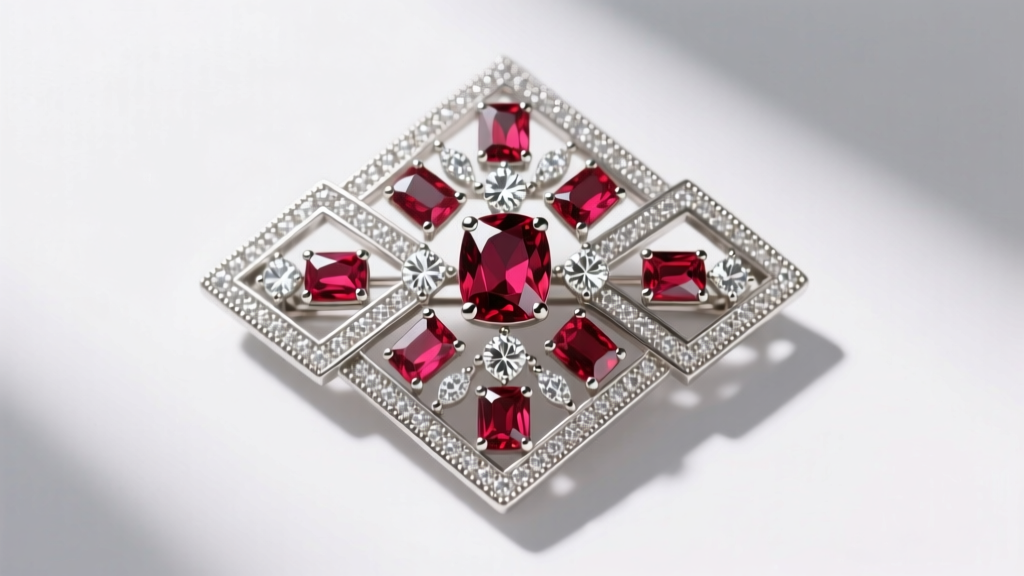
The visual impact of Art Deco jewelry relies heavily on high-contrast color blocking, achieved through calibré-cut gemstones. These are stones (typically onyx, coral, jade, rubies, and sapphires) custom-cut and faceted to fit seamlessly into geometric platinum channels without any visible metal between them.
Natural vs. Verneuil Synthetic Stones
A common misconception among novice collectors is that the presence of synthetic stones automatically renders a piece a fake or significantly diminishes its value. In reality, the Verneuil process (flame fusion) for creating synthetic rubies and sapphires was perfected in the early 1900s. By the 1920s, high-end Parisian houses like Cartier and Van Cleef & Arpels frequently paired flawless synthetic calibré-sapphires with natural old European cut diamonds. As noted by the Gemological Institute of America (GIA), synthetic sapphires from this era possess curved striae and gas bubbles visible under magnification, distinguishing them from the angular color zoning of natural stones. While an all-natural piece will always command the highest tier of valuation, a verified 1925 piece featuring period-correct Verneuil synthetics remains a highly valuable, authentic Art Deco artifact.
The Valuation Impact of Onyx and Jade
Dyed black onyx was the ultimate foil for bright diamonds in Art Deco design. True period onyx is a natural agate that has been treated with carbon and sugar to achieve a permanent, deep black. Modern reproductions often use black glass or black spinel. Under a gemological microscope, dyed onyx will show a cryptocrystalline structure, whereas glass will reveal spherical gas bubbles and conchoidal fractures.
Jade, specifically jadeite, was heavily influenced by the 1920s fascination with Orientalism. High-value Art Deco jade pieces feature "Type A" (untreated) translucent imperial green jadeite. If a piece features heavily dyed, opaque green stones, it is likely nephrite or treated jadeite, which drops the valuation from the tens of thousands into the low thousands.
Practical Valuation Framework for Collectors
When appraising Art Deco jewelry in the modern market, material integrity dictates the price ceiling. Use this framework to assess value beyond mere aesthetic appeal:
- Assess the Calibré Replacement Cost: Custom-cut calibré stones are incredibly difficult to replace today. If a 1930s platinum bracelet features three missing calibré-cut onyx batons, deduct not just the material cost, but the bespoke lapidary labor cost (often $300-$500 per stone) from the final valuation.
- Evaluate the Rhodium and Polish History: Platinum develops a desirable "patina" over time. Pieces that have been aggressively machine-polled, losing their crisp milgrain edges and softening their geometric steps, suffer a 15-20% value penalty. Sharp, original milgrain edges are a hallmark of untouched, high-value survivors.
- Verify the Diamond Cuts: Authentic Art Deco pieces should feature Old European Cut (OEC) or transitional cut diamonds. If the primary diamonds are modern Round Brilliant cuts with high-precision laser symmetry, the piece is likely a later reproduction or has been heavily altered, severely impacting its antique value.
Ultimately, mastering art deco jewelry identification and value is an exercise in material science. By training your eye to recognize the specific gravity of platinum, the chemical signatures of early phenolic resins, and the lapidary nuances of calibré-cut gems, you elevate your collecting from mere acquisition to true horological and gemological curation. For further historical context on the era's design shifts, the Victoria and Albert Museum's jewelry archives offer unparalleled visual references for period-correct material pairings.


