Authenticating Victorian Insect Jewelry: Expert Guide
Master the authentication of Victorian insect jewelry. Explore technical construction, enamel types, gemstone cuts, and valuation metrics for bug motifs.

The Entomological Obsession: Context and Craftsmanship
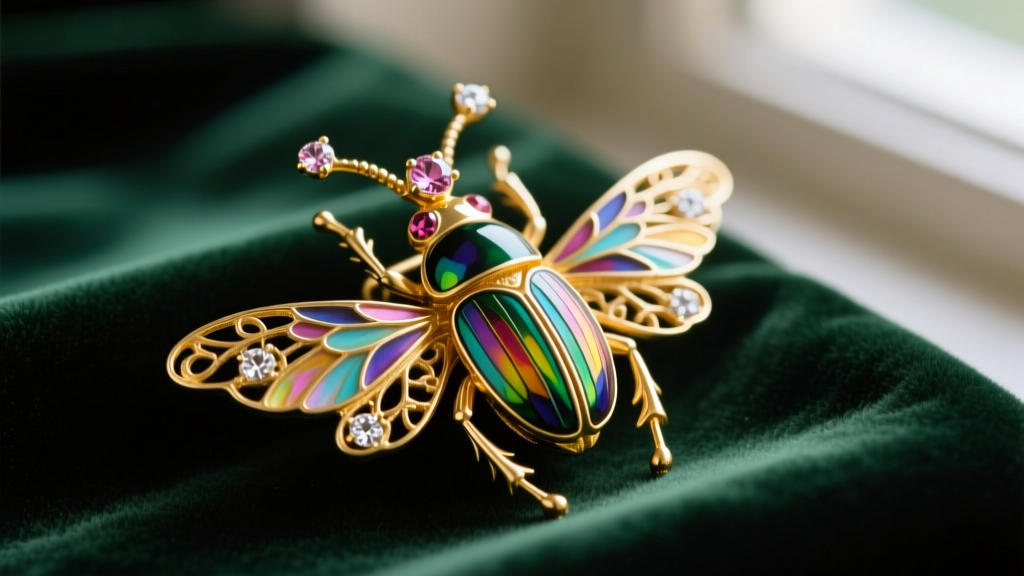
The Victorian era (1837–1901) was defined by a profound fascination with the natural world, driven by the publication of Charles Darwin’s On the Origin of Species and the rapid expansion of global botanical and entomological collections. Insect jewelry—ranging from delicate bees and dragonflies to unsettling spiders and beetles—became a dominant motif, particularly during the Romantic (1837–1860) and Grand (1861–1885) periods. For modern collectors and estate appraisers, authenticating these pieces requires looking past the whimsical aesthetics and deeply analyzing the metallurgical, gemological, and mechanical markers of 19th-century British and French craftsmanship. According to the Victoria and Albert Museum's Jewellery Collection, the transition from hand-fabricated naturalism to mass-produced revivalism in the late 1800s left a complex web of hallmarks and construction anomalies that experts must navigate today.
The Metallurgical Shift: 15k Gold and Pinchbeck
One of the most reliable authentication markers for mid-Victorian insect jewelry is the gold purity. Prior to the UK Gold Standard Act of 1854, British jewelers primarily worked in 18k and 22k gold. The 1854 Act legally introduced 15k, 12k, and 9k gold as standard hallmarks. Consequently, a vast majority of authentic mid-to-late Victorian bug brooches are crafted in 15k gold (62.5% pure gold). This specific alloy has a distinct, slightly warm, buttery-yellow hue that differs markedly from the paler 14k gold commonly used in American pieces or the richer 18k gold favored in French Art Nouveau creations.
For collectors encountering pieces that appear gold but lack hallmarks, the material is often Pinchbeck (an alloy of roughly 89% copper and 11% zinc) or rolled gold. Pinchbeck was heavily utilized for affordable insect brooches meant for daytime or mourning wear. Under 10x loupe magnification, authentic Victorian Pinchbeck will show a seamless color integration, whereas later 20th-century gold-plated replicas will reveal microscopic flaking, brass undertones, or the telltale 'EP' (Electroplated) stamps that did not exist in the 1850s.
Enamel Techniques: Champlevé vs. Basse-Taille
Insect wings and carapaces provided the perfect canvas for Victorian enamelers. The two most prevalent techniques were champlevé and basse-taille. In authentic champlevé pieces, the jeweler physically carved or cast troughs into the metal base, filling them with vitreous enamel powder before firing. You can identify this by examining the metal borders (cloisons); they should be slightly raised, uneven, and integral to the base metal, not soldered on as thin wires (which indicates cloisonné, a less common technique for British insect motifs).
Basse-taille enamel, often seen on high-end dragonfly and beetle wings, involves engine-turning (guilloché) the metal base with a rose engine lathe to create geometric patterns, then applying translucent enamel over the top. When examining a Victorian guilloché beetle wing, the light should catch the mechanical, perfectly parallel ridges beneath the glass-like enamel surface. If the pattern looks stamped, soft, or lacks the sharp, light-catching precision of a lathe, you are likely looking at a 1970s or later resin-filled revival piece.
Articulation and the 'En Tremblant' Mechanism
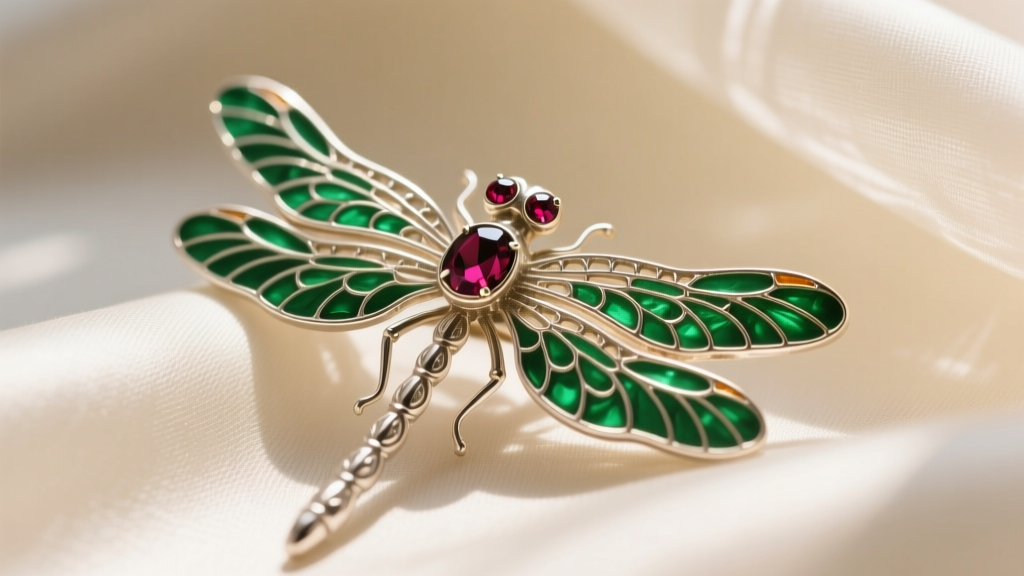
The pinnacle of Victorian insect jewelry engineering is the en tremblant (trembling) setting. Originally popularized in the 18th century, it saw a massive resurgence in the 1860s for diamond-encrusted butterflies and dragonflies. The wings or antennae are mounted on coiled steel springs hidden within tiny metal tubes. When the wearer moved, the insect appeared to flutter. To authenticate this, gently tap the side of the brooch with a wooden peg. An original Victorian steel spring will yield a soft, dampened vibration. If the piece is rigid, or if it springs back with the aggressive, snappy tension of modern beryllium-copper or titanium, it has either been repaired with modern materials or is a later reproduction. Furthermore, original Victorian steel springs will often show controlled, stable oxidation (a dark, matte patina) rather than bright, shiny rust.
Gemstone Cuts and Foil-Back Settings in Bug Motifs
The gemstones used in Victorian insect jewelry are heavily dictated by the era's cutting technology. You will almost never find modern round brilliant cuts in an authentic 19th-century piece. Instead, look for:
- Rose Cuts: Flat bases with domed, triangular facets. Frequently used for the bodies of bees and the wings of moths.
- Old Mine Cuts: Squarish or cushion-shaped with high crowns and large culets. Often used as the focal 'abdomen' of a spider or beetle.
- Cabochons: Smooth, unfaceted stones, particularly almandine garnets and moonstones, used for insect eyes or thorax segments.
A critical technical detail is the use of foil-backing. To maximize the brilliance of rose-cut diamonds and paste (lead glass) stones in dimly lit Victorian ballrooms, jewelers placed silver or gold foil behind the stone in closed-back settings. If you are examining a closed-back Victorian spider brooch and the stones look black, grey, or mirror-like, the foil has likely oxidized or been compromised by moisture. Never use ultrasonic cleaners on these pieces, as water ingress will instantly destroy the remaining historical foil.
Gemstone and Material Matrix by Insect Motif
| Insect Motif | Typical Victorian Materials | Common Gemstone Cuts | Estimated 2026 Market Value |
|---|---|---|---|
| Honey Bee | 15k Gold, Silver-Gilt | Rose-cut diamonds, Citrine | $800 - $2,500 |
| Dragonfly | Silver, Plique-à-jour enamel | Old Mine diamonds, Sapphires | $4,500 - $18,000+ |
| Scarab Beetle | 15k Gold, Pinchbeck | Chalcedony cabochons, Paste | $600 - $1,800 |
| Spider | Gold, Black Enamel | Old Mine diamonds, Garnets | $1,200 - $5,500 |
Authentication Red Flags: Spotting Revival Pieces
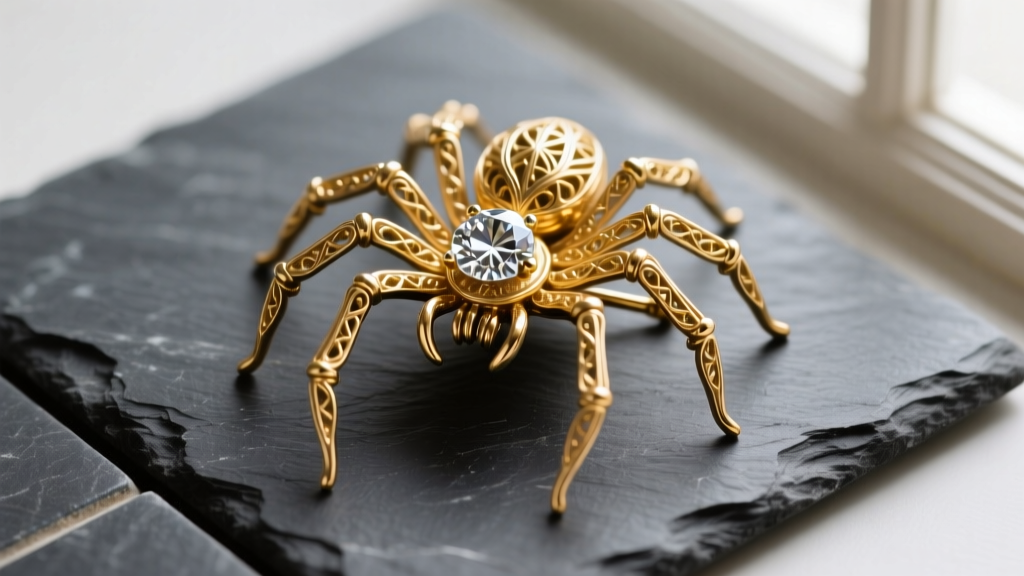
As the market for antique entomological jewelry has surged, so has the production of high-quality replicas, particularly those originating from the 1970s Victorian revival and modern artisan studios in Thailand and India. According to Antique Jewelry University, appraisers must look for specific anachronisms. First, examine the clasp. Authentic early-to-mid Victorian brooches utilize a simple 'T-bar' hinge and a 'C-clasp' without a rolling safety catch. The pin stem should extend slightly past the edge of the clasp. If the piece features a modern locking barrel clasp, a tube hinge, or a pin stem cut with modern, perfectly uniform machine grooves, it is a later piece.
Second, check for laser soldering marks. Victorian jewelers used lead or gold solder applied with a blowpipe, which leaves soft, slightly porous, and sometimes discolored joints. Modern laser welders leave perfectly smooth, microscopic, and brightly polished joints that are visible under a gemological microscope. Finally, look for rhodium plating. Victorian silver was never rhodium-plated; it was meant to patina. A bright, mirror-like silver finish that does not tarnish is a definitive marker of post-1930s manufacturing.
Care and Conservation Protocols
Preserving the structural integrity of 150-year-old insect jewelry requires specialized conservation. The articulated legs of spiders and the pinned wings of butterflies are highly susceptible to metal fatigue. Never bend an articulated limb to 'test' its flexibility; the silver or gold wire hinges will snap. When storing these pieces, they must be laid flat in acid-free tissue paper. Hanging a Victorian en tremblant brooch will place continuous stress on the steel springs, eventually causing them to snap or permanently deform.
Expert Conservation Tip: If the enamel on a Victorian beetle wing is chipped, do not attempt to fill it with modern jewelry epoxy. Modern resins have a different refractive index and will yellow over time, ruining the piece's historical value. Consult a specialist in vitreous enamel restoration who can match the historical lead-flux composition.
By mastering the nuances of 15k gold alloys, engine-turned enamel, and historic gemstone cutting, collectors can confidently navigate the complex market of Victorian insect jewelry, preserving these miniature masterpieces of natural history and metallurgical art for future generations.


