Authenticating Edwardian Era Jewelry: Platinum vs White Gold
Discover how to identify and compare platinum, white gold, and silver in Edwardian era jewelry. Expert metal testing and authentication tips.

The Platinum Revolution of the Edwardian Period
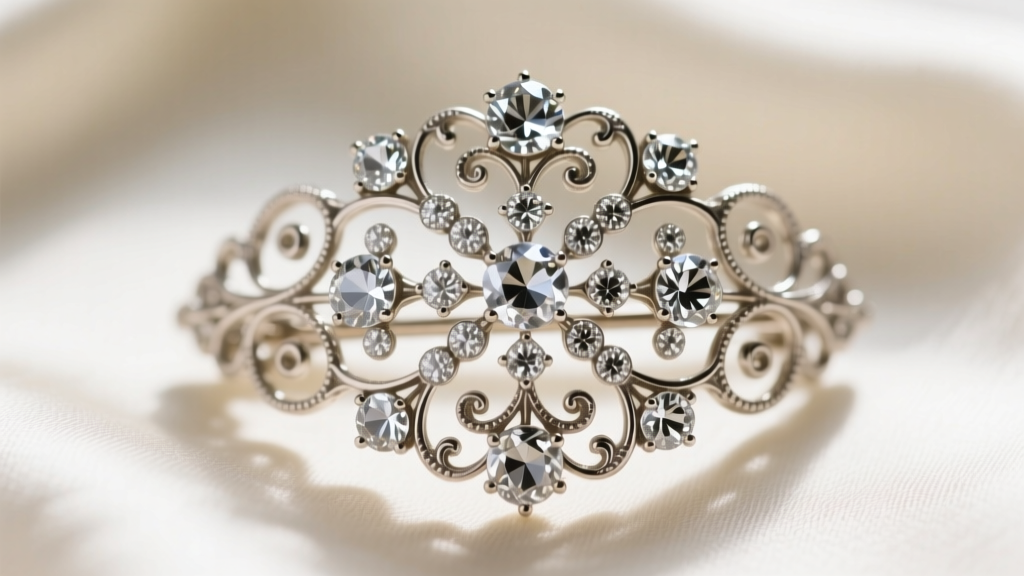
The Edwardian era (1901–1915) marked a profound metallurgical shift in fine jewelry, defined almost entirely by the mastery of platinum. Before the late 19th century, platinum's exceptionally high melting point (1,768°C) made it nearly impossible to work with using traditional jewelers' torches. The invention of the oxyhydrogen torch changed everything, allowing artisans to manipulate this incredibly strong, white metal. According to the Gemological Institute of America (GIA), this metallurgical breakthrough directly enabled the iconic 'garland' and 'lacework' styles of the era. Platinum's immense tensile strength meant that jewelers could create impossibly thin, delicate filigree and millegrain settings that would easily snap or warp if crafted in silver or gold.
However, authenticating Edwardian era jewelry requires a deep understanding of historical alloys. Pure platinum is too soft for secure stone setting. Edwardian platinum was almost universally alloyed with 10% iridium (stamped as 900 Pt or 10% Irid). This specific 900/100 ratio provided the perfect balance of malleability for hand-forging and hardness for securing old European and mine-cut diamonds. In contrast, modern platinum jewelry is typically alloyed with 5% ruthenium (950 Pt) for casting purposes. Identifying this subtle difference in alloy composition and patina is a primary step in separating true Edwardian artifacts from later 20th-century reproductions.
The White Gold Misconception in Edwardian Pieces
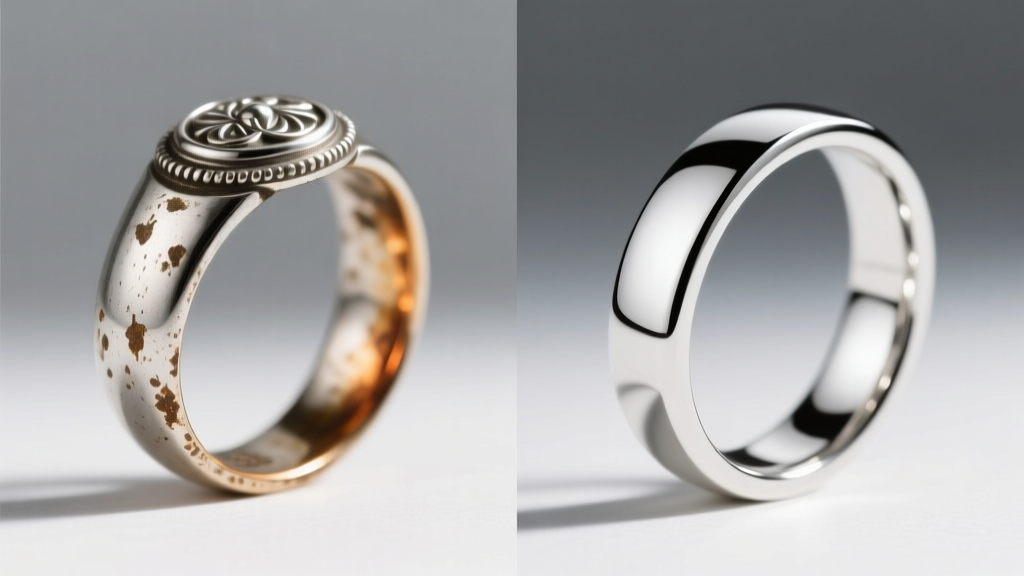
One of the most common errors in the vintage jewelry market is the misidentification of white gold as an Edwardian metal. While the visual aesthetic of white gold mimics platinum, its historical timeline does not align with the Edwardian period. David Belais patented the first successful 18-karat white gold alloy (a mixture of gold, nickel, and zinc) in 1912. However, early white gold was notoriously brittle, difficult to cast, and faced severe manufacturing delays due to World War I metal rationing.
Consequently, white gold did not achieve widespread commercial success or stylistic dominance until the 1920s Art Deco era. If you are evaluating a piece of purported Edwardian era jewelry that tests as white gold, you are likely looking at one of three scenarios: a 1920s Art Deco piece mislabeled by a seller, a later mid-century reproduction of an Edwardian design, or a piece that has been heavily modified. True Edwardian white metal jewelry is overwhelmingly platinum, or a precursor alloy discussed below. As noted by Lang Antiques, the presence of nickel-heavy white gold in a delicate filigree piece is an immediate red flag for anachronistic manufacturing.
Silver-Topped Gold: The Precursor to Platinum
Before platinum became fully workable and widely available, Victorian and early Edwardian jewelers relied on a composite material known as 'silver-topped gold' to achieve a white metal appearance. Diamonds reflect white light best when set in white metals, but setting them in silver posed a significant problem: silver tarnishes rapidly, and the resulting black oxidation would stain the wearer's skin and clothing.
To solve this, master jewelers laminated a thin layer of sterling silver over a base of 14k or 18k yellow gold. The silver top provided the brilliant white reflective surface for the diamonds, while the gold backing prevented skin contact and structural tarnishing. When examining Edwardian era jewelry under a loupe, look closely at the wear points on the backs of brooches or the inner shanks of rings. If you see a warm yellow hue bleeding through the white surface layer, you are looking at silver-topped gold, a highly desirable and historically accurate hallmark of the transitional late-Victorian to early-Edwardian period.
Material Comparison Matrix
Understanding the physical and chemical properties of these metals is critical for accurate identification and valuation. The table below outlines the definitive characteristics of the primary white metals used in or associated with the era.
| Metal / Alloy | Typical Edwardian Composition | Density (g/cm³) | Common Hallmarks | Patina & Tarnish Profile |
|---|---|---|---|---|
| Edwardian Platinum | 90% Pt, 10% Iridium | 21.45 | 900 Pt, PLAT, IRIDPLAT | Develops a soft, satiny patina; does not tarnish or oxidize. |
| Silver-Topped Gold | Sterling Silver over 14k/18k Gold | ~13.5 (Varies) | Rarely hallmarked on silver layer | Surface tarnishes black; requires gentle polishing. |
| Early White Gold | 18k Gold, Nickel, Zinc (Belais) | 15.6 | 18k, 750, BELAIS | Yellows over time as rhodium plating wears off. |
| Sterling Silver | 92.5% Ag, 7.5% Cu | 10.49 | 925, STERLING, Lion Passant | Heavy black oxidation; highly prone to sulfur tarnish. |
Practical Authentication Framework
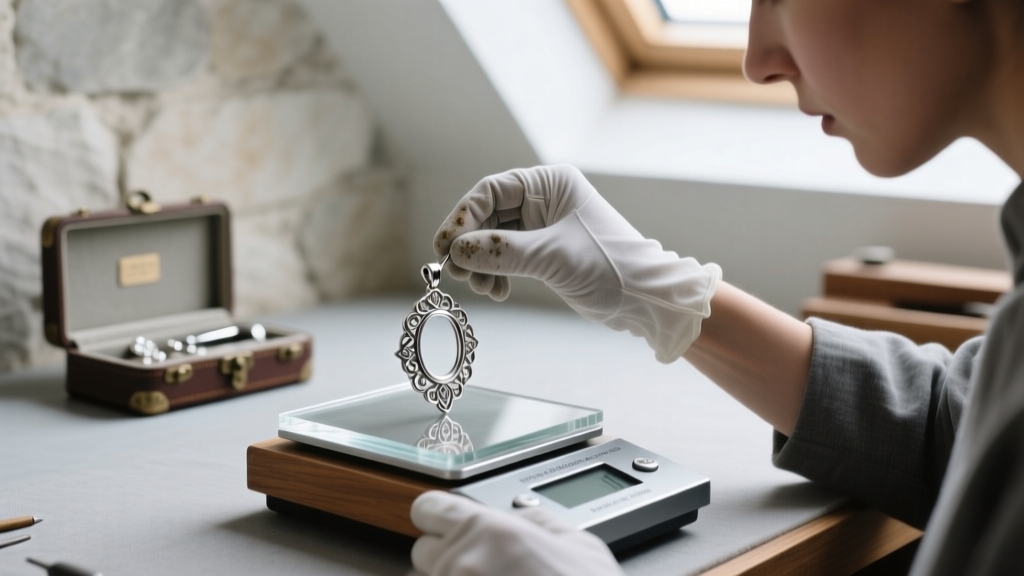
Because hallmarking laws were loosely enforced in the early 1900s, many authentic Edwardian platinum pieces are completely unmarked. Relying solely on visual inspection is insufficient; a rigorous testing framework is required.
Specific Gravity Testing
Specific gravity (SG) testing is the most reliable non-destructive method for differentiating platinum from white gold and silver. Platinum is extraordinarily dense. An Edwardian platinum brooch will feel surprisingly heavy in the hand compared to a similarly sized white gold piece. By using a hydrostatic scale, you can calculate the exact density. A reading near 21.45 g/cm³ confirms a platinum alloy, while a reading around 15.6 g/cm³ indicates 18k white gold, and 10.49 g/cm³ points to sterling silver. This data point alone can instantly authenticate an unmarked Edwardian era jewelry pendant or ring.
Magnetism and Acid Reactions
Platinum and silver are entirely non-magnetic. However, early white gold alloys heavily utilized nickel, which is slightly magnetic. Passing a rare-earth neodymium magnet over a suspected white gold piece can reveal a subtle drag, instantly dating the metal to the post-Edwardian era. For acid testing, platinum requires specialized, highly corrosive acids and a heating plate to react, making it safer to leave to professionals. Standard silver testing acid (nitric acid) will turn bright red on sterling silver, but will show little to no reaction on platinum or high-karat gold, helping to rule out solid silver constructions.
2026 Market Valuations and Investment Trends
In the 2026 vintage market, the material composition of Edwardian era jewelry heavily dictates its auction and retail value. Collectors and institutions prioritize original, unmodified platinum pieces due to their historical significance and superior craftsmanship. An authentic platinum and diamond Edwardian lacework tiara or large brooch can command anywhere from $15,000 to well over $85,000 at major auction houses, driven by the rarity of intact millegrain work.
Silver-topped gold pieces, while historically fascinating, generally trade at a 20% to 30% discount compared to their pure platinum counterparts, often ranging from $2,500 to $8,000 depending on the carat weight of the old European cut diamonds. Conversely, pieces misidentified as Edwardian but proven to be 1920s white gold suffer a significant valuation penalty in the antique sector, as they cross over into the more mass-produced Art Deco category, where prices for standard filigree rings typically sit between $800 and $2,500.
Conservation and Care by Metal Type
Preserving the metallurgical integrity of Edwardian jewelry requires an understanding of its composite nature. Aggressive polishing of silver-topped gold can strip the historical silver layer entirely, destroying both the aesthetic and the artifact's value.
Maintenance protocols must be strictly tailored to the metal. For platinum Edwardian pieces, ultrasonic cleaners are generally safe for the metal itself, but highly dangerous for the stones. Edwardian jewelry frequently features foil-backed diamonds, rose cuts, or early synthetic sapphires that will cloud or shatter in an ultrasonic bath. Always clean platinum filigree with a soft brush, mild dish soap, and lukewarm water.
For silver-topped gold, avoid commercial silver dips and harsh polishing cloths. These compounds will strip the thin silver lamination and expose the yellow gold underneath, ruining the original white-metal illusion intended by the master jeweler. According to the Victoria and Albert Museum's conservation guidelines, antique silver should only be lightly dusted or cleaned with specialized, non-abrasive conservation swabs to maintain the historical patina without compromising the structural layers. Understanding these material properties is not just about authentication; it is about preserving a fleeting, elegant moment in jewelry history.


