Lang Vintage Jewelry: Technical Authentication & Valuation Guide
Master the technical evaluation of Lang vintage jewelry. Deep dive into gemological cuts, metallurgical hallmarks, and condition grading.

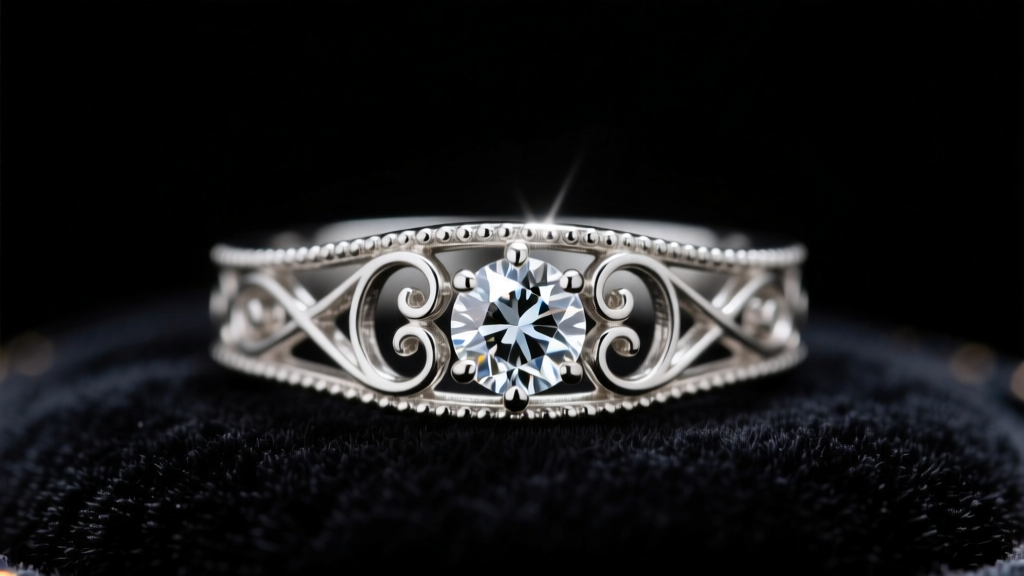
When collectors and gemologists discuss the pinnacle of estate curation, the benchmark is often set by top-tier dealers. Evaluating lang vintage jewelry requires more than a casual appreciation for aesthetics; it demands a rigorous understanding of historical manufacturing techniques, period-specific gemological cuts, and precise metallurgical standards. As we navigate the 2026 estate market, where high-quality antique pieces are becoming increasingly scarce, the ability to technically deconstruct and authenticate these jewels is paramount for serious investors and collectors.
This expert deep dive dissects the technical lexicon, condition grading matrices, and authentication protocols used to evaluate museum-quality vintage and antique jewelry, providing you with the actionable frameworks needed to assess estate pieces with a professional gemologist's eye.
The Gemological Lexicon: Decoding Antique Diamond Cuts
The foundation of any high-caliber vintage jewelry assessment lies in accurately identifying the diamond cut, which serves as a primary chronological marker. Modern round brilliant cuts (post-1919 Tolkowsky standard) are rarely found in genuine Victorian or early Edwardian pieces unless the stone has been replaced. When authenticating estate jewelry, you must differentiate between the following historical cuts:
- Old Mine Cut (OMC): Prevalent from the Georgian era through the late Victorian period. These stones feature a squarish or cushion-shaped girdle, a very high crown, a deep pavilion, and a distinctly large, open culet that is visible to the naked eye through the table.
- Old European Cut (OEC): The standard for Edwardian and early Art Deco jewelry. OECs are round but retain the high crown, small table, and large culet of the OMC. The facet pattern is chunky and blocky, optimized for candlelight rather than modern electric lighting.
- Transitional Cut: Emerging in the late 1920s and 1930s, these stones bridge the gap between OECs and Modern Round Brilliants. They feature larger tables, lower crowns, and smaller culets, reflecting the advent of motorized bruting machines.

According to the Gemological Institute of America (GIA), evaluating the symmetry and polish of antique cuts requires suspending modern grading standards. An OEC with "poor" symmetry by today's metrics is actually highly desirable and authentic to the 1910s, as it was cut entirely by hand to maximize carat weight retention from the rough crystal.
Metallurgical Analysis: Platinum, White Gold, and Hallmarks
Authenticating the metal composition is the second critical pillar of evaluating vintage jewelry. The transition from silver-topped gold to pure platinum, and eventually to white gold, provides exact temporal boundaries for dating a piece.
The Platinum Revolution (1900–1930)
Edwardian and authentic Art Deco masterpieces heavily feature platinum. Because platinum is incredibly strong, jewelers could execute the ultra-fine, intricate millegrain and filigree work characteristic of these eras. However, early 20th-century platinum was often alloyed with iridium or ruthenium. When inspecting a piece, look for the "PT", "PLAT", or "950" stamp. If a piece claims to be 1910 but features a rhodium-plated white gold setting, it is either a later reproduction or a re-shanked antique.
The White Gold Compromise (1920s Onward)
As platinum prices skyrocketed and it was eventually classified as a strategic military metal, the jewelry industry introduced white gold (an alloy of gold, nickel, and zinc). By the late 1920s, 14k and 18k white gold became prevalent. White gold requires rhodium plating to achieve a bright white finish, which wears off over time, revealing a faint yellowish-gray undertone—a key indicator of age in Retro and Mid-Century pieces.

For unmarked Victorian pieces, top dealers utilize X-Ray Fluorescence (XRF) spectrometry rather than destructive acid testing. XRF provides a precise elemental breakdown, revealing not just the karat weight, but the specific trace alloys (like copper or silver) that can help pinpoint the geographic origin of the gold.
Findings and Mechanics: The Hidden Authentication Markers
Amateur collectors look at the stones; experts look at the findings. The clasps, hinges, and catches on vintage jewelry are highly specific to their manufacturing decade. A mismatch here is an immediate red flag for alteration or outright forgery.
- C-Clasps and T-Hinges: Standard on Victorian brooches. The pin extends past the edge of the brooch and hooks into a simple C-shaped wire catch. If a Victorian brooch features a modern locking safety clasp, the pin mechanism has likely been replaced, impacting the historical value.
- Trombone Clasps: Predominantly used on European jewelry from the late 19th century through the 1940s. The push-pull mechanism resembles a trombone slide and is a hallmark of French and Swiss Art Deco pieces.
- Figure-Eight Safety Guards: Introduced in the 1920s alongside the modern safety clasp to prevent accidental loss. Finding a double figure-eight guard on a heavy platinum Art Deco bracelet is a strong indicator of original, high-end manufacture.
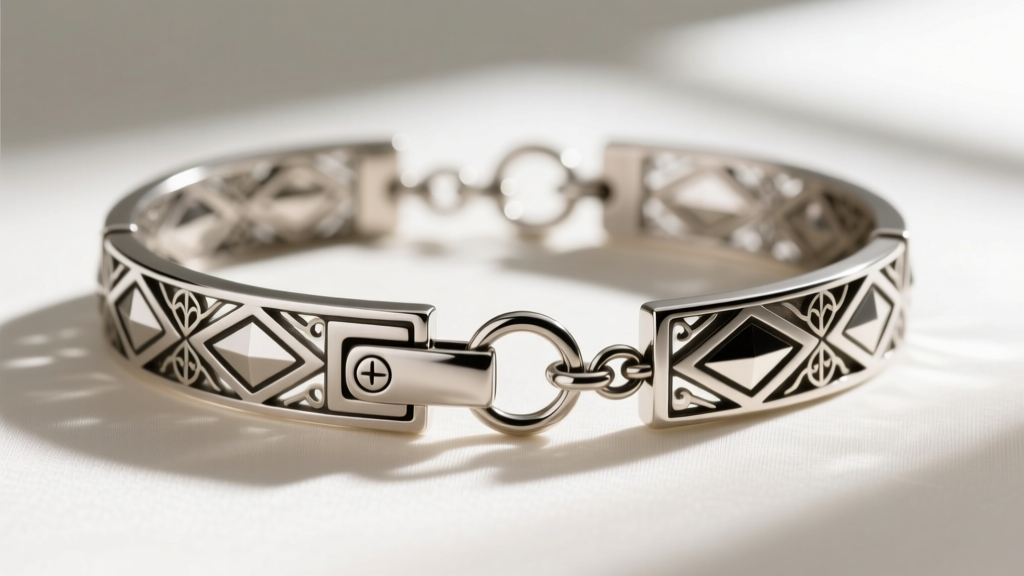
Resources like the Lang Antiques Educational Blog provide extensive visual databases of these historical findings, which are indispensable for cross-referencing clasp mechanics during authentication.
Condition Grading Matrix for Estate Jewelry
Unlike modern jewelry, antique pieces are rarely "flawless." The value of lang vintage jewelry relies heavily on a transparent, standardized condition report. Below is the technical grading matrix used by elite estate dealers to evaluate structural integrity and wear.
| Condition Grade | Technical Definition & Acceptable Wear | Impact on Valuation |
|---|---|---|
| Mint / Museum | No visible wear under 10x loupe. Original polish, pristine millegrain, no re-tipped prongs, original clasp mechanics fully intact. | Commands a 30-50% premium over standard market value. |
| Excellent | Minor, expected wear. Prongs may show slight flattening but are secure. Micro-scratches on metal consistent with age. No replaced components. | Standard baseline for high-end retail estate pricing. |
| Good / Very Good | Noticeable wear. Millegrain rubbed smooth on high points. Prongs re-tipped (must be disclosed). Shanks may be slightly thinned. Clasps replaced with period-appropriate alternatives. | Priced at a 10-20% discount. Requires careful wear and maintenance. |
| Fair / As-Is | Structural compromises. Cracked shanks, chipped girdles on primary stones, missing enamel, or non-period modern soldering repairs. | Sold at melt-plus-stone value or heavily discounted for restoration projects. |
Disclosing Interventions: Solder and Re-Tipping
A critical aspect of technical evaluation is identifying laser soldering versus traditional torch soldering. Laser soldering, introduced in the late 20th century, allows for precise prong re-tipping without removing heat-sensitive antique stones (like emeralds or opals). While re-tipping is a normal maintenance procedure, traditional torch solder can cause thermal shock or leave visible, messy joints that degrade the piece's structural and historical integrity.
Provenance and the 2026 Market Valuation
In 2026, the provenance of a piece—its documented history of ownership—can elevate a standard antique ring into a highly contested auction lot. When evaluating high-tier vintage jewelry, always request the original period box, historical appraisal documents, or maker's marks that tie the piece to a specific maison (e.g., Cartier, Boucheron, or Marcus & Co.).
Ultimately, mastering the technical authentication of vintage jewelry transforms the acquisition process from a subjective emotional purchase into a calculated, data-driven investment. By scrutinizing the facet architecture of Old European cuts, verifying the elemental composition of platinum alloys, and meticulously inspecting the mechanics of period-correct clasps, collectors can confidently navigate the estate market and secure pieces of enduring historical and financial significance.


