Authenticating Victorian Era Jewelry: A Technical Guide
Master the technical authentication of Victorian era jewelry. Explore metallurgy, hallmarking, mourning materials, and construction analysis.

The Metallurgy of the 19th Century: Gold Alloys and Pinchbeck
Identifying genuine Victorian era jewelry requires a fundamental understanding of 19th-century metallurgy and legislative shifts. Prior to the UK Hallmarking Act of 1854, British law strictly mandated that only 22-karat and 18-karat gold could be legally hallmarked. Consequently, early Victorian pieces (1837–1850) were either high-karat gold or entirely unmarked, relying on the reputation of the goldsmith. The 1854 Act revolutionized the market by legally recognizing 15k, 12k, and 9k gold, democratizing ownership and leading to a massive influx of lower-karat stamped pieces.
Pinchbeck and the Illusion of Gold
For collectors, distinguishing between gold and Pinchbeck is a critical skill. Invented by Christopher Pinchbeck in the early 18th century, this alloy remained highly popular through the mid-Victorian period. True Pinchbeck consists of exactly 89% copper and 11% zinc. Unlike later brass alloys which tarnish to a dull, muddy brown, high-quality Pinchbeck retains a warm, golden luster and is highly resistant to tarnish. Under a 10x loupe, authentic Pinchbeck will show microscopic surface porosity distinct from the denser, smoother finish of rolled gold or electroplated pieces. According to Lang Antique Jewelry University, true Pinchbeck was almost exclusively used for watch chains, chatelaines, and heavy repoussé brooches, rarely for delicate gemstone settings.
Construction Techniques: Cannetille, Repoussé, and Die Stamping
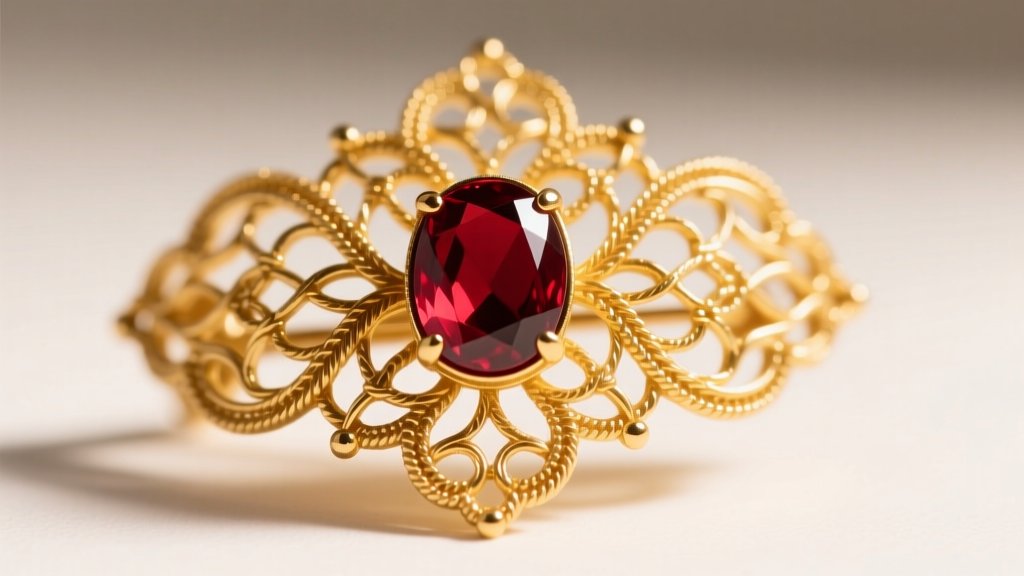
The structural anatomy of a piece is often the most reliable indicator of its specific decade within the Victorian era. The Romantic Period (1837–1860) was defined by labor-intensive, hand-fabricated techniques. Cannetille work, which peaked in the 1830s, involved soldering impossibly fine gold wires (often 28 to 30 gauge) into intricate coils, tendrils, and beehive motifs. Authentic cannetille will show microscopic variations in coil tension and slight soldering bloom under magnification. Reproductions often feature uniform, machine-extruded wires with laser-welded joints that lack the organic irregularity of 19th-century handwork.
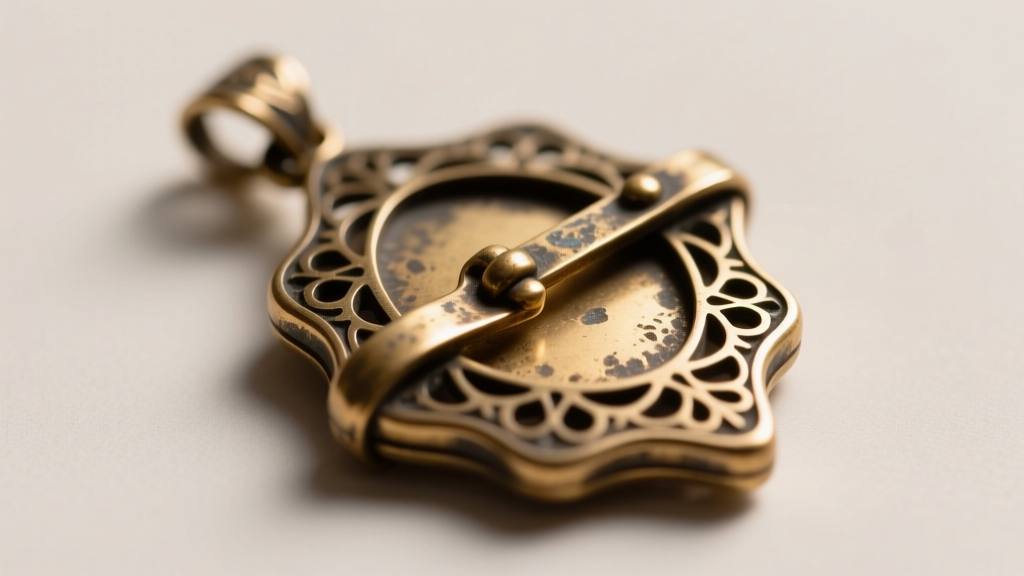
By the 1850s, the Industrial Revolution introduced die stamping to jewelry manufacturing. Die-stamped Victorian era jewelry is characterized by its lightweight, hollow construction, remarkably sharp edges, and visible seams where the front and back plates were soldered together. While early hand-hammered repoussé pieces feature a heavy, solid feel with a slightly uneven reverse side, die-stamped pieces are uniformly thin. Furthermore, examining the hinge mechanism is crucial. Early Victorian brooches utilized simple tube hinges (a hollow cylinder of metal soldered to the back), whereas the later Grand and Aesthetic periods saw the introduction of more refined, rounded hinges. If a piece features a modern safety catch or a ball-style hinge, it is almost certainly post-1900 or has been heavily repaired.
Mourning Materials: Differentiating Jet, Vulcanite, and French Jet
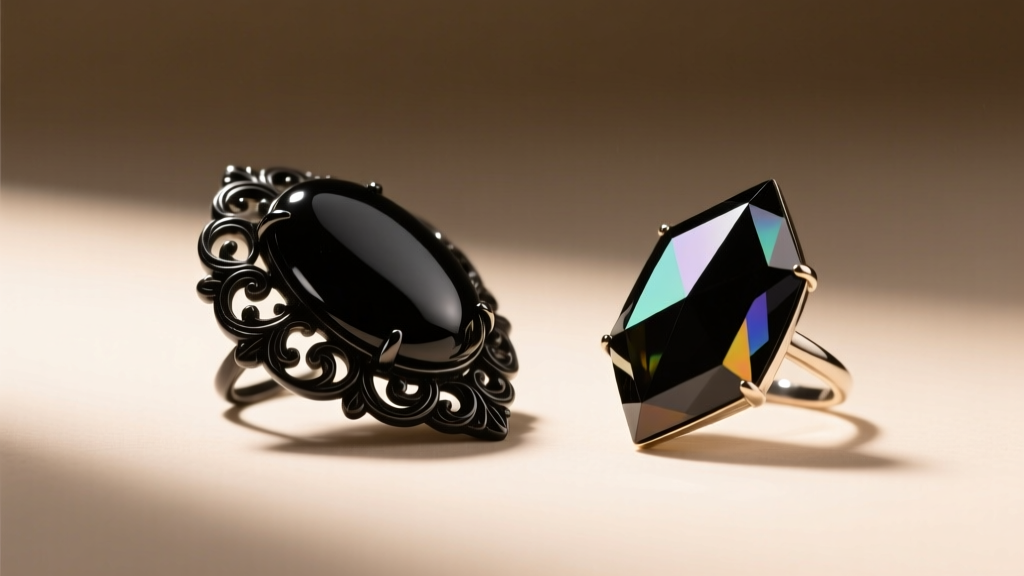
The death of Prince Albert in 1861 plunged the empire into decades of strict mourning etiquette, spawning a massive industry for black jewelry. However, not all black materials are created equal, and misidentification is rampant in the antique market. Whitby Jet, fossilized wood from the Araucaria tree, was the premier material. It is exceptionally lightweight (specific gravity of roughly 1.30), warm to the touch due to low thermal conductivity, and leaves a distinct light brown streak when rubbed gently on unglazed porcelain.
Conversely, Vulcanite (hardened rubber mixed with sulfur) was a cheaper alternative. It is slightly heavier than jet, often exhibits a faint brownish or greenish hue in areas where the black dye has faded, and emits a distinct rubbery odor when subjected to gentle friction. French Jet, despite its name, is simply black glass. It is significantly heavier (SG of 2.50+), cold to the touch, and produces a high-pitched 'clink' when tapped against a tooth or glass surface. Bog oak, another common material, is actually fossilized wood that is lighter than jet but typically features visible wood grain patterns under high magnification.
| Material | Specific Gravity | Thermal Conductivity | Streak / Friction Test | Common Failure Modes |
|---|---|---|---|---|
| Whitby Jet | 1.30 - 1.40 | Low (Warm) | Light brown streak | Chipping, drying/cracking |
| Vulcanite | 1.15 - 1.25 | Low (Warm) | Rubbery odor, no streak | Fading to brown/green |
| French Jet (Glass) | 2.40 - 2.80 | High (Cold) | No streak, high-pitched ring | Shattering, facet abrasion |
| Bog Oak | 1.20 - 1.35 | Low (Warm) | Brown streak, wood grain visible | Splitting along the grain |
Gemstone Settings and Cutting Styles
The lapidary techniques of the 19th century left distinct fingerprints on the gemstones used in Victorian era jewelry. The Old Mine Cut, the precursor to the modern brilliant, was the dominant diamond shape. These stones were cut by hand to maximize carat weight rather than optical symmetry, resulting in high crowns, small tables, squarish girdles with rounded corners, and notably large, open culets that are easily visible through the table facet. If a diamond in a purported 1850s setting features a perfectly symmetrical round brilliant cut with a pointed culet, the stone is likely a 20th-century replacement.
The Transition from Foil-Backed to Open-Back Settings
Early Victorian jewelry heavily relied on foil-backed gemstones set in closed-back collets to enhance color and brilliance. The foil, typically made of thin silver or copper leaf, is highly susceptible to moisture. A genuine early Victorian closed-back piece will often show signs of foil degradation—darkening, mottling, or complete disintegration—if the seal was ever compromised. By the 1880s, advancements in gem cutting and the introduction of electric lighting rendered foil obsolete. Late Victorian jewelry predominantly features open-back settings, allowing light to pass freely through the pavilion. According to the Victoria and Albert Museum, the transition from closed to open settings is one of the most reliable chronological markers for dating 19th-century gemstone rings and pendants.
Practical Authentication Framework for Collectors
When evaluating a potential acquisition, systematic analysis prevents costly errors. Use the following technical checklist to authenticate Victorian era jewelry:
- Examine the Clasp and Hinge: Look for a simple C-clasp and a tubular hinge. A safety catch with a locking lever strongly suggests an Edwardian or later origin, or a modern repair.
- Inspect the Gold Color and Wear: Early Victorian gold often has a softer, rosier hue due to higher copper content in the alloy. Check high-wear areas; if a silvery or brassy base metal is showing through, it is gold-filled or electroplated, not solid gold.
- Analyze the Stone Proportions: Use a 10x triplet loupe to inspect the culet of diamonds and colored stones. A visible, flat culet indicates an antique Old Mine or Old European cut.
- Test the Black Materials: Never use a hot pin to test jet or vulcanite; this causes irreversible thermal damage. Rely on the streak test, specific gravity (heft), and thermal conductivity (temperature to the touch).
- Check for Maker's Marks vs. Hallmarks: A maker's mark (initials or symbol) is not a legal guarantee of metal purity in the UK. Look for the crown (gold standard), the anchor (Birmingham assay office), or the leopard's head (London).
Conclusion
Mastering the authentication of Victorian era jewelry requires moving beyond aesthetic appreciation into the realm of material science and historical manufacturing analysis. By understanding the legislative shifts in gold hallmarking, recognizing the physical limitations of 19th-century die stamping, and applying non-destructive testing to mourning materials, collectors can confidently navigate the complex antique market. The true value of these pieces lies not just in their beauty, but in the fascinating technical ingenuity of the era that produced them.


