Victorian Tooth Jewelry: Material Properties & Identification Guide
Explore the material properties of Victorian tooth jewelry. Learn to identify enamel, dentin, and period mounts while comparing them to jet and vulcanite.

The Biological Anatomy of Antique Tooth Jewelry
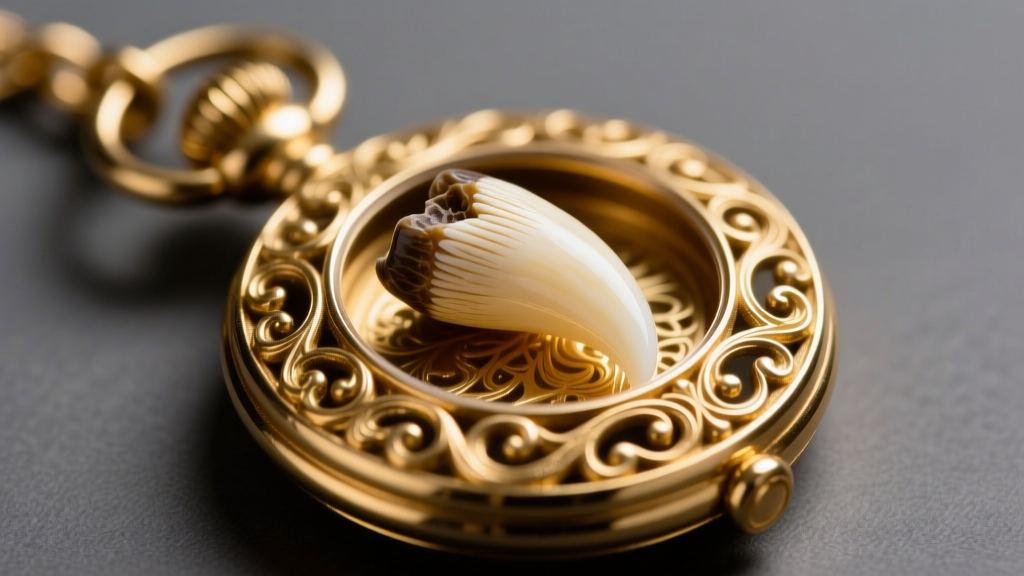
When collectors discuss Victorian tooth jewelry, they are almost exclusively referring to animal teeth—such as wolf, bear, boar, shark, and tiger—rather than human remains. During the 19th century, the rise of big-game hunting, the expansion of the British Empire, and the popularity of sporting culture led to a surge in trophy jewelry. These organic artifacts were transformed into watch fobs, stickpins, and charms. To properly identify and value these pieces today, one must understand the biological composite of the tooth itself.
A tooth is not a single uniform material; it is a complex biological composite consisting of three primary layers, each with distinct physical properties that dictate how the piece ages over 150 years:
- Enamel: The outermost layer, composed primarily of hydroxyapatite (calcium phosphate). It is the hardest biological material in nature, registering a 5.0 on the Mohs scale. However, it is highly brittle and prone to micro-cracking when subjected to the tension of metal prongs.
- Dentin: The porous, tubular core beneath the enamel. With a Mohs hardness of roughly 3.5 and a specific gravity between 2.1 and 2.2, dentin is highly susceptible to desiccation (drying out), which leads to internal structural collapse.
- Cementum: The calcified layer covering the root, which Victorian jewelers often filed down or encased entirely in gold or silver mounts to hide the rough extraction point.
Understanding this stratification is critical. Many antique pieces suffer from 'enamel delamination,' where the brittle outer shell separates from the shrinking dentin core due to century-long humidity fluctuations.
Material Comparison: Tooth vs. Other Victorian Organics
Victorian mourning and sentimental jewelry relied heavily on organic materials. Distinguishing authentic tooth dentin from carved bone, jet, or vulcanite requires a systematic approach to material testing. Below is a comparative breakdown of the physical properties of these common Victorian organics.
| Material | Mohs Hardness | Specific Gravity | Hot Pin Test Reaction | UV Fluorescence |
|---|---|---|---|---|
| Tooth (Enamel) | 5.0 | 2.9 - 3.0 | No reaction / slight odor | Dull white/blue |
| Tooth (Dentin) | 3.5 | 2.1 - 2.2 | Smells like burning hair | Dull white |
| Carved Bone | 2.5 - 3.0 | 1.7 - 2.0 | Smells like burning hair | None / Weak |
| Jet | 2.5 - 4.0 | 1.30 - 1.35 | Smells like coal/tar | None |
| Vulcanite | 2.0 - 3.0 | 1.20 - 1.40 | Smells like rubber | None |
| Bog Oak | 2.0 - 3.0 | 1.25 - 1.35 | Smells like burning wood | None |
According to the Gemological Institute of America (GIA), the most reliable non-destructive test for separating tooth from carved bone is the presence of the pulp cavity. In authentic Victorian tooth jewelry, the base of the root will often feature a small, dark void or a historical fill material (like lead or sealing wax) where the nerve and blood vessels once resided. Bone, conversely, will show a uniform cross-section with tiny Haversian canals but no central pulp chamber.
Period Mounts: How Victorian Metals Interact with Dentin
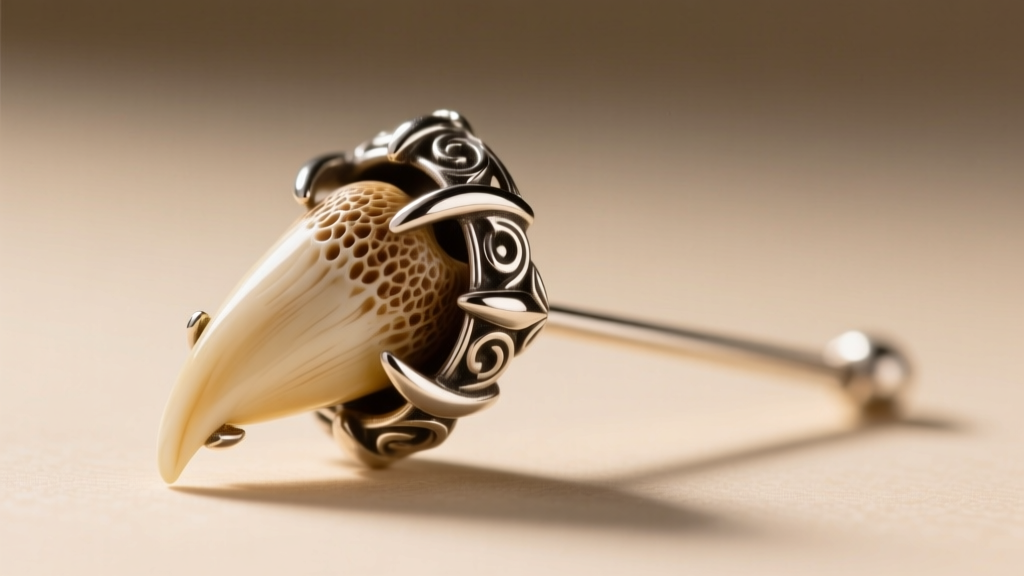
The metalwork used to secure Victorian tooth jewelry plays a massive role in its survival. Because dentin is hygroscopic (moisture-absorbing), the way a jeweler mounted the tooth dictated its long-term structural integrity.
Identifying 9k Gold, 15k Gold, and Pinchbeck Settings
British Victorian jewelers frequently utilized 15k gold (a standard abolished in 1932) for high-end sporting charms. The Lang Antique Jewelry University notes that 15k gold offers a distinct, rich yellow hue that contrasts sharply with the ivory dentin. However, lower-end pieces were often mounted in 9k gold, silver, or Pinchbeck (a copper-zinc alloy designed to mimic gold).
A critical failure mode in these pieces is 'metal-induced rot.' If a Victorian jeweler used a closed-back silver or base-metal cap over the root of the tooth without a moisture barrier, trapped ambient humidity would cause the dentin to fester and degrade from the inside out. When evaluating a piece, always check for a slight give or sponginess at the metal-tooth junction, which indicates advanced internal decay.
Preservation: Managing Moisture and Structural Failure
Preserving Victorian tooth jewelry requires a departure from standard gemological cleaning protocols. The organic nature of the material means that modern jewelry cleaning techniques can be catastrophic.
- Never use ultrasonic cleaners: The high-frequency acoustic cavitation will easily shatter the brittle, desiccated enamel and cause the dentin core to fracture along its natural tubular grain.
- Avoid chemical dips: Silver polishing liquids and acidic gold dips will strip the natural patina from the tooth and chemically burn the porous cementum.
- Consolidation techniques: If the enamel is flaking, museum conservators typically use Paraloid B-72, an acrylic resin dissolved in acetone, applied with a fine sable brush. This stabilizes the flaking without altering the optical properties of the tooth.
- Hydration control: To prevent further desiccation, store these pieces in an environment with a stable relative humidity of 45-55%. Applying a micro-crystalline wax, such as Renaissance Wax, once a year can provide a breathable barrier against rapid humidity swings.
For deeper historical context on how these organic materials were originally sourced and worn, the Victoria and Albert Museum's jewelry archives provide excellent documentation on 19th-century sporting and exotic revival accessories.
Valuation and Market Pricing in the Modern Era
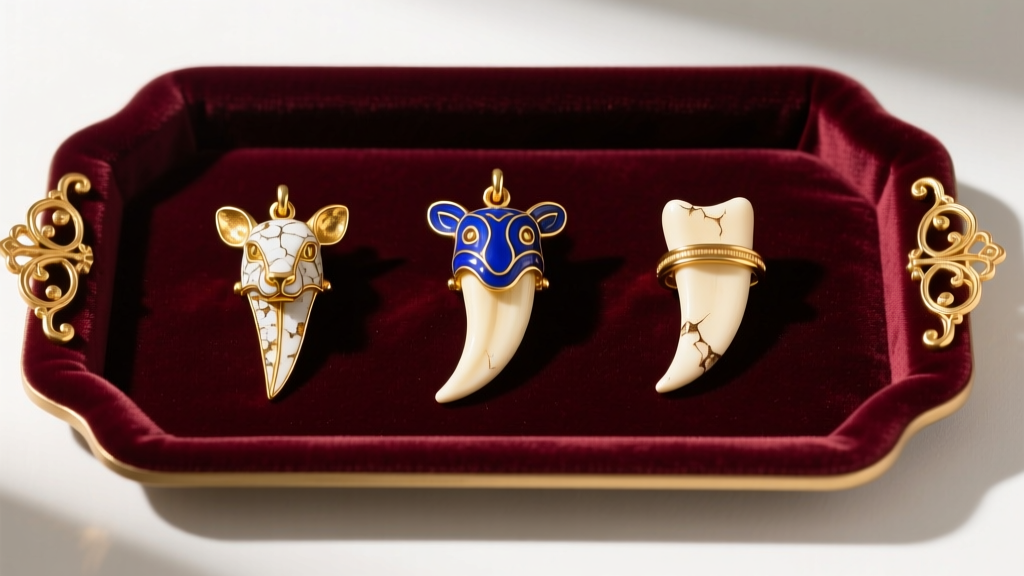
The market for Victorian tooth jewelry is highly niche, driven by collectors of hunting memorabilia, Victorian sentimental jewelry, and natural history curio cabinets. Pricing is heavily dictated by the quality of the metal mount, the species of the animal, and the condition of the enamel.
- Base Tier ($120 - $250): Simple silver-mounted wolf, boar, or deer tooth stickpins. These often feature minimal engraving and may show significant enamel wear or yellowing of the dentin.
- Mid Tier ($300 - $600): 9k gold-mounted shark teeth or smaller carnivore teeth used as watch fobs. These pieces usually feature decorative bale work and remain in excellent structural condition.
- Premium Tier ($1,200 - $2,800+): 15k or 18k gold-mounted tiger claws or large bear teeth featuring intricate repoussé metalwork, seed pearl accents, or integrated bloodstone panels. Provenance linking the piece to a specific historical hunting expedition can push valuations well beyond $3,500.
Conclusion
Authentic Victorian tooth jewelry represents a fascinating intersection of natural history and 19th-century metalworking. By understanding the biological properties of enamel and dentin, recognizing the hallmarks of period mounts, and employing conservative preservation techniques, collectors can safeguard these unique organic artifacts for future generations. Always prioritize the structural integrity of the dentin core over the shine of the gold when acquiring and maintaining these remarkable historical pieces.


