18g vs 16g Earring: The Ultimate Beginner's Sizing Guide
Confused about 18g vs 16g earring sizes? Learn the exact differences in thickness, piercing types, and how to choose the right gauge for your ears.

Decoding the Gauge System: Why Smaller Numbers Mean Thicker Metal
If you are new to buying body jewelry, the gauge system can feel entirely backward. Unlike standard measurements where a larger number means a larger size, the jewelry gauge system—rooted in the historical Birmingham Wire Gauge (BWG)—works in reverse. The higher the gauge number, the thinner the metal. For beginners building their collection, the most common point of confusion arises when comparing an 18g vs 16g earring. While a fraction of a millimeter might seem negligible to the naked eye, in the world of piercings, it dictates healing outcomes, tissue stability, and long-term comfort.
Understanding the exact physical differences between these two sizes is the first step toward curating a collection that fits your anatomy perfectly. Whether you are replacing your starter studs or upgrading to fine jewelry, knowing when to choose 18g and when to opt for 16g will save you from irritation bumps, migration, and damaged fistulas (the tube of healed tissue lining your piercing).
The Core Difference: 18g vs 16g Earring Thickness
To make an informed decision, we must look at the exact mathematical conversions. The difference between 18 gauge and 16 gauge is approximately 0.27 millimeters. While this sounds microscopic, it represents a 20% increase in metal volume and structural rigidity.
- 18 Gauge (18g): Measures exactly 1.02mm (0.040 inches). This is a delicate, relatively thin wire commonly used for standard earlobe piercings and lightweight dangle earrings.
- 16 Gauge (16g): Measures exactly 1.29mm (0.051 inches). This is a thicker, more robust post that provides superior structural integrity, making it the gold standard for cartilage and high-stress areas.
Which Gauge is Right for Your Piercing?
Choosing between an 18g vs 16g earring is rarely about personal preference; it is strictly dictated by the anatomy of the piercing site and how the tissue was originally punctured.
Standard Lobe Piercings: The 18g Sweet Spot
Most standard earlobe piercings performed with a hollow needle are initially pierced at 16g or 14g. However, once fully healed, the lobe tissue is highly elastic and forgiving. Many commercial jewelry brands and fine jewelers craft lobe-specific studs, huggies, and lightweight hoops at 18g. Because the earlobe lacks rigid cartilage, an 18g post will not cause the dreaded 'cheese-cutter effect' (where thin wire slowly slices through the tissue) unless the earring is excessively heavy or subjected to severe trauma.
Cartilage, Helix, and Tragus: Why 16g Rules
Cartilage is an entirely different biological environment. It is avascular (lacking direct blood supply) and highly prone to irritation bumps and migration. Professional piercers almost universally recommend 16g (or 14g) for initial cartilage piercings. According to the Association of Professional Piercers (APP), thicker jewelry provides a wider surface area that distributes pressure evenly across the healing fistula. If you attempt to wear an 18g earring in a fresh or healing cartilage piercing, the thin metal can act like a blade against the swelling tissue, leading to rejection or severe hypertrophic scarring.
Expert Insight: Never force a thicker earring into a hole pierced at a thinner gauge without professional tapering. Forcing a 16g earring into an 18g fistula will cause micro-tears, immediate swelling, and potential blowout.
18g vs 16g Earring Comparison Chart
| Feature | 18 Gauge (18g) | 16 Gauge (16g) |
|---|---|---|
| Thickness (mm) | 1.02 mm | 1.29 mm |
| Thickness (inches) | 0.040 inches | 0.051 inches |
| Primary Use Case | Healed lobes, delicate nose studs | Cartilage, helix, tragus, conch |
| Structural Rigidity | Low (prone to bending) | High (resists bending) |
| Cheese-Cutter Risk | Moderate (if heavy) | Very Low |
| Common Jewelry Types | Wire hoops, delicate dangles, push-pins | Flat-back labrets, clickers, captive beads |
Real-World Scenarios: Stretching, Downsizing, and Healing
Understanding how your tissue reacts to gauge changes is critical for long-term ear health. Here is how the 18g vs 16g dynamic plays out in real-world scenarios:
Scenario 1: Downsizing from 16g to 18g
If your cartilage was pierced at 16g but you want to wear a specific 18g designer earring, you can technically 'downsize' the hole. Because cartilage is somewhat rigid, wearing 18g jewelry for a few weeks will cause the fistula to shrink around the thinner post. However, this is generally discouraged by professionals. A thinner post in cartilage leaves the tissue vulnerable to migration if you sleep on it, as the 1.02mm metal does not provide enough leverage to keep the piercing channel perfectly straight.
Scenario 2: The Heavy Hoop Dilemma
If you love oversized, heavy gold hoops for your earlobes, you must opt for 16g. An 18g wire supporting a heavy cast-gold hoop will eventually warp under the weight, pulling the earlobe downward and stretching the piercing hole into an oval shape over time. The 16g wire provides the necessary tensile strength to support heavier aesthetics without distorting your anatomy.
Material Matters: Gauge Stability and Tissue Health
The structural integrity of your earring is not just about thickness; it is about the intersection of gauge and material. This is where many beginners make costly mistakes.
When shopping for an 18g earring, material choice is paramount. Soft metals like high-karat gold (18k or 24k) or pure silver are incredibly malleable. At 18g thickness, an 18k gold post can easily bend if you sleep on it, which will subsequently warp your piercing channel and cause chronic irritation. If you must wear 18g, opt for harder alloys or platinum.
Conversely, 16g jewelry is thick enough to maintain its shape even in softer metals, though implant-grade titanium remains the undisputed champion for tissue health. According to the APP Jewelry Materials Guide, ASTM F136 implant-grade titanium is highly biocompatible, nickel-free, and possesses the exact rigidity required to keep a 16g cartilage piercing perfectly stable during the 6-to-12-month healing window.
How to Accurately Measure Your Current Earring Gauge
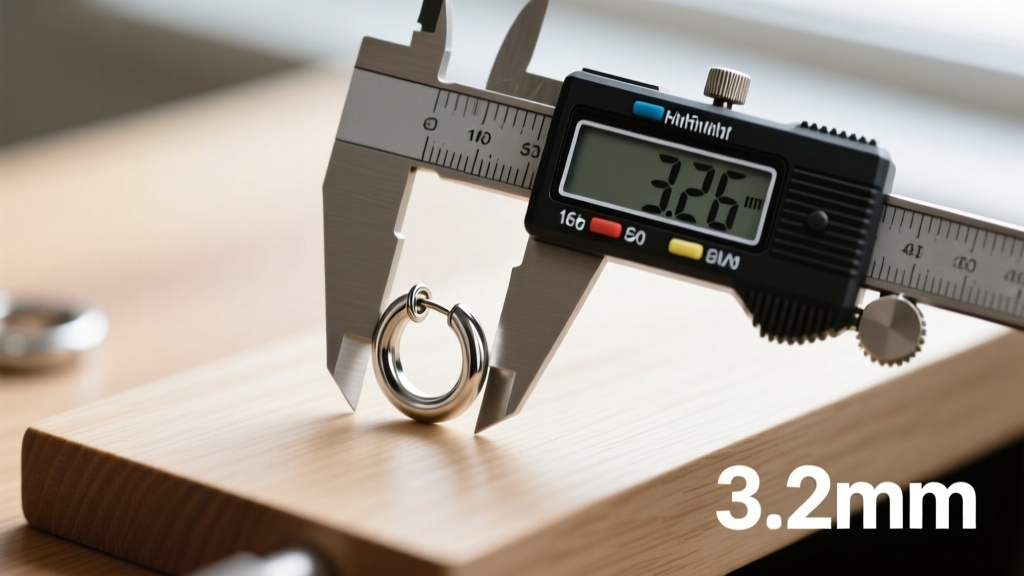
Guessing your gauge by comparing it to a sewing needle or a paperclip is a recipe for buying jewelry that does not fit. To definitively solve the 18g vs 16g earring mystery in your own collection, you need the right tools.
- Invest in Digital Calipers: A cheap pair of digital calipers from a hardware store will measure to the hundredth of a millimeter.
- Measure the Post, Not the Decor: Close the caliper jaws gently around the metal post (the part that goes through your ear), avoiding any gemstones or decorative ends.
- Read the Data: If the screen reads between 0.95mm and 1.05mm, you are holding an 18g earring. If it reads between 1.20mm and 1.35mm, it is 16g.
By mastering these precise measurements, you transition from a casual jewelry buyer to an informed collector, ensuring every piece you purchase perfectly respects your unique anatomy.


