Captive Ball Earrings: Material Guide for Cartilage & Lobes
Compare implant-grade titanium, niobium, and gold for captive ball earrings. Learn which metal suits your cartilage or lobe piercing best.

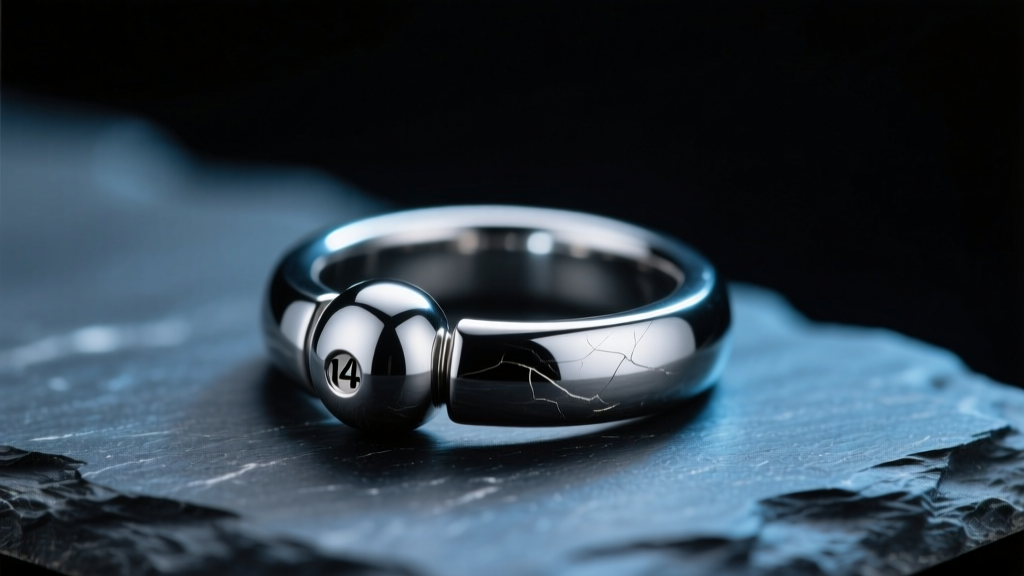
The Anatomy and Mechanics of Captive Ball Earrings
Captive ball earrings, universally known in the professional piercing community as Captive Bead Rings (CBRs), are a staple in both lobe and cartilage piercings. Unlike segment rings or clickers that rely on hidden hinges or interlocking segments, a CBR operates on pure mechanical tension. The ring features a small gap, and the captive bead (or ball) has two shallow dimples on opposite sides. The tensile strength of the metal ring is what snaps the bead into place and holds it securely against the pressure of daily movement.
Because the security of the earring relies entirely on the metal's physical properties, choosing the right material is not just a matter of aesthetics or skin sensitivity—it is a structural necessity. A metal that is too soft will warp, losing tension and dropping the bead. A metal that is too brittle may snap under pressure. When selecting captive ball earrings for complex cartilage placements like the daith, rook, or conch, understanding metallurgical properties is critical for long-term wearability and healing success.
Material Showdown: Titanium vs. Niobium vs. Gold vs. Steel
Not all metals are created equal, especially when subjected to the saline, high-friction environment of a healing or healed fistula. Below is a comprehensive breakdown of the most common materials used for CBRs, evaluated on their ASTM standards, tensile strength, and biocompatibility.
| Material | Standard | Tensile Strength | Nickel Content | Avg. Price (14G 3/8") |
|---|---|---|---|---|
| Implant-Grade Titanium | ASTM F136 | Very High | 0% | $15 - $30 |
| Niobium | Elemental (No ASTM) | Low/Medium | 0% | $12 - $22 |
| 14k/18k Solid Gold | APP Compliant Alloy | Medium/High | 0% (Palladium alloy) | $85 - $250+ |
| Surgical Steel | ASTM F138 | High | 8% - 12% | $4 - $10 |
Deep Dive: Implant-Grade Titanium (ASTM F136)
For fresh cartilage piercings and hypersensitive lobes, Implant-Grade Titanium (specifically Ti6Al4V ELI) is the undisputed gold standard. According to the Association of Professional Piercers (APP), this specific alloy is completely nickel-free and highly biocompatible. But beyond its hypoallergenic properties, titanium's mechanical advantages make it the superior choice for captive ball earrings.
Titanium boasts an exceptional strength-to-weight ratio and high fatigue resistance. When a 14-gauge (1.6mm) or 16-gauge (1.2mm) titanium CBR is stretched open to insert the bead, it exhibits high "spring-back" memory. This means it aggressively attempts to return to its original circular shape, creating immense inward pressure that locks the captive bead firmly in place. This high tensile strength makes titanium CBRs highly secure for active individuals or for piercings prone to snagging, such as the tragus or helix.
The Niobium Alternative for Hypersensitive Skin
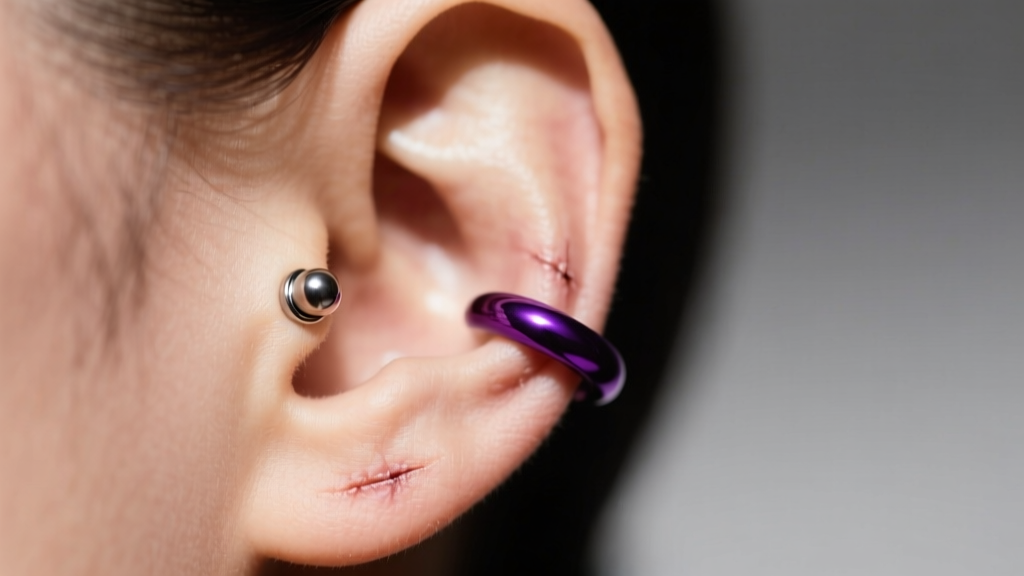
Niobium is an elemental metal, meaning it is not an alloy and cannot contain hidden nickel impurities. It is highly favored by piercers for clients with severe metal allergies who cannot even tolerate the trace elements sometimes found in lower-grade titanium. Furthermore, niobium is highly reactive to anodization, allowing it to be safely colored in vibrant hues—like deep purples, blues, and golds—without the use of toxic plating or enamel.
However, niobium's primary drawback in the context of captive ball earrings is its malleability. It is significantly softer than titanium. While this makes it incredibly easy to open and close with standard ring-opening pliers, it also means the metal is prone to warping. If a niobium CBR is repeatedly opened and closed, or if it catches on clothing, the ring can permanently deform into an oval shape. Once the circular geometry is compromised, the tension drops, and the captive bead will inevitably fall out.
Solid Gold CBRs: Karat and Alloy Considerations
Gold captive ball earrings offer unmatched luxury and a rich aesthetic, but they require strict scrutiny regarding their alloy composition. Pure 24-karat gold is far too soft for body jewelry; it would bend under the slightest pressure and fail to hold a captive bead. Therefore, gold must be alloyed with other metals to increase its hardness.
For body jewelry, 14k and 18k solid gold are the acceptable standards. The critical factor is what the gold is alloyed with. Many commercial white gold alloys use nickel to achieve a silver color, which can trigger severe contact dermatitis in a piercing fistula. Reputable body jewelry brands like BVLA or Maria Tash use palladium-based alloys to create nickel-free white gold. Yellow and rose gold alloys typically utilize copper and silver, which are generally well-tolerated. When purchasing a gold CBR, always verify with the manufacturer that the alloy is specifically formulated for implant-grade body jewelry and is completely nickel-free.
Why "Surgical Steel" Fails in Captive Bead Rings
The term "Surgical Steel" is largely a marketing misnomer. Most steel body jewelry is made from 316L or 316LVM stainless steel, which falls under the ASTM F138 standard. While perfectly safe for surgical instruments that are used once and sterilized, ASTM F138 steel contains between 8% and 12% nickel. The ASTM International guidelines distinguish heavily between the biocompatibility of F138 steel and F136 titanium for long-term internal wear.
In a captive bead ring, the steel bead constantly rubs against the interior dimples of the steel ring. This micro-friction can compromise the metal's passive chromium oxide layer, leading to microscopic nickel leaching directly into the piercing channel. For healed, robust lobe piercings, steel CBRs are often tolerated. However, for cartilage piercings—which have poor blood circulation and are highly prone to irritation bumps and hypertrophic scarring—steel CBRs are a significant liability and should be avoided.
Sizing, Gauge, and Tension: Matching Material to Anatomy
The security of a captive ball earring is dictated by the intersection of material thickness (gauge) and inner diameter. The smaller the diameter of the ring, the tighter the curve, and the more difficult it is to generate the lateral tension required to hold the bead.
- 16-Gauge (1.2mm): The standard for most ear cartilage piercings (helix, forward helix, tragus). In titanium, a 16G ring at a 5/16" (8mm) diameter provides excellent tension. In niobium, this same size may feel slightly loose and require careful handling.
- 14-Gauge (1.6mm): The preferred gauge for daith, rook, and conch piercings. The thicker wire provides massive structural integrity. A 14G titanium CBR requires specialized heavy-duty ring opening pliers to separate the gap wide enough to seat the bead.
- 12-Gauge (2.0mm) and 10-Gauge (2.4mm): Reserved for stretched lobes or specific industrial-grade cartilage piercings. At these thicknesses, the tensile strength of the metal is so high that losing the bead is nearly impossible without tools, but inserting it manually is equally impossible.
Expert Maintenance and Troubleshooting
The most common complaint regarding captive ball earrings is the frustration of losing the bead or struggling to reinsert it. This is rarely a flaw in the jewelry itself, but rather a failure in technique and tooling.
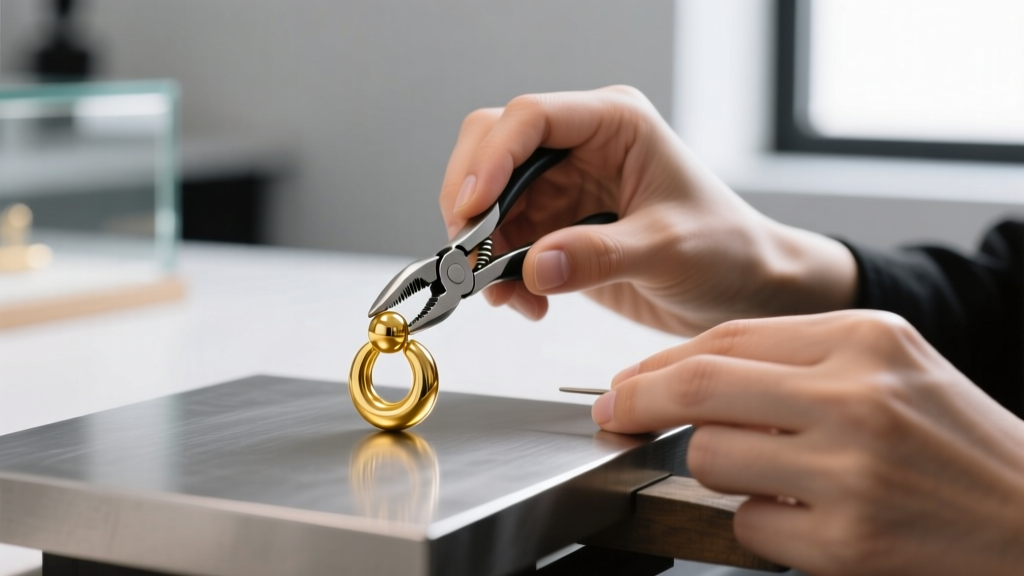
Pro-Tip: Never use your bare fingers or standard household pliers to open a CBR. Bare fingers cannot generate even torque, leading to a twisted, warped ring. Household pliers have serrated teeth that will permanently mar and scratch the metal, creating microscopic harbors for bacteria.
To properly maintain the tension of your captive ball earrings, invest in two specialized tools: ring opening pliers (which expand the ring outward evenly) and ball grabber pliers (which feature a concave tip designed to hold the spherical bead securely). When opening the ring, only expand it just wide enough to clear the bead. Over-expanding the metal, particularly in softer alloys like niobium or gold, will permanently stretch the crystalline structure of the metal, resulting in a permanent loss of tension. If your titanium CBR feels too tight to open, do not force it; take it to a professional piercer who possesses the heavy-duty mechanical leverage tools required to service thick-gauge titanium safely.
Final Verdict on Material Selection
When choosing captive ball earrings, prioritize the mechanical demands of your specific piercing. For fresh cartilage, high-tension security, and absolute biocompatibility, Implant-Grade Titanium (ASTM F136) remains the ultimate choice. For those seeking vibrant, anodized colors without the risk of nickel exposure, Niobium is a fantastic secondary option, provided you treat the softer metal with care to avoid warping. By matching the metallurgical properties of the metal to the anatomical realities of your piercing, you ensure a secure, comfortable, and long-lasting wear.


