Planet Earrings: Engineering Orbital Designs & Gemstone Spheres
Explore the structural engineering, material grades, and gauge specifications behind high-end planet earrings and orbital sphere designs.

The Anatomy of Orbital Planet Earrings
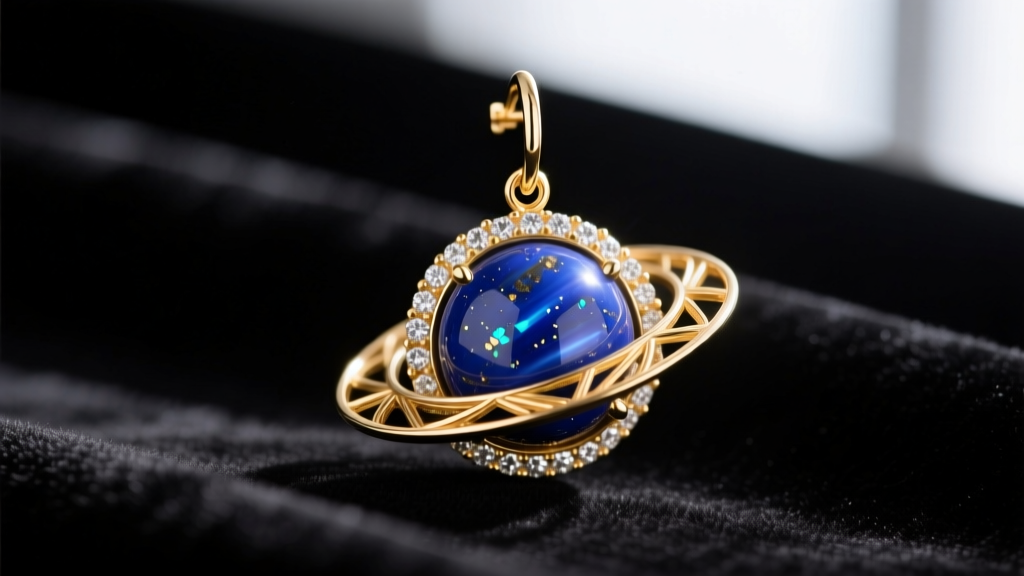
Planet earrings represent a unique intersection of lapidary art and micro-engineering. Unlike standard studs or hoops, a true orbital planet earring features a central spherical gemstone (the planet) suspended within or bisected by a metallic halo (the orbital ring). This kinetic or multi-axis design introduces complex structural challenges regarding weight distribution, tensile strength, and gemstone security.
At a fundamental level, the anatomy of a high-quality planet earring consists of four distinct components:
- The Post or Labret Base: The anchoring mechanism, typically ranging from 18-gauge (1.0mm) for standard lobes to 16-gauge (1.2mm) for cartilage placements.
- The Central Bezel or Cradle: The micro-setting that secures the spherical gemstone. In premium designs, this is a tension-set or half-bezel cradle to maximize light return.
- The Orbital Halo: The outer ring, often paved with micro-diamonds or crafted from brushed metal, which must maintain perfect circularity without warping under the stress of daily wear.
- The Solder Joints or Laser Welds: The critical connection points where the orbital halo meets the central cradle or the earring post.
Material Science: Alloys and Gemstone Spheres
The longevity of planet earrings is dictated by the Vickers hardness (HV) of the chosen metals and the Mohs hardness of the central sphere. Because the orbital ring acts as a lever arm, any torque applied to the earring is magnified at the connection joints.
Metallurgical Specifications
Standard 18k yellow gold possesses a Vickers hardness of approximately 115-125 HV. While beautiful, it is relatively soft and prone to bending if the orbital ring is crafted below 1.2mm in thickness. Consequently, expert fabricators prefer 14k gold (130-150 HV) or Grade 5 Titanium (Ti-6Al-4V, ~350 HV) for the orbital bands. Grade 5 titanium is exceptionally rigid, allowing for ultra-thin, lightweight orbital rings that resist deformation, making it the superior choice for large-diameter planet earrings intended for cartilage piercings.
Gemstone Spheres: Porosity and Thermal Shock
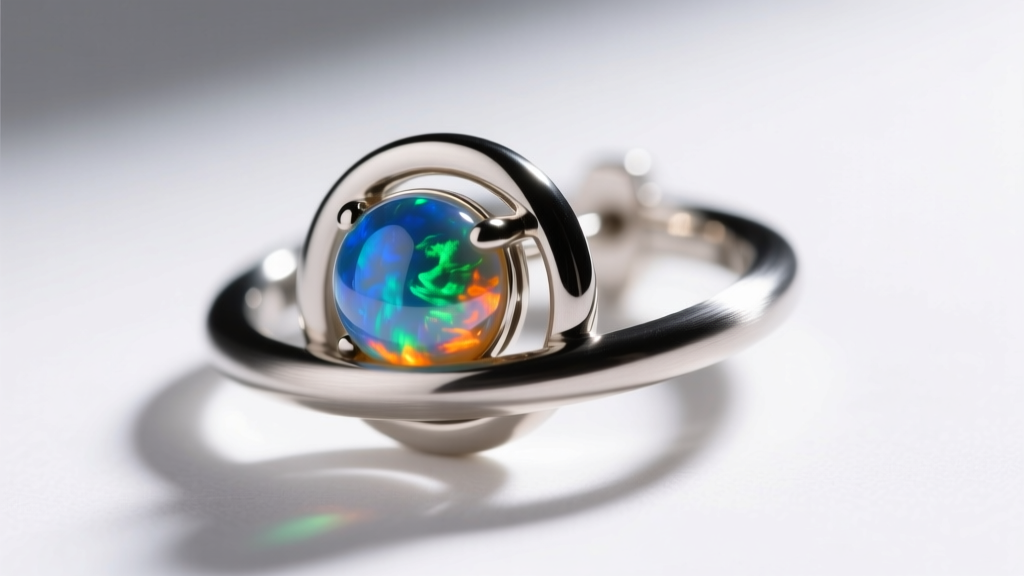
The central sphere is most commonly cut from Lapis Lazuli, Malachite, or Opal. However, shaping a gemstone into a perfect sphere requires aggressive lapidary grinding, which can introduce micro-fractures. According to the Gemological Institute of America (GIA), porous stones like Lapis (Mohs 5-6) and Malachite (Mohs 3.5-4) are highly susceptible to chemical degradation and thermal shock. If a jeweler uses traditional torch soldering to attach the orbital ring after the stone is set, the heat transfer will fracture the sphere. High-end manufacturers circumvent this by utilizing laser pulse welding, which localizes heat to a microscopic focal point, allowing the orbital ring to be assembled safely around heat-sensitive gemstone spheres.
Structural Failure Modes and Prevention
When analyzing repair logs for celestial-themed jewelry, three primary failure modes emerge in poorly engineered planet earrings:
The Lever-Arm Effect: A 12mm gemstone sphere on an 18g post creates a high center of gravity. When the earring snags on clothing, the orbital ring acts as a lever, applying sheer force to the post joint. This frequently results in the post snapping off at the base plate.
Metal Fatigue at the Halo Joint: If the orbital ring is cast as a single piece with a microscopic gap that is later filled with standard lead-free solder, the joint becomes a brittle failure point. Repeated micro-movements cause metal fatigue, leading to the halo snapping in half. Laser welding with matching alloy filler wire creates a joint that is as strong as the parent metal.
Bezel Lift and Sphere Ejection: Spherical gemstones lack the flat girdles of faceted stones, making them notoriously difficult to secure. If the bezel wall is pushed over the stone's equator without adequate internal bearing support, the stone will eventually pop out. Expert setters use an internal 'step' or bearing cut inside the bezel wall to lock the sphere's lower hemisphere securely in place.
Technical Specifications & Buyer's Matrix
When evaluating planet earrings for retail or custom commission, use the following matrix to assess the structural viability of the design based on its material composition and intended placement.
| Material Profile | Hardness (HV) | Specific Gravity | Minimum Gauge | Best Placement | Estimated Price Range |
|---|---|---|---|---|---|
| 18k Yellow Gold + Lapis | 125 HV | 15.6 (Heavy) | 16g (1.2mm) | Standard Lobe | $450 - $800 |
| 14k White Gold + Diamond Pave | 140 HV | 14.2 (Medium) | 18g (1.0mm) | Lobe or Flat | $900 - $2,500 |
| Grade 5 Titanium + Synthetic Opal | 350 HV | 4.4 (Ultra-Light) | 16g (1.2mm) | Helix / Cartilage | $120 - $250 |
| Platinum 950 + Black Onyx | 135 HV | 21.4 (Very Heavy) | 14g (1.6mm) | Standard Lobe (Heavy Duty) | $1,500 - $3,200 |
Ergonomics and Cartilage vs. Lobe Placement
Weight distribution is the most overlooked aspect of planet earring design. A standard 10mm lapis lazuli sphere weighs approximately 1.4 grams. When encased in a 14k gold orbital ring, the total head weight can easily exceed 3.5 grams. On a standard butterfly-back earring, this front-heavy mass causes 'earring droop,' where the jewelry tilts downward, stretching the piercing fistula over time.
To counteract this, ergonomic modifications are required:
- For Lobe Placements: Utilize La Pousette (locking) clutch backs or oversized silicone friction discs (minimum 8mm diameter) to distribute the weight across a wider surface area of the earlobe.
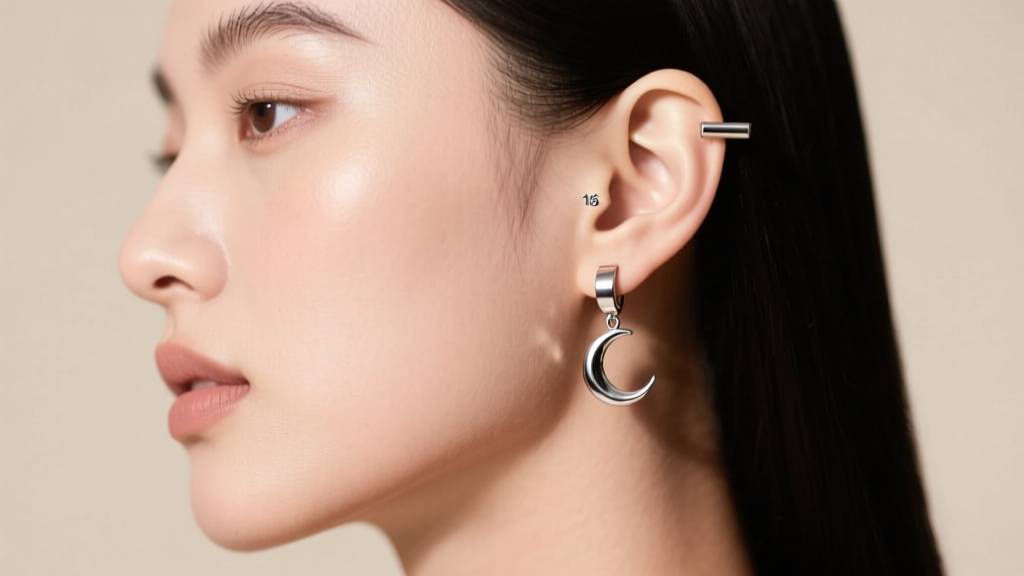
- For Cartilage (Helix) Placements: Planet earrings adapted for the helix must abandon traditional posts entirely. Instead, they should be engineered on a 16-gauge flat-back labret post (typically 6mm or 8mm in length). The flat base plate rests flush against the back of the ear cartilage, providing a stable, non-rotating foundation that prevents the orbital ring from catching on hair or clothing.
Care and Maintenance of Suspended Spheres
The maintenance of planet earrings requires strict adherence to material-specific protocols. The intersection of the orbital ring and the central sphere creates micro-crevices where sebum, cosmetics, and environmental dust accumulate.
While ultrasonic cleaners are highly effective for removing debris from diamond-paved orbital bands, they are catastrophic for porous planetary spheres. The high-frequency cavitation bubbles can penetrate the micro-fissures of Malachite or Lapis Lazuli, causing the stone to crack or dissolve from the inside out. Furthermore, the vibration can loosen the internal bearing of the bezel setting. For mixed-material planet earrings, manual cleaning using a soft-bristled brush, warm distilled water, and a pH-neutral surfactant is the only safe methodology to preserve both the structural integrity of the metal halo and the polish of the gemstone sphere.


