Diamond Cut Gold Earrings: 2026 Trend Analysis & Styling Guide
Discover the 2026 trends for diamond cut gold earrings. Expert analysis on facets, karat weights, styling frameworks, and top hoop and huggie designs.

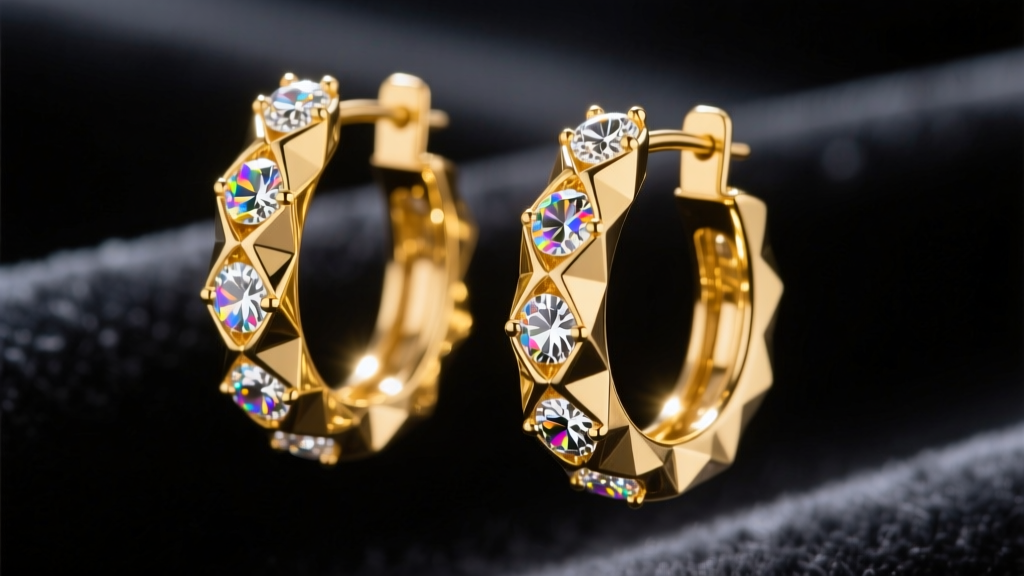
The Geometry of Light: What Defines Diamond Cut Gold?
When navigating the saturated landscape of fine jewelry, few finishing techniques command attention quite like the diamond cut. Contrary to what the uninitiated might assume, diamond cut gold earrings do not necessarily feature actual diamonds. Instead, this refers to a precision metalworking technique where microscopic facets are carved directly into the gold surface. Using multi-axis CNC (Computer Numerical Control) lathes or traditional hand-chasing tools, jewelers slice into the metal at precise 45- to 60-degree angles. This creates a mirrored, geometric surface that refracts light with a brilliance that rivals actual gemstones.
In 2026, the jewelry industry is pivoting away from the high-polish, mirror-finish dominance of the early 2020s. The new era is defined by what industry analysts call 'architectural luminescence.' According to the Gemological Institute of America (GIA), the alloy composition of gold fundamentally dictates how well it can hold a mechanical cut. Pure gold is too soft, meaning the art of the diamond cut relies entirely on the masterful blending of alloys to achieve both structural integrity and blinding light return.
2026 Trend Forecast: Asymmetric Faceting and Mixed Textures
The most significant shift in the 2026 earring market is the departure from uniform, fully-faceted designs. Today's top designers are embracing asymmetric faceting, where only specific zones of a hoop or huggie are diamond-cut, leaving the rest with a matte, sandblasted, or hammered finish. This contrast amplifies the sparkle of the faceted sections by providing a dark, non-reflective visual anchor.
'Consumers in 2026 are gravitating toward tactile, multi-sensory jewelry. A diamond-cut huggie with a brushed interior and a highly faceted exterior offers a dynamic visual experience that changes as the wearer moves.' — Senior Market Analyst, JCK Magazine.
Another major trend is the 'liquid metal' illusion. By utilizing ultra-fine micro-facets on elongated drop earrings, manufacturers are creating pieces that look like dripping, solidified light. This technique is particularly prominent in 14k white gold, which is often rhodium-plated after cutting to enhance the icy, diamond-like reflection.
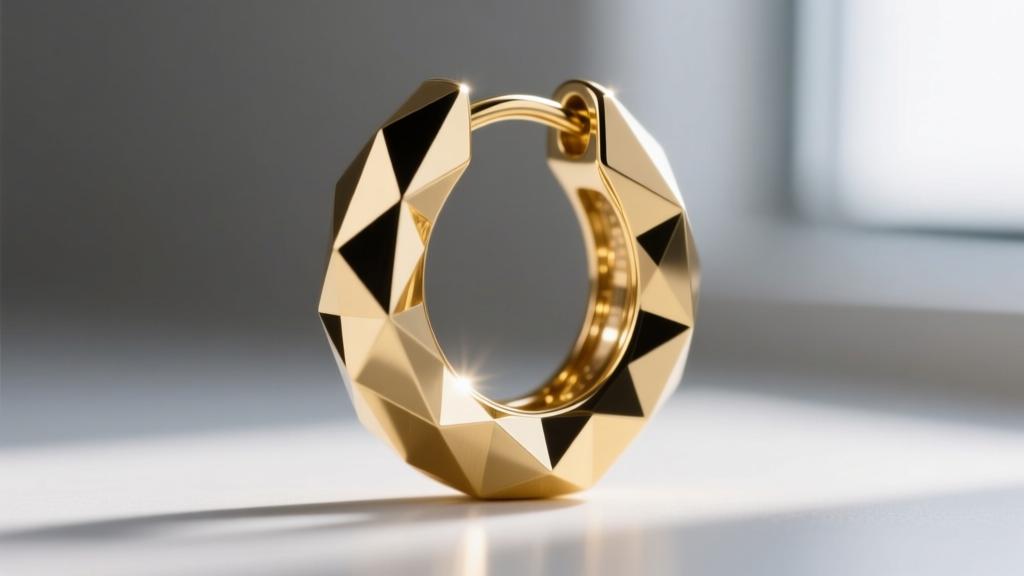
Karat Weight & Durability: A Technical Breakdown
The longevity of a diamond cut is directly tied to the Vickers hardness of the gold alloy. Softer metals will experience 'facet rounding' over time, where the sharp edges of the cuts wear down, diminishing the light reflection. Here is how the three primary karat weights perform in diamond-cut applications:
| Karat Weight | Gold Purity | Facet Durability | Color Profile | Average Price Range (Hoops) |
|---|---|---|---|---|
| 14k Gold | 58.5% | Excellent (Holds sharp edges for decades) | Pale yellow, highly versatile | $250 - $600 |
| 18k Gold | 75.0% | Very Good (Slight softening after 10+ years) | Rich, warm yellow | $650 - $1,400 |
| 22k Gold | 91.6% | Poor (Facets dull quickly; requires careful wear) | Deep, saturated orange-yellow | $1,200 - $2,500+ |
For everyday wearers, 14k gold remains the undisputed champion of diamond-cut longevity. However, for heirloom pieces or occasional wear, the luxurious hue of 18k gold provides a superior canvas for the light to bounce off. The World Gold Council notes that 18k gold continues to dominate the premium sector due to its optimal balance of purity and workability.
Styling Frameworks by Face Shape & Ear Anatomy
Selecting the right diamond cut gold earrings requires an understanding of facial geometry and ear anatomy. The high-reflection nature of faceted gold draws the eye immediately, making placement critical.
Face Shape Pairings
- Round Faces: Opt for elongated diamond-cut drop earrings or linear front-back studs. The vertical lines and concentrated light reflection create an illusion of length, balancing the width of the face.
- Square Faces: Choose diamond-cut continuous hoops or circular huggies. The curved geometry of the facets softens strong jawlines and adds a touch of fluidity to angular features.
- Heart-Shaped Faces: Teardrop or chandelier styles with diamond-cut detailing at the bottom half draw the eye downward, adding visual weight to a narrower chin.
Cartilage vs. Lobe Applications
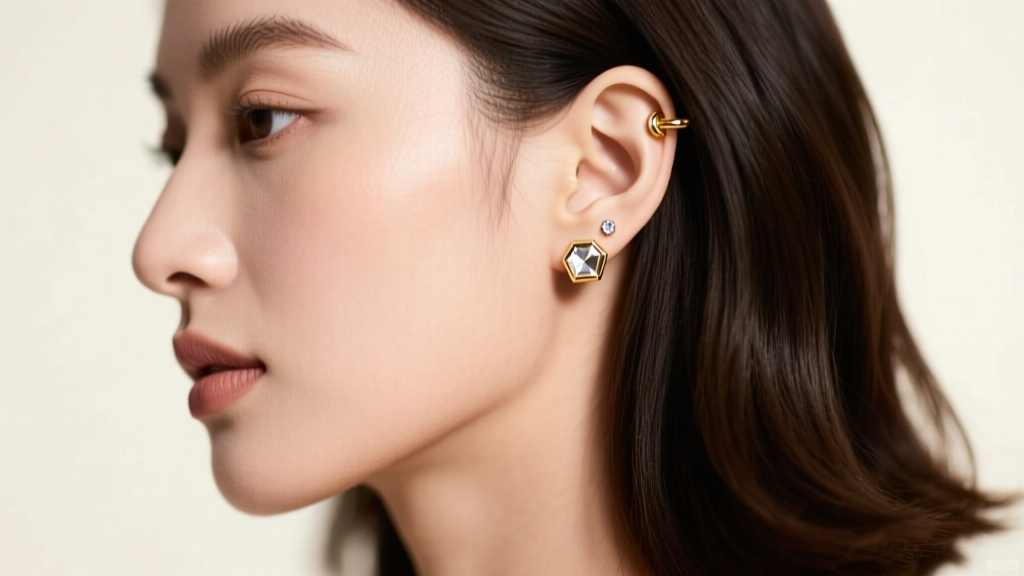
The diamond cut technique has revolutionized cartilage jewelry. In 2026, 16-gauge and 14-gauge threadless ends featuring diamond-cut bezels are highly sought after for helix and conch piercings. Because cartilage piercings are more prone to irritation, the smooth, CNC-polished surfaces of high-quality diamond-cut ends reduce friction compared to traditional prong-set gemstones. For standard lobe piercings (typically 20g or 18g), diamond-cut screw-back studs offer a secure, high-impact option that won't snag on hair or clothing.
Price Index & Investment Value in 2026
With global gold spot prices experiencing significant fluctuations over the past few years, the pricing of diamond cut gold earrings has shifted. You are no longer just paying for the raw material weight; you are paying for the machining time. Multi-axis CNC cutting requires expensive equipment and skilled programming.
Expect to pay a 30% to 50% manufacturing premium on diamond-cut pieces compared to their smooth, high-polish counterparts of the exact same weight. A standard 5-gram pair of 14k gold smooth hoops might retail for $350, while a 5-gram pair with intricate, multi-layered diamond cuts will easily command $550 to $650. However, this premium is justified by the visual impact: a well-cut pair of gold earrings often outshines diamond-accented pieces that cost three times as much.
Care & Maintenance: Preserving the Facets
The very grooves that give diamond cut gold earrings their brilliance are also their greatest vulnerability when it comes to maintenance. Lotions, oils, and cosmetic powders can easily become trapped in the microscopic valleys of the facets, creating a dull, cloudy film that blocks light refraction.
The Expert Cleaning Protocol:
- Avoid ultrasonic cleaners for heavily textured or mixed-metal diamond cut pieces, as the intense vibrations can sometimes loosen secondary components or trap moisture in deep cuts.
- Create a solution of warm distilled water and a few drops of mild, phosphate-free dish soap.
- Use an extra-soft baby toothbrush to gently sweep along the grain of the facets. Never scrub in aggressive circles, as this can introduce micro-scratches to the polished edges.
- Rinse thoroughly with distilled water and dry immediately with a lint-free microfiber cloth to prevent water spots.
By understanding the geometry, material science, and styling nuances of diamond cut gold earrings, you can make informed investments that will continue to catch the light—and the eye—for decades to come.


