20mm Gold Hoop Earrings: 2026 Trend & Style Guide
Discover why 20mm gold hoop earrings are dominating 2026 trends. Explore styling guides, metal grades, gauge thicknesses, and face-shape pairings.

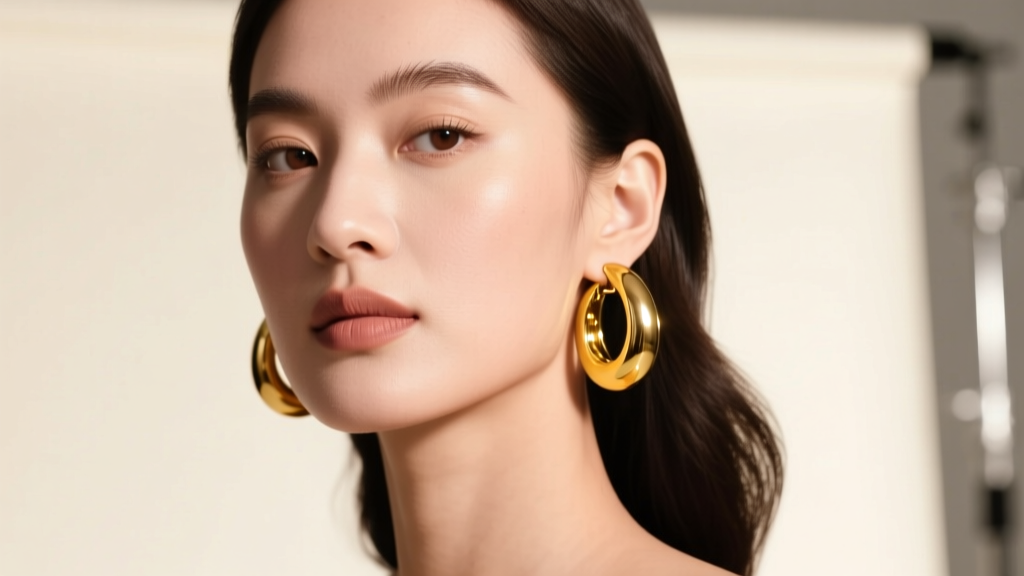
The 2026 Shift: Why 20mm is the New Standard
In the ever-evolving landscape of fine jewelry, the pendulum of proportion swings with deliberate precision. From 2020 through 2023, the market was saturated with micro-huggies (10mm-12mm) that hugged the lobe tightly, catering to the pandemic-era desire for subtle, webcam-friendly accessories. Conversely, the 35mm+ statement hoops of the late 2010s felt increasingly cumbersome for the hybrid-work lifestyles of the mid-2020s. Enter 2026, where 20mm gold hoop earrings have firmly established themselves as the 'Goldilocks zone' of ear styling.
Measuring approximately 0.78 inches in diameter, a 20mm hoop drops just below the earlobe, offering enough physical presence to frame the face without overwhelming it. This specific diameter bridges the gap between delicate minimalism and bold expression. According to trend forecasters, the 2026 aesthetic of 'proportional minimalism' demands jewelry that is understated in design but substantial in physical footprint. The 20mm hoop achieves this by providing a continuous, unbroken line of precious metal that catches the light dynamically as the wearer moves, making it a staple for both boardroom presentations and evening engagements.
Material & Karat Analysis: What to Buy in 2026
When investing in 20mm gold hoops, understanding the metallurgy is critical for both longevity and aesthetic warmth. The Gemological Institute of America (GIA) outlines strict standards for gold purity, which directly impacts how your hoops will wear over time.
- 14k Solid Gold (58.5% Pure Gold): The undisputed workhorse of everyday hoops. With a Vickers hardness rating of approximately 160 HV, 14k gold offers superior tensile strength. If you are buying a 20mm hoop with a thinner wire gauge (1mm - 1.5mm), 14k is highly recommended to prevent the hoop from warping when slept in. The alloy mix (often silver, copper, and zinc) gives it a slightly paler, highly durable finish. Pricing for solid 14k 20mm hoops typically ranges from $150 to $300.
- 18k Solid Gold (75% Pure Gold): Prized for its rich, buttery yellow hue due to the higher pure gold content. However, 18k gold is softer (around 125 HV). For a 20mm hoop, this means it is more susceptible to scratching and bending if subjected to lateral pressure. 18k is best reserved for thicker, tubular hoop designs or for wearers who meticulously remove their jewelry before sleeping. Expect to pay between $350 and $650+ for quality 18k pairs.
- Gold Vermeil (Sterling Silver Base): A 2026 favorite for trend-conscious buyers who want the 18k aesthetic without the solid gold price tag. True vermeil requires a sterling silver base plated with at least 2.5 microns of gold. While visually identical to solid gold on day one, the friction of the clasp and exposure to skin oils will eventually wear through the plating on the inner curve of the hoop. Priced between $45 and $120, they are excellent for seasonal styling but lack generational durability.
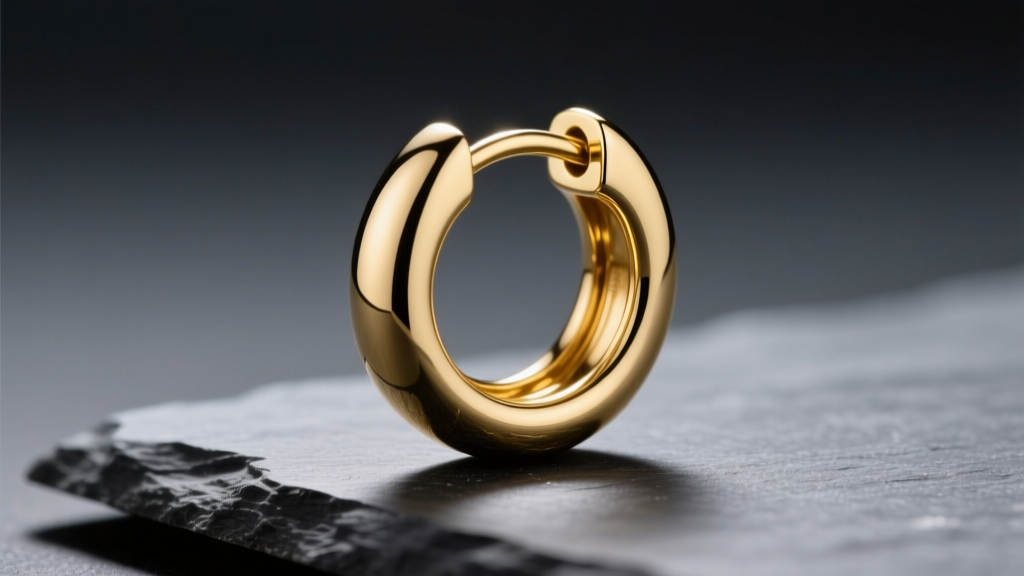
Gauge Thickness & Proportion Matrix
The diameter (20mm) is only half the equation; the gauge (thickness of the wire or tube) dictates the earring's weight, light reflection, and overall vibe. A 20mm hoop can look drastically different depending on its cross-section. Below is a structural matrix to help you select the right proportion for your piercing and style profile.
| Gauge/Thickness | Diameter | Weight per Pair | Best For | Price Range (14k Solid) |
|---|---|---|---|---|
| 1.0mm (Wire) | 20mm | ~1.2g | Minimalist, secondary piercings, cartilage | $120 - $180 |
| 1.5mm (Wire) | 20mm | ~2.1g | Everyday wear, primary lobe, office attire | $180 - $260 |
| 2.0mm (Wire) | 20mm | ~3.4g | Vintage aesthetic, bold lobe presence | $280 - $400 |
| 3.0mm (Tube) | 20mm | ~4.8g | Statement, 90s revival, evening wear | $450 - $700 |
Expert Note: Standard primary lobe piercings are usually done at 20g (0.81mm) or 18g (1.02mm). A 1.5mm wire hoop will require an 18g or 16g piercing hole. If your piercings are tightly healed at 20g, opt for the 1.0mm thickness to avoid micro-tearing the fistula during insertion.
Face Shape & Placement Dynamics
Because a 20mm hoop forms a perfect circle that terminates just below the jawline's hinge, it interacts uniquely with different facial geometries. Understanding these dynamics allows you to leverage the earring as a contouring tool.
- Round Faces: A 20mm hoop adds a circular echo to a round face. To counteract this, stylists recommend pairing 20mm hoops with a 1.5mm or 2.0mm wire thickness to introduce a sharper, more defined line of light, and wearing hair pulled back to elongate the neck.
- Square Faces: The soft, continuous curve of a 20mm gold hoop is incredibly flattering on square jawlines, as it visually softens sharp angles. A polished, high-shine finish will draw the eye downward, balancing the lower third of the face.
- Heart Faces: Characterized by a wider forehead and narrow chin, heart-shaped faces benefit immensely from the volume a 20mm hoop adds precisely at the jawline, creating an illusion of width and balance at the bottom of the face.
- Oval Faces: The universal donor of face shapes. Oval faces can carry any gauge of 20mm hoop, from the barely-there 1.0mm wire to the chunky 3.0mm tubular design, without disrupting natural facial harmony.
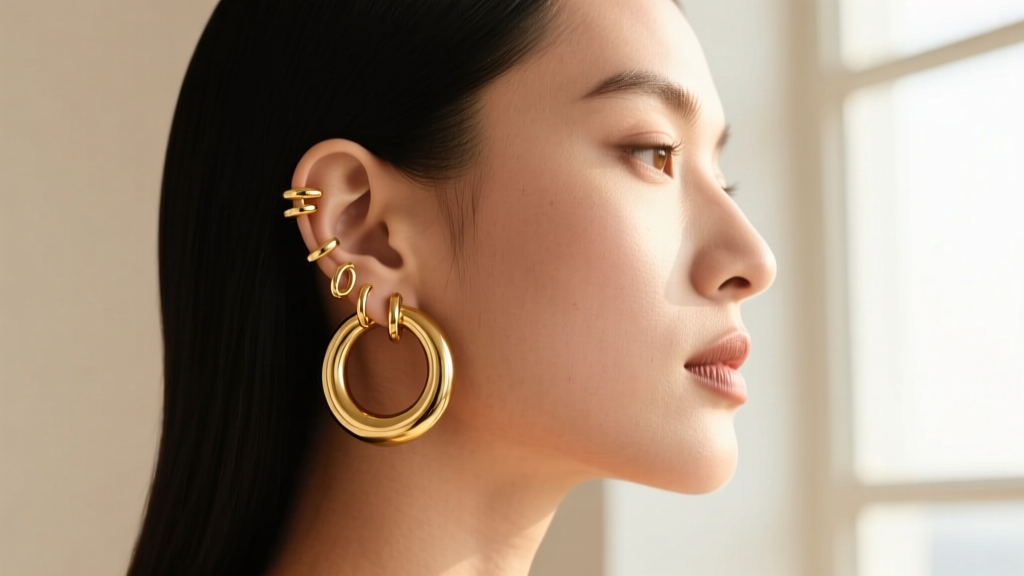
Alternative Placements: While primarily a lobe earring, the 20mm hoop has become a staple for lower helix and rook piercings in 2026. For cartilage placements, ensure the hoop features a flat-back clicker mechanism rather than a traditional wire latch, as the 20mm diameter provides the exact clearance needed to hug the outer rim of the ear without pressing uncomfortably against the anti-helix.
Clasp Mechanisms: Durability & Failure Modes
A hoop is only as good as its closure. The Jewelers of America frequently cites clasp failure as the primary reason consumers lose fine jewelry. When shopping for 20mm gold hoops, scrutinize the hinge and locking mechanism.
The Latch-Back (V-Clasp)
The traditional post-and-catch mechanism. While classic, the V-wire catch is notorious for snagging on silk pillowcases, sweaters, and hair. Furthermore, the thin wire post can bend if the earring is dropped, rendering the clasp useless. Verdict: Avoid for everyday, sleep-in wear.
The Continuous Hinged Snap
A seamless look where the wire clicks into a hollow tube. The failure mode here is structural: if the wire is too thin (under 1.2mm) and the wearer applies lateral pressure, the wire will bend and no longer align with the catch tube. Verdict: Excellent for 2.0mm+ gauges, risky for dainty 1.0mm wires.
The Clicker (Segment Ring)
Originally designed for septum and cartilage piercings, the clicker has been adapted for 20mm lobe hoops. It features a robust, straight post that snaps securely into a milled groove with an audible 'click.' It eliminates snagging entirely and offers the highest tensile security. Verdict: The superior choice for 20mm hoops in 2026, especially for active lifestyles.
Final Verdict: Building Your 20mm Hoop Wardrobe
"The 20mm gold hoop is no longer just a basic; it is the architectural anchor of the modern ear stack. Its ability to transition from a solitary statement of quiet luxury to the foundational base of a curated cartilage constellation makes it the most versatile millimeter measurement in contemporary jewelry design."
As we navigate the style landscape of 2026, investing in a high-quality pair of 20mm gold hoop earrings is a strategic style move. For a bulletproof everyday pair, prioritize 14k solid gold with a 1.5mm wire thickness and a secure clicker clasp. This specific configuration guarantees structural integrity, optimal weight distribution, and a timeless silhouette that will outlast fleeting micro-trends. Whether you are framing a square jawline or adding a touch of warmth to a minimalist wardrobe, the 20mm hoop remains the definitive standard of proportional elegance.


