The Anatomy of Arrowhead Earrings: Metals, Gauges & Fit Guide
Explore the technical anatomy of arrowhead earrings. Expert guide on ASTM titanium grades, gauge sizing, weight distribution, and secure backs.

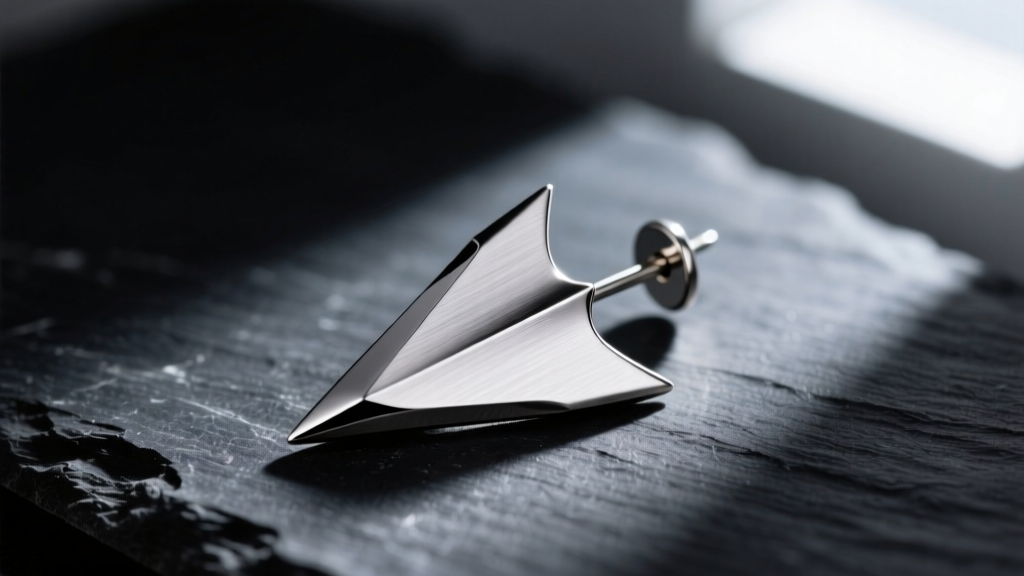
The Biomechanics of Bottom-Heavy Silhouettes
Arrowhead earrings are celebrated for their sharp, directional aesthetic and symbolic resonance, but their unique geometry presents specific structural and biomechanical challenges that generic jewelry guides often overlook. Unlike perfectly spherical studs or evenly distributed hoops, an arrowhead silhouette is inherently bottom-heavy. The center of mass sits significantly lower than the piercing fistula, creating a pendulum effect with every movement of the wearer's head.
This localized weight distribution generates continuous micro-torque on the earlobe. If the earring's post is too thin or the backing system lacks adequate surface area, this pendulum effect will slowly stretch the piercing channel. Over months or years, this can lead to irreversible lobe elongation or the dreaded 'cheese-cutter effect,' where the jewelry slowly migrates downward through the tissue. Understanding the physics of the arrowhead drop is the first step in selecting a piece that is both visually striking and structurally sound for long-term wear.
Metallurgy and Implant-Grade Standards
Because arrowhead designs often feature elongated posts or intricate wire-wrapping to achieve the silhouette, the tensile strength and biocompatibility of the metal are paramount. Cheap alloys will bend under the leverage of the bottom-heavy design, while reactive metals will cause contact dermatitis in the stretched fistula. When evaluating high-end arrowhead earrings, you must look beyond marketing terms like 'hypoallergenic' and demand specific metallurgical grades.
| Material Grade | Tensile Strength | Nickel Release | Best Application |
|---|---|---|---|
| ASTM F136 Titanium | 895 MPa | Zero | Fresh piercings, heavy drops |
| 316L Surgical Steel | 485 MPa | Low (Trace) | Healed lobes, budget options |
| 14k Solid Gold (Nickel-Free) | 350-500 MPa | Zero (if alloyed correctly) | Everyday wear, luxury drops |
| Niobium (99.9% Pure) | 125 MPa | Zero | Hypersensitive skin, ear cuffs |
According to The Association of Professional Piercers (APP), implant-grade titanium (specifically ASTM F136 or F1295) is the gold standard for any jewelry that sits in a piercing. For arrowhead earrings, titanium offers the highest strength-to-weight ratio, meaning the post can be machined slightly thinner for comfort without sacrificing the rigidity needed to support the heavy arrowhead pendant. Conversely, 316L surgical steel contains trace amounts of nickel; while generally safe for fully healed lobes, the continuous friction caused by the swinging arrowhead can trigger localized allergic reactions in sensitive individuals.
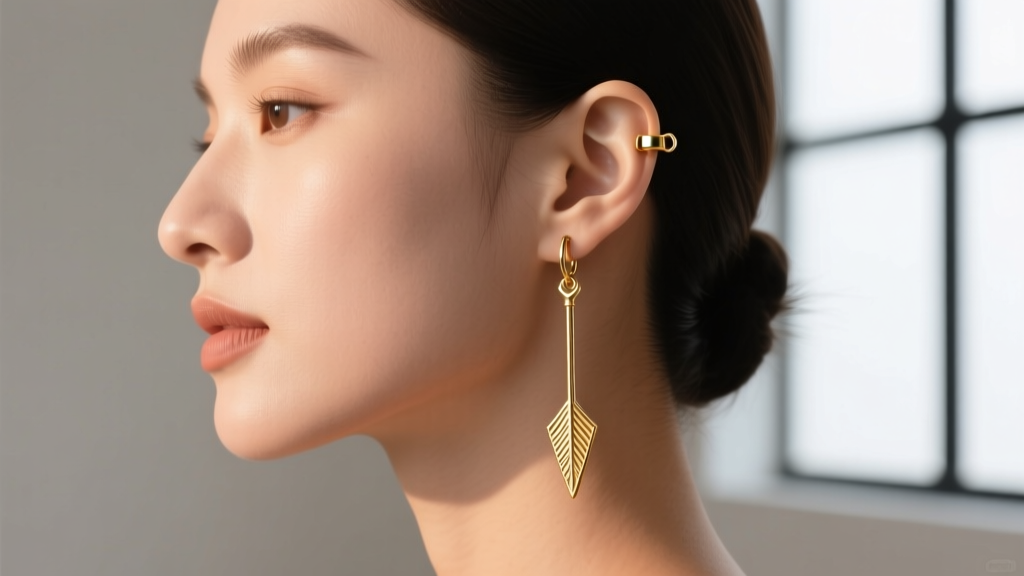
Gauge Sizing and the Cheese-Cutter Effect
The 'gauge' refers to the thickness of the earring post or wire. Standard fashion earrings are typically 20-gauge (0.81mm) or 18-gauge (1.02mm). However, applying these delicate gauges to a heavy, elongated arrowhead design is a critical engineering failure. The concentrated downward force of the arrowhead tip acts as a lever against the thin wire, creating immense pressure on the bottom edge of the piercing hole.
"The cheese-cutter effect occurs when a thin wire under tension or bearing heavy weight slowly slices through soft tissue. To counteract this in bottom-heavy designs like arrowheads, increasing the post thickness to 16-gauge (1.29mm) or even 14-gauge (1.63mm) distributes the load across a wider surface area of the fistula."
If you are purchasing arrowhead dangles, insist on an 18-gauge post at the absolute minimum, with 16-gauge being the ideal specification for daily wear. For solid, heavier cast-metal arrowheads, a 14-gauge post is highly recommended. Note that upgrading to a thicker gauge may require a professional piercer to gently taper your healed lobe piercing to accommodate the wider post, a quick and relatively painless in-studio procedure.
Cartilage vs. Lobe Placement Dynamics
While traditional arrowhead dangles are designed for the earlobe, the motif is increasingly popular in cartilage placements, such as the helix, tragus, or conch. The structural requirements shift dramatically when moving from soft tissue to rigid cartilage.
- Helix Arrowheads: Usually designed as flat-back labret studs. The arrowhead face must be lightweight (under 2 grams) to prevent the post from tilting and irritating the cartilage channel. A 16-gauge, 6mm to 8mm post length is standard.
- Tragus Arrowheads: Requires a shorter post (5mm to 6mm) and a smaller silhouette to avoid catching on headphones or hair. Threadless (push-pin) ends are preferred here, as the tension of the bent pin holds the arrowhead securely against the thick tragus tissue.
- Ear Cuffs (Non-Pierced): Arrowhead ear cuffs rely on spring tension. Look for cuffs cast in solid sterling silver or gold rather than plated brass, as the repeated bending required to adjust the cuff will cause plated base metals to crack and expose reactive copper alloys.
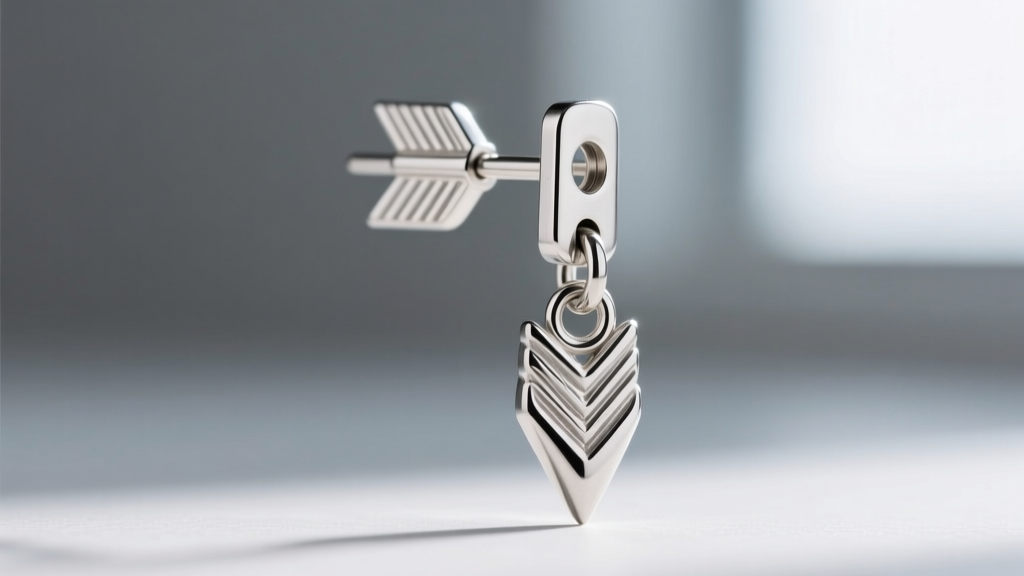
Backing Engineering: Preventing the Droop
The most common point of failure for heavy drop earrings is the backing. Standard friction backs (butterfly clutches) rely on a small groove on the post and the spring tension of the metal clutch. The pendulum motion of an arrowhead earring will quickly wear down this groove or loosen the clutch, resulting in lost jewelry. To secure a valuable arrowhead piece, you must upgrade the backing mechanism.
La Pousette (Locking) Backs
Originally patented in the 1980s, La Pousette backs feature a mechanical locking mechanism with dual spring-loaded wings. Once pushed onto the post, they click into a secondary locking groove, making it physically impossible for the earring to fall off without manually depressing the wings. This is the ultimate solution for heavy, elongated arrowhead drops.
Screw-Back Threaded Posts
For high-end 14k or 18k gold arrowhead earrings, internally threaded screw-backs provide a secure fit. 'Internally threaded' means the screw mechanism is on the backing, while the post itself is smooth. This prevents the sharp threads from tearing the delicate tissue of the fistula during insertion, a common issue with cheap, externally threaded fashion jewelry.
Troubleshooting and Maintenance
Even with optimal materials and engineering, arrowhead earrings require specific maintenance due to their sharp angles and crevices. The acute points of the arrowhead are prone to impact damage. If dropped on a hard surface, the tips can blunt or chip, especially if the piece is cast in high-karat gold (18k or 22k), which is inherently softer due to its higher pure gold content.
Furthermore, if your arrowhead earrings feature pavé or bezel-set gemstones along the shaft, the bottom-heavy swing will cause the settings to accumulate sebum, dead skin cells, and environmental debris. This buildup not only dulls the stones but creates a breeding ground for bacteria near the piercing site. Clean your arrowhead earrings bi-weekly using an ultrasonic jewelry cleaner and a soft-bristled brush, paying special attention to the junction where the post meets the arrowhead body, as this is the primary stress point where metal fatigue and shearing can eventually occur. For deeper material standards, refer to the ASTM International guidelines on F136 titanium to ensure your investment meets medical-grade safety benchmarks.


