2026 Trends: Diamond and Emerald Earrings & The Art Deco Revival
Explore the 2026 Neo-Deco trend for diamond and emerald earrings. Discover expert insights on gem grading, V-prong settings, and market pricing.

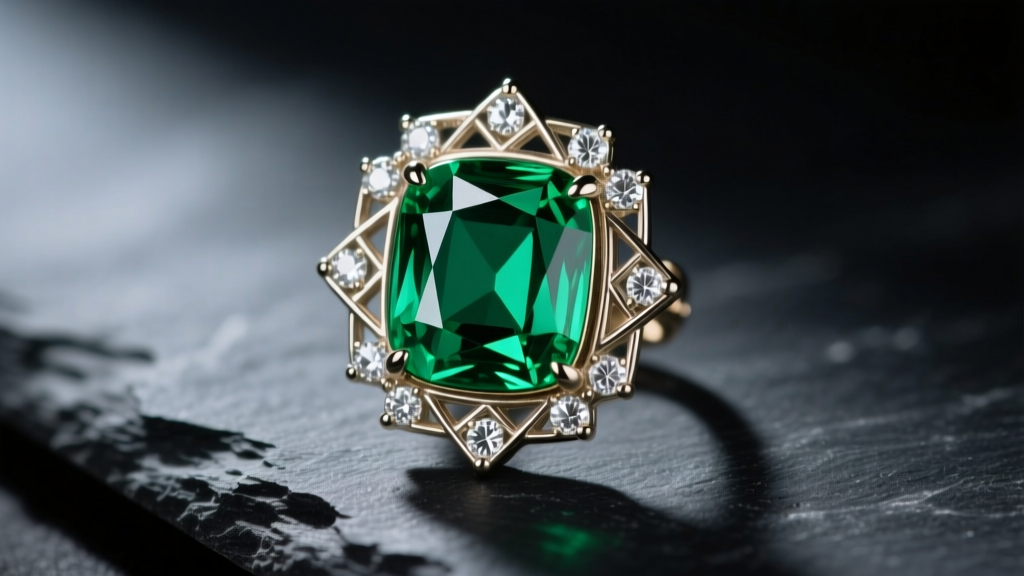
The 2026 Neo-Deco Movement: Redefining Diamond and Emerald Earrings
The jewelry landscape of 2026 has decisively pivoted away from the ultra-minimalist "quiet luxury" aesthetic that dominated the early 2020s. In its place, the "Neo-Deco" movement has emerged, bringing bold geometry, high-contrast color palettes, and architectural silhouettes back to the forefront of high and accessible jewelry. At the absolute center of this trend are diamond and emerald earrings, which perfectly encapsulate the era's desire for structured elegance and vivid visual impact.
Unlike the fluid, organic shapes of the bohemian trends of the past decade, Neo-Deco relies on sharp angles, stepped settings, and the striking chromatic contrast between icy white diamonds and deep, saturated green emeralds. Designers are heavily referencing the 1920s and 30s Art Deco period, but with modern 2026 manufacturing techniques that allow for lighter, more wearable pieces. From elongated chandelier drops to geometric ear cuffs that scale the helix, diamond and emerald earrings are no longer reserved for red-carpet galas; they are being engineered for elevated daily wear.
Material Deep-Dive: Selecting the Right Emerald and Diamond Pairings
When investing in diamond and emerald earrings, understanding the provenance and treatment of the gemstones is critical. The interplay between the center emerald and the surrounding diamond accents dictates both the aesthetic value and the structural longevity of the piece.
Zambian vs. Colombian Emeralds in Drop Settings
The origin of an emerald drastically alters its visual profile in a Neo-Deco setting. Colombian emeralds, particularly from the Muzo and Chivor mines, are renowned for their warm, intense green hue with slight yellowish undertones. However, they are heavily included (the "jardin" effect), making them brittle and challenging to cut into the precise, sharp-cornered baguette or emerald cuts required for Art Deco designs.
Conversely, Zambian emeralds (primarily from the Kagem mine) exhibit a cooler, bluish-green saturation and possess significantly higher natural clarity. According to the Gemological Institute of America (GIA), Zambian emeralds are generally more robust and better suited for the precise geometric faceting demanded by 2026's Neo-Deco earrings. For buyers seeking sharp, flawless lines in their diamond and emerald earrings, Zambian stones offer superior structural integrity and a modern, icy color contrast against white diamonds.
The Lab-Grown Diamond Accent Shift
The most significant market shift impacting diamond and emerald earrings in 2026 is the total dominance of lab-grown diamonds in the melee and halo sectors. The Bain & Company Global Diamond Report highlights that Chemical Vapor Deposition (CVD) lab-grown diamonds have effectively captured the accent stone market. Jewelers are now utilizing F-G color, VVS2-VS1 clarity lab-grown melee diamonds (ranging from 0.01 to 0.18 carats) to create intricate pavé halos and stepped borders around natural emeralds. This allows consumers to allocate the vast majority of their budget toward a high-grade, natural center emerald, rather than overpaying for natural diamond accents that serve a purely structural and decorative role.
Structural Integrity: Protecting Soft Gemstones in Daily Wear
A common misconception is that emeralds are highly durable due to their Mohs hardness rating of 7.5 to 8. While they resist scratching relatively well, their toughness (resistance to chipping and breaking) is notoriously poor. The natural inclusions and microscopic fissures inherent to emeralds make them highly vulnerable to the shear forces experienced by earrings, which are prone to snagging on hair and clothing.
If you are purchasing diamond and emerald earrings for frequent wear, the setting architecture is non-negotiable. Here are the critical structural requirements for 2026:
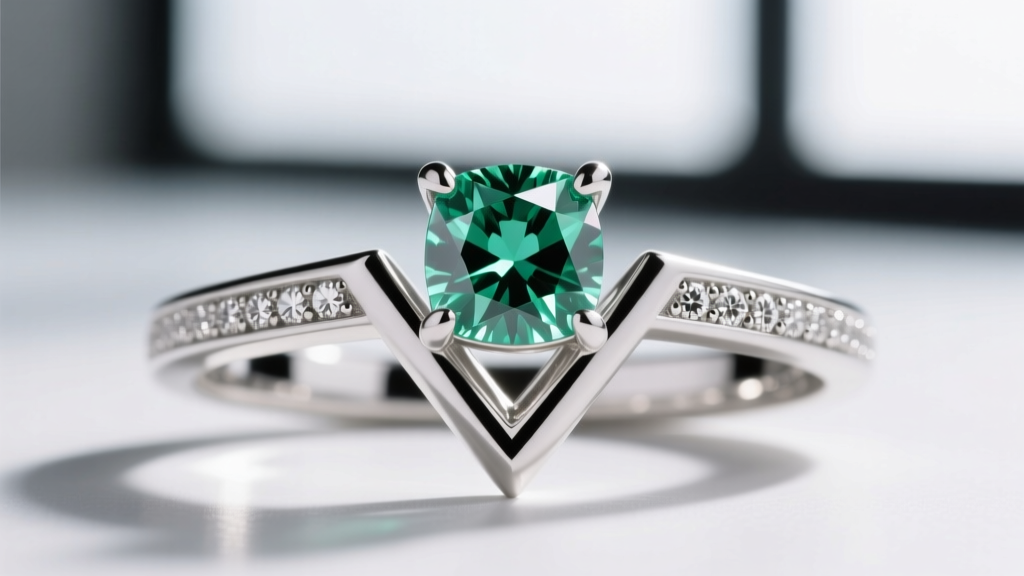
- V-Prong Mandate: Emerald-cut and baguette-cut emeralds feature sharp 90-degree corners. Standard prongs will leave these corners exposed to catastrophic chipping. V-prongs (where the metal wraps around the corner in a V-shape) are mandatory for any geometric emerald earring.
- Bezel and Half-Bezel Settings: For cabochon or pear-shaped emeralds used in drop earrings, a continuous metal bezel provides the highest level of protection against lateral impacts.
- Avoid Ultrasonic Cleaners: The vast majority of emeralds are treated with cedar oil or resins to mask surface-reaching fractures. Ultrasonic vibrations and harsh chemical solvents will strip these oils, turning a vibrant green stone cloudy and white-fractured. Diamond and emerald earrings must only be cleaned with a soft brush, lukewarm water, and mild, non-detergent soap.
- Post and Clutch Security: Heavy Neo-Deco drops require thicker posts. Standard 20-gauge (0.8mm) posts will bend under the weight of a 3-carat emerald and diamond drop. Look for 18-gauge (1.0mm) or 16-gauge (1.2mm) posts paired with secure screw-backs or heavy friction clutches with wide bases to prevent the earring from drooping on the lobe.
2026 Price Index: Natural vs. Lab-Grown Diamond and Emerald Earrings
Pricing for diamond and emerald earrings has bifurcated in 2026. The cost of high-clarity natural emeralds has surged due to supply chain constraints in South America and Africa, while the cost of lab-grown diamond accents has plummeted. Below is a realistic retail price index for the current market, assuming 18k white gold or platinum settings.
| Earring Style | Emerald Origin & Weight | Diamond Accent Type | Estimated 2026 Retail Price |
|---|---|---|---|
| Geometric Studs (1.5 ctw) | Zambian, Minor Oil (1.0 ct) | Lab-Grown CVD Melee (0.5 ct) | $2,800 - $4,200 |
| Art Deco Drops (3.5 ctw) | Colombian, Moderate Oil (2.0 ct) | Natural Earth-Mined Baguettes (1.5 ct) | $14,500 - $22,000 |
| Chandelier Dangles (5.0+ ctw) | Zambian, No Oil (3.0 ct) | Lab-Grown CVD Pavé & Baguettes (2.0 ct) | $8,500 - $13,000 |
| Helix Ear Cuffs (1.0 ctw) | Colombian, Minor Oil (0.4 ct) | Lab-Grown CVD Melee (0.6 ct) | $1,900 - $2,600 |
Styling Frameworks: Face Shapes and Ear Anatomy
The bold, linear nature of Neo-Deco diamond and emerald earrings requires strategic styling to flatter the wearer's facial structure and ear anatomy. Because these earrings rely on high contrast and sharp geometry, they act as visual anchors.
"When styling high-contrast geometric earrings, the goal is to create optical balance. You want the jewelry to elongate and frame, never to widen or truncate the natural lines of the face." — Master Gemologist Appraiser, 2026 Style Symposium
Matching Face Shapes to Deco Silhouettes
Square and Angular Faces: Avoid wide, horizontal geometric studs or short, chunky hoops, as these will exaggerate the jawline. Instead, opt for elongated, vertical chandelier drops or linear bar earrings. The verticality of a stepped diamond and emerald drop earring draws the eye downward, softening the angles of the jaw and cheekbones.
Round and Oval Faces: Round faces benefit immensely from the sharp, 90-degree angles of emerald-cut studs and rectangular Art Deco drops. The rigid geometry of the diamonds and emeralds provides a striking, flattering contrast to soft facial curves, adding structure and definition to the wearer's profile.
Heart-Shaped Faces: To balance a wider forehead and narrower chin, choose diamond and emerald earrings that feature a wider base or a teardrop silhouette. A Neo-Deco drop that flares slightly at the bottom (using pear-cut emeralds or fanned baguette diamonds) will add visual weight to the lower half of the face.
Cartilage vs. Lobe: Adapting Neo-Deco for Ear Cuffs
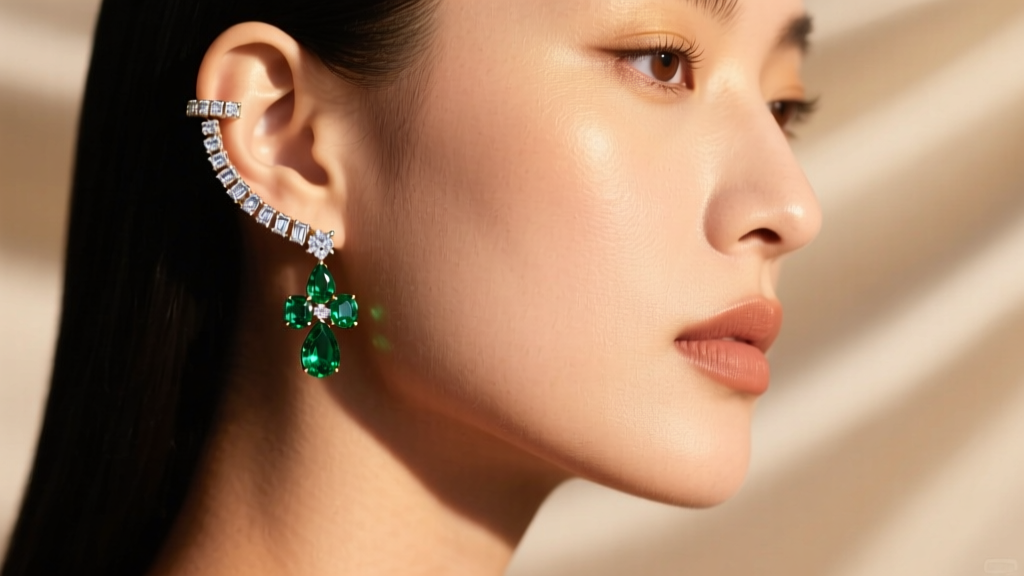
The 2026 trend of "earscaping" has pushed diamond and emerald motifs beyond the traditional earlobe. Jewelers are now designing specialized Neo-Deco ear cuffs and helix studs that map the architectural lines of the outer ear.
When moving up the ear, gauge sizing and weight distribution become critical. Standard lobe piercings are typically 20-gauge (0.8mm) or 18-gauge (1.0mm). Cartilage piercings (helix, conch, flat) are usually pierced at 16-gauge (1.2mm) or 14-gauge (1.6mm) to prevent the "cheese-cutter effect," where thin metal migrates through the tissue. High-quality diamond and emerald ear cuffs designed for cartilage will feature 16-gauge posts or tension-fit cuffs that distribute pressure evenly across the cartilage ridge, ensuring the heavy gemstones do not cause tissue fatigue or piercing rejection over time.
Final Verdict: Investment vs. Trend
Diamond and emerald earrings in the Neo-Deco style represent a unique intersection of historical reverence and modern material science. By leveraging the structural predictability of Zambian emeralds and the financial efficiency of lab-grown diamond accents, buyers in 2026 can acquire museum-quality aesthetics without the prohibitive price tags of the past.
When making your selection, prioritize structural integrity—specifically V-prongs and appropriate post gauges—over sheer carat weight. An impeccably set, 1.5-carat Zambian emerald protected by a precision-milled platinum bezel and lab-grown diamond halo will outlast, outshine, and outperform a poorly set, heavily included 3-carat stone every time. The Art Deco revival is not just a fleeting trend; it is a return to the golden age of jewelry engineering, adapted perfectly for the modern ear.


