Gold Disc Drop Earrings: A 2026 Budget & Value Guide
Discover how to evaluate gold disc drop earrings in 2026. We break down material grades, post gauges, and pricing tiers to help you find true value.

The Enduring Appeal of the Geometric Drop
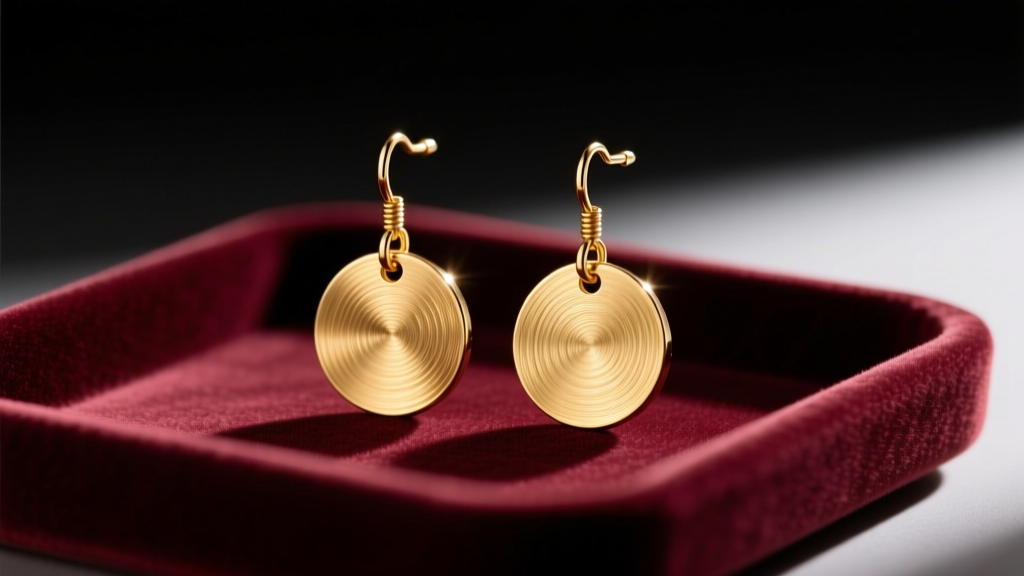
The gold disc drop earring has cemented its place as a cornerstone of modern minimalist jewelry. Blending architectural geometry with fluid movement, this silhouette bridges the gap between everyday studs and formal chandeliers. However, as of 2026, the market is heavily saturated. A quick search yields options ranging from $18 to over $2,500, leaving consumers to navigate a minefield of deceptive marketing terminology. How do you determine if a pair of gold disc drop earrings is a genuine investment or an overpriced liability? This guide breaks down the metallurgy, hardware mechanics, and pricing structures you need to know to assess true value.
The Material Matrix: Plated vs. Vermeil vs. Solid
When evaluating material composition, consumers are frequently misled by the word 'gold.' The Federal Trade Commission (FTC) strictly regulates how jewelers label gold-plated items, yet loopholes and vague terms like 'gold dipped' still proliferate in the budget tier.
- Flash Plating (The Budget Trap): Often found on brass or copper alloy bases, flash plating deposits a microscopic layer of gold (0.05 to 0.1 microns). This layer wears away within weeks of daily friction, exposing the reactive base metal and causing the dreaded 'green ear' effect via copper oxidation.
- Gold Vermeil (The Mid-Tier Sweet Spot): True vermeil requires a base of 925 sterling silver coated with a minimum of 2.5 microns of 10k, 14k, or 18k gold. According to the Gemological Institute of America (GIA), the sterling silver base ensures that when the gold eventually wears thin, the underlying metal remains hypoallergenic and structurally sound.
- Solid 14k or 18k Gold (The Fine Standard): Solid gold offers intrinsic melt value, zero risk of plating wear, and generational longevity. 14k (58.5% gold) is generally preferred for drop earrings due to its superior tensile strength compared to the softer 18k (75% gold).
Hardware Mechanics: Where Brands Cut Costs
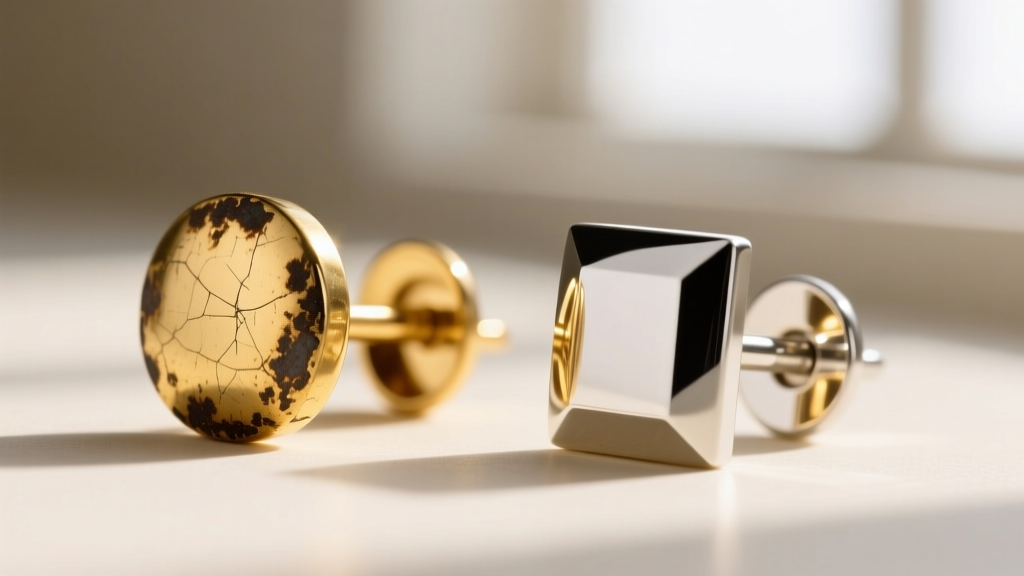
The structural integrity of a drop earring relies entirely on its connection points and post gauge. This is where budget brands silently compromise quality to maintain low price points.
The Gauge Problem
A standard earlobe piercing is typically 20-gauge (0.81mm) or 18-gauge (1.02mm). Budget manufacturers frequently stamp out 22-gauge (0.64mm) or even 24-gauge posts to save fractions of a gram in metal weight. While a 22-gauge post might suffice for a lightweight 3mm stud, it is a catastrophic failure point for a 15mm or 20mm disc drop. The pendulum effect of a dangling disc creates kinetic torque every time you turn your head. Over three to six months, this repetitive micro-stress will permanently bend a thin post, causing the earring to droop forward and eventually snap.
Jump Ring Integrity
If the disc is not rigidly fixed to the post but instead hangs from a jump ring, the soldering of that ring is the ultimate test of quality. High-end fine jewelry brands use laser-welded or seamlessly soldered jump rings. In contrast, mid-tier and budget options often use 'snapped' or unsoldered jump rings. A 5-gram gold disc generates enough gravitational pull that an unsoldered jump ring will slowly distort into an oval shape, eventually creating a gap wide enough for the earring to slip off and be lost.

Sizing and Proportion: The Budget Multiplier
The price of solid gold scales exponentially with volume and weight. A 10mm solid 14k gold disc drop earring might retail for $180, but scaling that design up to a 25mm statement disc increases the gold weight by a factor of six, pushing the price well over $800. For consumers who prefer the bold, architectural look of oversized discs but lack a fine jewelry budget, gold vermeil is the mathematically superior choice. Vermeil allows you to achieve the visual weight and physical presence of a heavy statement piece without paying the intrinsic melt-value premium of solid gold.
2026 Price Tier Breakdown
Use this framework to benchmark the market and identify fair pricing based on material and construction quality.
| Tier | Price Range (Pair) | Base Metal | Gold Layer | Post Gauge | Expected Longevity |
|---|---|---|---|---|---|
| Budget | $15 - $50 | Brass / Copper | Flash Plated (<0.5 microns) | 22g - 24g | 1 - 6 Months |
| Mid-Tier (Vermeil) | $65 - $180 | 925 Sterling Silver | 2.5+ microns (14k/18k) | 20g | 2 - 5 Years |
| Fine (Solid) | $250 - $1,200+ | Solid 14k / 18k Gold | N/A (Solid throughout) | 18g - 20g | Lifetime / Heirloom |
Red Flags: Spotting Overpriced Costume Jewelry
Even within the mid-tier, some brands charge vermeil prices for flash-plated brass. Protect your wallet by watching for these specific failure modes and red flags:
The Magnet Test: While gold and silver are non-magnetic, the internal springs inside cheap butterfly backing clasps often contain steel or nickel. If the backing violently snaps to a magnet, it indicates a low-quality clasp that will likely lose its tension and fail to secure your drop earring.
- Seam Lines on the Disc: Run your fingernail across the edge of the disc. Cheap manufacturing involves stamping two thin sheets of metal and pressing them together, leaving a visible seam line that catches on hair and sweaters. Solid or well-cast drops feature seamless, beveled edges.
- Friction Back Tolerance: Premium backs feature deep, precise grooves and a tight tolerance that grips the post's notch securely. Cheap stamped backs lose their tension within a month, turning into loose sleeves that slide off the post. For heavier gold disc drops, the kinetic swing can easily shake a loose butterfly back off the ear.
- Vague Material Descriptions: If a product page says 'Gold Tone' or 'Gold Alloy' instead of explicitly stating '14k Gold Vermeil' or 'Solid 14k,' assume it is plated brass.
The Verdict: Maximizing Your Investment
Evaluating gold disc drop earrings requires looking past the initial shine and examining the structural engineering. If you are buying for daily wear and have sensitive skin, bypass the budget tier entirely; the cost per wear of a $30 pair that turns your ears green and bends in a month is infinitely higher than a $90 pair of 14k vermeil drops. For those seeking generational pieces or investing in smaller, 10mm-15mm everyday silhouettes, solid 14k gold remains the undisputed champion of long-term value. By scrutinizing the post gauge, demanding soldered jump rings, and understanding FTC plating standards, you can confidently navigate the 2026 jewelry market and secure a pair of geometric drops that will endure both in style and structure.


