Backing Earring Materials: Security & Comfort Guide
Discover the best backing earring materials for sensitive ears and security. Compare titanium, gold, silicone, and steel earring backs for comfort.

The Hidden Importance of the Backing Earring
When investing in fine jewelry, consumers overwhelmingly focus on the front-facing aesthetics: the gemstone cut, the metal finish, and the overall silhouette. Yet, the component responsible for security, comfort, and long-term skin health is entirely hidden. The backing earring is the unsung hero of your jewelry box. It bears the mechanical stress of daily movement, interfaces directly with your skin's microbiome, and dictates whether a heavy drop earring sits flush or droops awkwardly.
In 2026, material science has evolved significantly, offering specialized alloys and medical-grade polymers designed to eliminate contact dermatitis and prevent lost jewelry. However, the market remains flooded with outdated, nickel-heavy components that compromise both comfort and security. Understanding the metallurgical and physical properties of your earring backs is no longer optional for serious collectors or those with sensitive piercings. This guide breaks down the exact material properties, gauge compatibilities, and failure modes of the most common backing earring options available today.
Why Earring Backing Material Matters
The skin on the posterior earlobe is remarkably thin and highly susceptible to friction and moisture trapping. According to the American Academy of Dermatology, nickel allergy is the most common cause of allergic contact dermatitis, affecting up to 18% of the population. Because a backing earring sits flush against this sensitive skin—often trapping sweat, sebum, and hair products—the material's corrosion resistance and ion-leaching rate are critical.
Beyond allergies, the material dictates the mechanical grip. Softer metals will wear down the friction grooves on an earring post over time, leading to catastrophic failure (losing the earring). Conversely, overly rigid materials can cause micro-tears in the piercing fistula if the wearer sleeps with them in. Choosing the right backing earring requires balancing biocompatibility with tensile strength.
Material Breakdown: Metals vs. Polymers
Implant-Grade Titanium (ASTM F136)
Titanium is the undisputed champion of biocompatibility. Specifically, you must look for ASTM F136 compliant titanium, which guarantees the complete absence of nickel and limits other alloying elements to safe thresholds. The Association of Professional Piercers mandates this specific grade for all fresh piercings due to its inert nature. As a backing earring material, titanium offers exceptional strength-to-weight ratios. It will not bend under the weight of heavy statement pieces, and it will never corrode from exposure to humidity or cosmetic chemicals. The primary drawback is cost; precision-machined titanium locking backs or screw-backs typically retail between $15 and $35 per pair.
Solid Gold (14k vs. 18k)
Gold is a classic choice, but its purity drastically affects its performance as a backing earring. Pure 24k gold is far too soft for mechanical components. Even 18k gold, while beautiful, can suffer from 'groove wear'—where the clutch of the backing earring slowly files away the notch on the earring post, eventually causing the earring to slip off. Therefore, 14k gold is the optimal choice for friction backs. Alloyed with metals like zinc and copper, 14k gold possesses the necessary Vickers hardness to maintain structural integrity over decades of daily insertion and removal. Always avoid gold-plated brass backs, as the plating will inevitably chip, exposing highly reactive base metals to your skin.
Surgical Stainless Steel (316L)
Often marketed as 'hypoallergenic,' 316L surgical steel is a budget-friendly staple that harbors a hidden flaw: it contains between 8% and 12% nickel. While it passes the EU Nickel Directive for static contact, the dynamic friction of a backing earring rubbing against the earlobe can accelerate nickel ion release. For individuals with robust skin, 316L is a durable and economical choice (often under $5 per pair). However, for hyper-sensitive ears, it is a primary trigger for localized eczema and weeping piercings.
Medical-Grade Silicone & Polyurethane
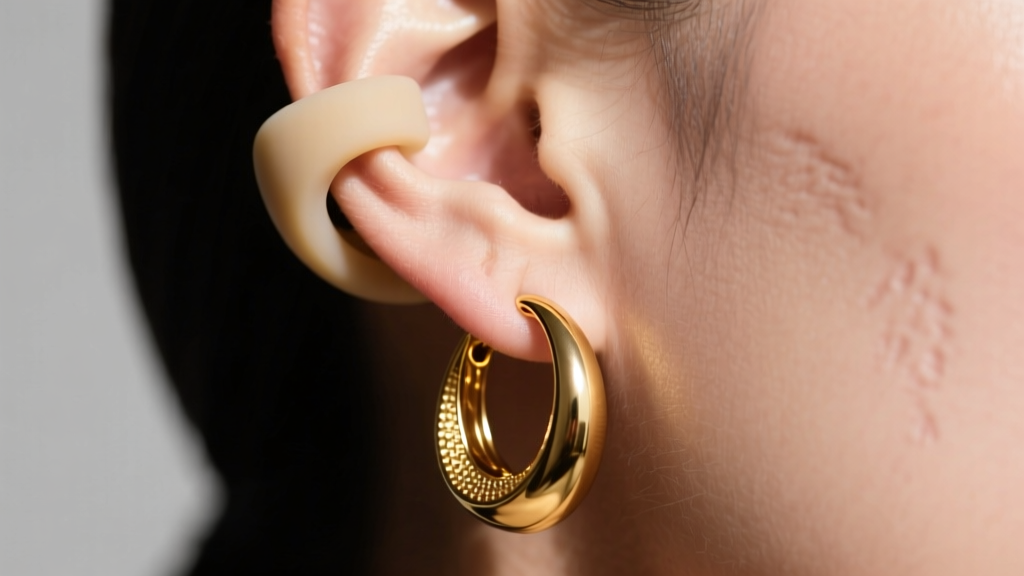
Non-metal options have surged in popularity for their comfort and shock absorption. Silicone disc backs distribute the weight of heavy earrings across a wider surface area, preventing the dreaded 'earlobe droop.' However, silicone is inherently porous. It traps bacteria and dead skin cells, and it degrades rapidly when cleaned with isopropyl alcohol or harsh solvents. Silicone backing earrings should be treated as consumables, replaced every 3 to 6 months, and cleaned only with mild, fragrance-free soap and warm water.
Comprehensive Material Comparison Chart
| Material | Biocompatibility | Mechanical Grip | Durability | Average Price Range |
|---|---|---|---|---|
| Implant-Grade Titanium | Excellent (Nickel-Free) | High (Precision CNC) | Lifetime | $15 - $40 |
| 14k Solid Gold | Very Good | High (Retains Grooves) | Lifetime | $45 - $120 |
| 316L Surgical Steel | Poor (Contains Nickel) | Moderate | High | $2 - $8 |
| Medical Silicone | Excellent (Inert) | Moderate (Friction) | Low (3-6 Months) | $3 - $10 |
Matching the Backing Earring to the Piercing Type
Standard Lobe Piercings (20G - 18G)
Standard lobe piercings typically accommodate 20-gauge or 18-gauge posts. For everyday wear, a 14k gold or titanium butterfly clutch is ideal. If you sleep in your earrings, swap the metal butterfly for a flat silicone disc or a specialized 'sleeping back' that features a smooth, rounded capsule to prevent the metal prongs from digging into your neck.
Cartilage & Helix Piercings (16G - 14G)
Cartilage is highly unforgiving and prone to embedding. Traditional butterfly backs are strongly discouraged for cartilage because their sharp prongs can catch on hair and pillows, driving the post into the tissue. Instead, opt for internally threaded or threadless (push-pin) flat-back labret posts made from ASTM F136 titanium. The flat disc sits flush against the back of the ear, eliminating pressure points and snag hazards.
Heavy Statement Earrings
When wearing elaborate chandeliers or heavy gemstone drops, the center of gravity shifts, pulling the earring post downward. A standard metal clutch will fail to support the weight, causing the earring to point at the floor. The solution is a jumbo silicone backing earring or a specialized locking metal back (like the 'Levin lock' or 'La pousette' mechanism) that utilizes a secondary silicone O-ring to create an airtight, friction-heavy seal against the post.
Troubleshooting Common Backing Earring Failures
- The Backing is Stuck: This is rarely a mechanical failure of the metal; it is almost always caused by hardened sebum, dead skin, and hairspray cementing the clutch to the post. Fix: Do not use pliers, which will bend the post. Soak the earlobe in warm saline solution for 5 minutes to dissolve the biological buildup, then gently twist and pull.
- The Earring Constantly Droops: This indicates a gauge mismatch or a worn-out clutch. Fix: Check your post thickness. If it is a flimsy 22-gauge wire, it will bend under its own weight. Upgrade to an 18-gauge post and pair it with a wide-base silicone backing earring to distribute the load.
- Itchy, Flaky Earlobes: You are likely experiencing nickel-induced contact dermatitis from 316L steel or brass-core plated backs. Fix: Discard all mystery-metal backs immediately. Replace your entire inventory with certified implant-grade titanium or 14k solid gold components.
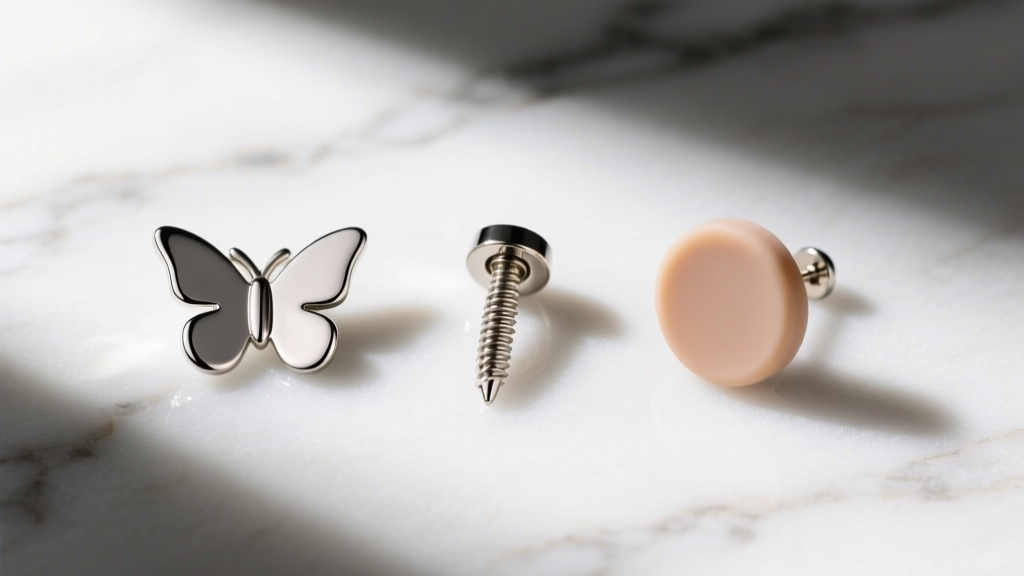
- The Screw-Back Strips: Cross-threading occurs when the backing earring is forced onto the post at an angle. Fix: Always start threading the back in reverse (counter-clockwise) until you feel the threads 'drop' into alignment, then gently twist clockwise to secure.
Final Verdict: Investing in Security and Health
The backing earring is the foundation of your jewelry's wearability. While it may be tempting to rely on the complimentary metal or plastic backs provided by mass-market retailers, upgrading your hardware is one of the most impactful investments you can make for your ear health. For those with sensitive skin or healing piercings, ASTM F136 titanium is non-negotiable. For luxury everyday wear, 14k gold offers the perfect blend of prestige and mechanical durability. By aligning your backing material with your specific anatomical needs and earring weight, you ensure that your jewelry remains secure, comfortable, and beautiful for years to come.


