The Ultimate Material Guide for Barbell Hoop Earrings
Compare implant-grade titanium, niobium, and solid gold for barbell hoop earrings. Find the best hypoallergenic metals for sensitive cartilage.

The Anatomy of a Barbell Hoop Earring
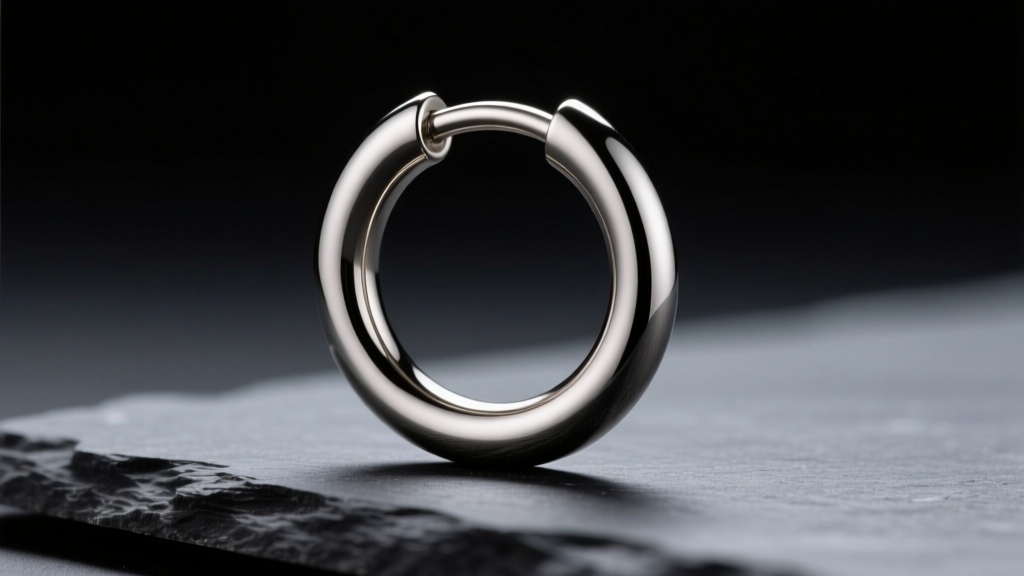
When body jewelry enthusiasts and professional piercers refer to 'barbell hoop earrings,' they are typically describing a hybrid category of hardware that merges the structural security of a straight barbell with the continuous aesthetic of a hoop. This primarily encompasses circular barbells (often called horseshoe rings), hinged segment rings, and clickers that utilize barbell-style threading mechanisms. Unlike standard seamless hoops or captive bead rings (CBRs) that rely on tension or soldered seams, barbell hoops feature removable ends, making them vastly superior for insertion, cleaning, and swapping in healed cartilage piercings like the helix, tragus, daith, and rook.
However, the mechanical design is only half the battle. The metallurgical composition of the jewelry dictates how your body's immune system responds to the fistula (the piercing channel). Choosing the wrong alloy can lead to contact dermatitis, hypertrophic scarring, or chronic irritation bumps. In this comprehensive guide, we dissect the exact material properties, grading standards, and biocompatibility metrics you need to know before purchasing your next barbell hoop.
Material Deep-Dive: What Actually Touches Your Fistula?
Implant-Grade Titanium (ASTM F-136)
Implant-grade titanium, specifically Ti6Al4V ELI (Extra Low Interstitial), is the undisputed gold standard for initial piercings and sensitive healed ears. The critical designation here is ASTM F-136. This standard guarantees that the alloy contains virtually 0% nickel and has been processed to minimize impurities. Titanium naturally forms a passive oxide layer when exposed to oxygen, which prevents corrosion and stops metal ions from leaching into the surrounding tissue. Furthermore, titanium is highly lightweight, reducing the gravitational drag on delicate cartilage structures like the forward helix or snug.
Niobium (Unalloyed Element 41)
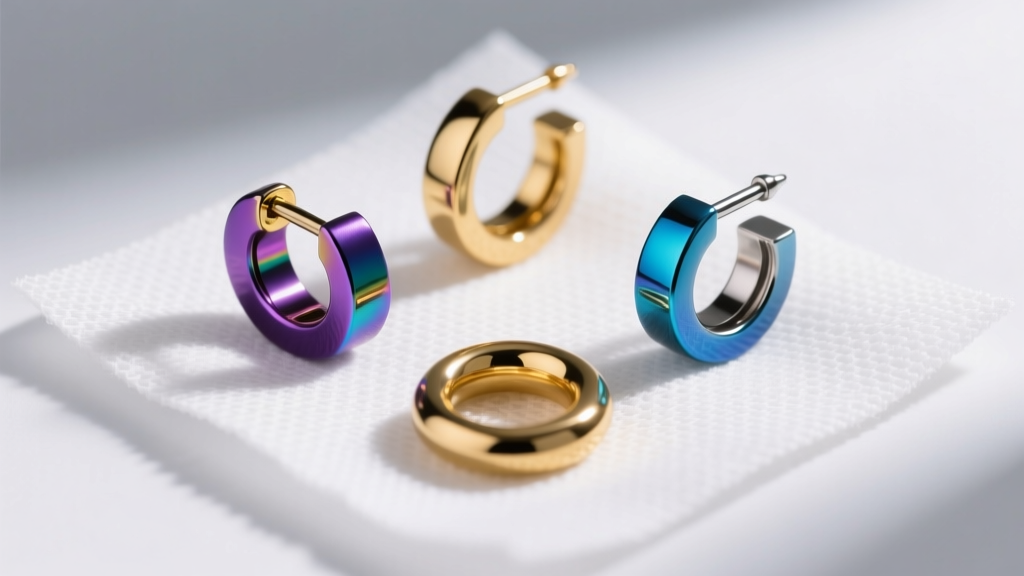
Niobium is a pure, unalloyed elemental metal that shares titanium's exceptional biocompatibility but offers distinct advantages in malleability and aesthetics. Because it is an element rather than an alloy, there is zero risk of nickel contamination from mixed batches. Niobium is slightly softer than titanium, allowing piercers to gently bend circular barbell hoops for a custom fit without the metal snapping or losing its temper. It also anodizes brilliantly; by applying specific electrical voltages, the oxide layer thickens to refract light, creating vibrant, permanent colors like deep teals, purples, and true blacks without using toxic dyes or plating.
Solid Gold (14k and 18k Body-Safe Alloys)
Gold is a prestigious choice for barbell hoop earrings, but purity matters immensely. 24k gold is too soft for body jewelry and will easily warp or scratch, harboring bacteria. Conversely, 10k gold contains too many filler alloys. The sweet spot is 14k or 18k solid gold, provided it is explicitly alloyed for body jewelry. Reputable manufacturers use palladium or silver to harden the gold while strictly avoiding nickel, cadmium, and lead. According to the Association of Professional Piercers (APP), high-quality, nickel-free 14k or 18k gold is perfectly safe for both initial and healed piercings, offering a warm, luxurious aesthetic that titanium cannot replicate.
Surgical Steel (ASTM F-138) - The Caveats
Surgical steel is the most common and affordable metal on the market, but it comes with significant biological caveats. Even the highest grade, ASTM F-138, contains between 8% and 12% nickel to achieve its corrosion resistance and shine. While the passivation layer usually traps the nickel inside the metal, micro-abrasions from insertion or daily wear can expose the underlying alloy. For the 10-15% of the population with a nickel allergy, as documented by the National Center for Biotechnology Information (NCBI), surgical steel barbell hoops will almost certainly trigger localized allergic contact dermatitis, resulting in weeping, itching, and swelling.
Comparative Data: Biocompatibility & Pricing Matrix
To make an informed purchasing decision, it is essential to weigh the biological safety of the metal against its market cost and aesthetic versatility. The table below synthesizes the core properties of the four primary metals used in premium barbell hoop earrings.
| Metal Grade | Nickel Content | Anodizable? | Avg. Price Range (16G Hoop) | Best Use Case |
|---|---|---|---|---|
| Titanium (ASTM F-136) | 0% | Yes (Bright colors) | $30 - $85 | Fresh piercings, severe allergies |
| Niobium (Pure) | 0% | Yes (Rich darks/blacks) | $25 - $65 | Custom bends, dark aesthetics |
| 14k/18k Solid Gold | 0% (If body-safe) | No | $120 - $450+ | Healed piercings, luxury wear |
| Steel (ASTM F-138) | 8% - 12% | No | $10 - $25 | Budget-friendly, non-sensitive ears |
Threading and Hardware: The Hidden Irritants
The metal of the hoop is only part of the equation; the threading mechanism of the barbell ends plays a massive role in tissue health. When shopping for barbell hoop earrings, you will encounter three main threading types:
- Externally Threaded: The screw threads are on the ball/end, which must pass through the fistula. This acts like a microscopic file, tearing and scratching the delicate epithelial lining of the piercing channel. Never wear externally threaded jewelry.
- Internally Threaded: The screw threads are inside the hollow shaft of the hoop, while the ball has a smooth, flush pin. This allows the jewelry to glide through the piercing without causing micro-trauma. This is the minimum standard for safe body jewelry.
- Threadless (Push-Pin): The end features a slightly bent pin (usually angled at 10 to 15 degrees) that pushes into the hollow shaft. The tension created by the bend holds the jewelry securely in place. Threadless barbell hoops are currently the industry favorite due to their seamless aesthetic, lack of cross-threading issues, and supreme ease of removal.
Sizing Mechanics: Gauge and Inner Diameter (ID)
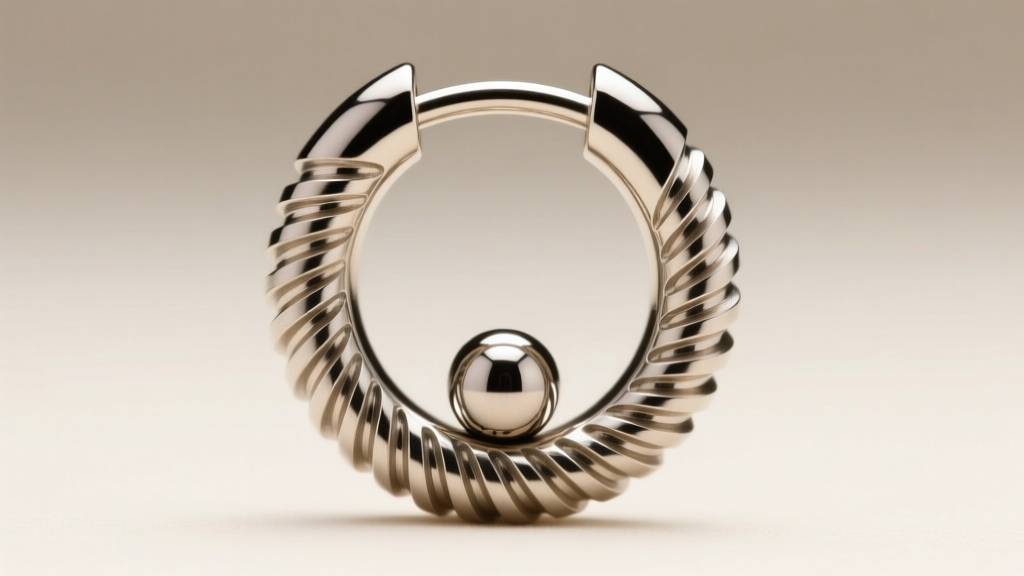
A barbell hoop that is improperly sized will cause mechanical irritation, leading to migration or rejection. Sizing involves two distinct measurements: Gauge (the thickness of the wire) and Inner Diameter (the space inside the hoop).
Standard Gauge Thicknesses
For most ear cartilage piercings (helix, tragus, forward helix), 16-gauge (1.2mm) is the industry standard. It provides enough structural integrity to resist the 'cheese-cutter effect' (where thin wire slowly slices through tissue under pressure). For heavier tissue areas like the daith or conch, 14-gauge (1.6mm) is often preferred. Thinner 18-gauge (1.0mm) hoops should generally be avoided in cartilage due to the heightened risk of migration.
Inner Diameter (ID) and Swelling Allowances
The ID dictates how snug the hoop sits against the ear. A common mistake is inserting a hoop with an ID that is too small for the specific anatomy.
- Standard Helix / Lobe: 5/16' (8mm) is standard for a healed, snug fit. During initial healing, a 3/8' (10mm) is required to accommodate swelling.
- Daith / Rook: These inner-ear folds require precise measurements, typically ranging from 5/16' (8mm) to 7/16' (11mm) depending on the thickness of the cartilage ridge.
- Tragus: Usually requires a smaller ID, around 1/4' (6mm) to 5/16' (8mm), to prevent the hoop from catching on headphones or hair.
Expert Verdict: Which Metal Should You Buy?
If you are purchasing barbell hoop earrings for a fresh piercing, or if you have a known history of metal sensitivities, Implant-Grade Titanium (ASTM F-136) is your mandatory starting point. It offers the perfect intersection of biocompatibility, lightweight comfort, and affordability. For those seeking a premium, heirloom-quality piece for a fully healed piercing, nickel-free 14k or 18k solid gold provides unmatched warmth and prestige. Avoid surgical steel unless you are absolutely certain you do not possess a nickel allergy, and always prioritize internally threaded or threadless hardware to protect your fistula from mechanical damage.


