The Ultimate Guide to Wearing 60mm Gold Hoop Earrings
Learn how to choose, style, and safely wear 60mm gold hoop earrings. Discover gauge sizes, closure types, and lobe-saving tips for large hoops.


Why 60mm is the Ultimate Statement Threshold
When transitioning from everyday jewelry to bold statement pieces, size matters immensely. In the world of hoop earrings, the 60mm diameter (approximately 2.36 inches) represents a critical threshold. Unlike 20mm huggies that hug the earlobe or 40mm mid-sized hoops that frame the jaw, 60mm gold hoop earrings extend well past the jawline, brushing against the neck and collarbone. This dramatic length offers unparalleled movement and visual impact, but it also introduces unique structural and anatomical challenges that beginners must understand before making a purchase.
Wearing a hoop of this magnitude is not just about aesthetics; it is an exercise in physics and material science. The larger the diameter, the greater the leverage exerted on the earlobe piercing. If you are stepping into the world of oversized hoops for the first time, understanding gauge thickness, closure mechanics, and gold alloy hardness will save you from discomfort, damaged jewelry, and stretched piercings.
The Physics of Large Hoops: Gauge and the "Cheese-Cutter" Effect
The most common mistake beginners make when buying 60mm hoops is ignoring the wire gauge (thickness). Because large hoops require more metal, they are inherently heavier. If a 60mm hoop is crafted with a thin wire—such as 20-gauge (0.81mm) or 18-gauge (1.0mm)—the combination of gravity and the "pendulum effect" (the swinging motion of the hoop as you walk) concentrates all that kinetic energy onto a tiny surface area of your earlobe fistula.
Over time, this pressure acts like a wire cheese slicer, slowly migrating the piercing downward and stretching the tissue. This phenomenon, widely recognized by professional piercers, is known as the "cheese-cutter effect." To prevent this, the Association of Professional Piercers (APP) recommends thicker jewelry for heavy or oversized pieces to distribute weight more evenly across the piercing channel.
| Gauge Size | Thickness (mm) | Lobe Stress Level | Best Use Case |
|---|---|---|---|
| 18G | 1.0mm | High (Cheese-cutter risk) | Only for lightweight, hollow-tube 60mm hoops |
| 16G | 1.2mm | Moderate | Standard solid wire hoops for short-term wear |
| 14G | 1.6mm | Low (Ideal) | Solid wire 60mm hoops for all-day comfort |
| 12G | 2.0mm | Very Low | Heavy statement pieces, requires 12G piercing |
Decoding Closure Mechanics for 60mm Diameters
The closure mechanism on a large hoop is its weakest structural link. At 60mm, the tension required to open and close certain clasps can permanently warp the circular geometry of the earring.
Why Continuous (Endless) Hoops Fail at This Size
Continuous hoops feature a seamless design where a thin wire bends to snap into a hollow receiving tube. While elegant for 15mm cartilage hoops, bending a 60mm solid gold wire back and forth to insert it into your ear will quickly cause metal fatigue. The hoop will lose its perfect circle, becoming ovalized, and the tension pin will eventually snap off. Avoid endless hoops for any diameter over 40mm.
The Superiority of Saddleback and Hinged Clickers
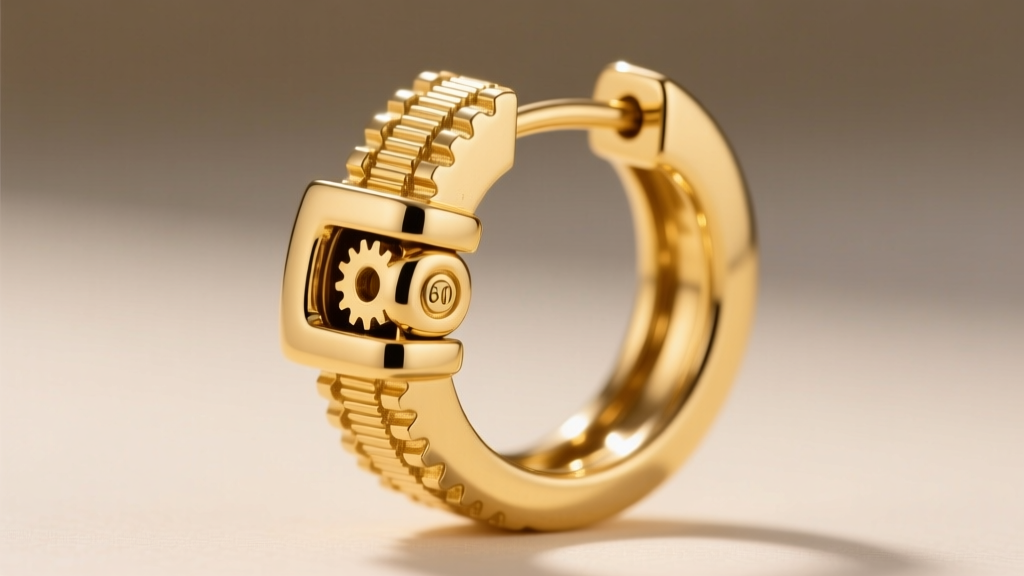
For 60mm gold hoop earrings, you need a hinge. A hinged clicker features a seamless barrel hinge that snaps shut with an audible "click," preserving the structural integrity of the hoop since no bending is required. A saddleback clasp offers even more security; the post locks into a grooved saddle, completely eliminating the risk of the earring catching on clothing and pulling open. When investing in large hoops, always prioritize hinged mechanisms over friction backs or wire latches.
Material Science: 14k vs. 18k Gold for Large Diameters
Gold purity drastically affects the durability of oversized jewelry. Pure 24k gold is far too soft for jewelry, so it is alloyed with metals like copper, silver, and zinc. According to the Gemological Institute of America (GIA), the ratio of these alloys dictates the Vickers hardness of the final metal.
- 18k Gold (75% Pure): Rich, warm color and highly hypoallergenic. However, it is relatively soft. A solid 18k gold 60mm hoop is prone to bending if dropped or slept on. Expect to pay $600–$1,200 for solid 18k hoops.
- 14k Gold (58.3% Pure): The gold standard for large, structural hoops. The higher alloy content increases tensile strength, meaning a 14k hoop will hold its perfect circular shape far better than 18k. Pricing typically ranges from $350–$800.
- Gold Vermeil (Sterling Silver Base): A budget-friendly option ($80–$150) featuring a thick layer of gold over sterling silver. While affordable, silver is highly malleable; vermeil 60mm hoops will warp easily and require frequent reshaping.
Styling 60mm Hoops for Your Face Shape
Because 60mm hoops drop roughly 2.5 inches below the earlobe, they interact directly with your jawline, neck, and shoulders. Styling them requires balancing proportions:
- Round Faces: Opt for 60mm hoops with a slightly oval or teardrop silhouette to elongate the face. Avoid perfectly wide circular hoops that mirror the roundness of your cheeks.
- Square Faces: Medium-to-thick round 60mm hoops soften angular jawlines beautifully. The curved metal contrasts elegantly with sharp bone structure.
- Heart-Shaped Faces: Hoops that are wider at the bottom (like a subtle triangle or elongated oval) help balance a narrower chin.
- Oval Faces: You have the versatility to wear any 60mm shape, from thick tubular vintage styles to ultra-thin modern wires.
Maintenance and Storage to Prevent Warping
Large hoops are notorious for getting crushed in the bottom of handbags or tangled in jewelry boxes. To maintain the pristine geometry of your 60mm gold hoop earrings, never store them loose. Utilize a jewelry box with dedicated, deep compartments, or hang them on a specialized earring tree. If your solid gold hoop does become slightly ovalized from pressure, do not attempt to bend it back into a circle with your bare hands, as this creates micro-fractures. Instead, take it to a local jeweler who can use a mandrel to gently reshape the metal without compromising its structural integrity.
Pro Tip: Always put your 60mm hoops in after applying hairspray, perfume, and lotions. The large surface area of the gold acts as a magnet for aerosolized chemicals, which can dull the high-polish finish over time. A quick wipe with a microfiber cloth after each wear will keep them looking brilliant for decades.


