Big Star Earrings: A Beginner's Guide to Celestial Style
Learn how to choose and style big star earrings. This beginner-friendly guide covers materials, weight distribution, and face shape matching.

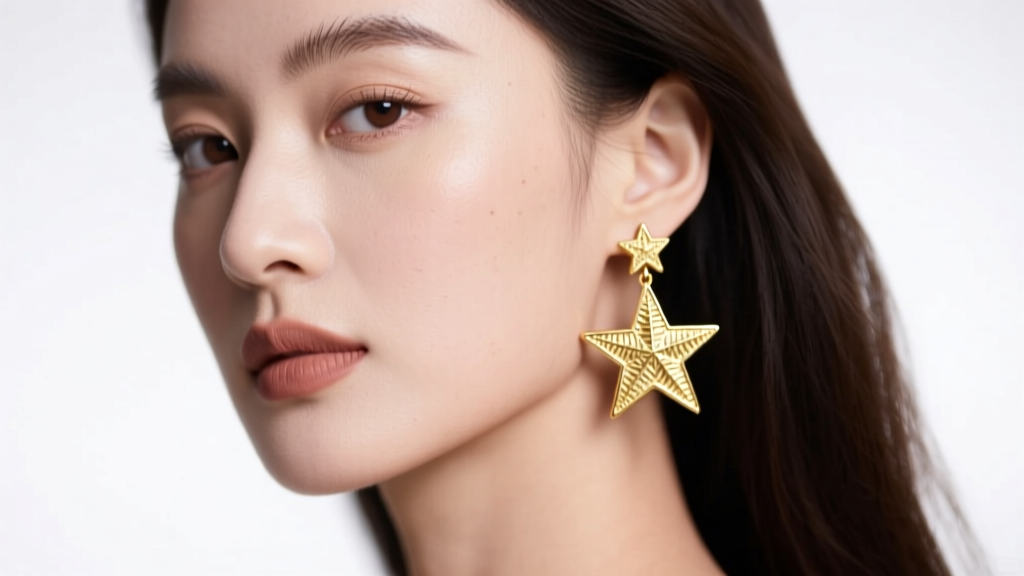
Why Big Star Earrings Are Dominating the Jewelry Scene
Celestial motifs have cycled through jewelry trends for decades, but the current iteration is all about scale and statement. Big star earrings have moved beyond festival wear and costume jewelry, evolving into sophisticated, demi-fine, and fine jewelry staples. For beginners, the appeal is obvious: they offer an instant focal point that elevates a simple outfit. However, transitioning from delicate studs to oversized celestial drops requires an understanding of jewelry mechanics, metallurgy, and styling proportions.
When you scale up a star motif, you are not just increasing the visual impact; you are exponentially increasing the weight, the center of gravity, and the potential for lobe strain. This guide will walk you through the exact specifications you need to look for when shopping for big star earrings, ensuring your earlobes remain healthy while your style shines.
The Metallurgy of Statement Stars: What to Avoid
The most common mistake beginners make when buying oversized fashion jewelry is ignoring the base metal. Because big star earrings require more raw material, manufacturers of cheap jewelry often use heavy, reactive alloys to keep costs down.
The Allergy and Tarnish Trap
Many fast-fashion star earrings are cast from brass or zinc alloy and plated with a microscopic layer of gold. According to the American Academy of Dermatology, prolonged contact with nickel and copper alloys frequently triggers allergic contact dermatitis. When an earring is heavy, it pulls against the piercing fistula (the hole), creating micro-tears that allow reactive metals to enter the bloodstream, resulting in itching, weeping, and swelling.
What to Buy Instead
- 925 Sterling Silver: An excellent, hypoallergenic choice for big star earrings. It is naturally white and can be polished indefinitely. However, silver is soft; ensure the post is reinforced.
- 14k Gold Vermeil: Vermeil requires a thick layer of gold (at least 2.5 microns) over a sterling silver base. It offers the look of solid gold without the exorbitant price tag of a 15-gram solid gold statement piece.
- Implant-Grade Titanium (ASTM F136):strong> If you have highly sensitive lobes, look for brands that use titanium posts, even if the decorative star face is silver or vermeil.
Understanding Gauge, Weight, and the 'Cheese Cutter' Effect
The physics of wearing big star earrings dictate that gravity will constantly pull the heavy decorative element downward. If the post connecting the star to your ear is too thin, it will act like a wire cheese cutter, slowly migrating through your earlobe tissue over time.
Gauge Sizes Explained
Earring thickness is measured in gauges (G). The higher the number, the thinner the wire.
- 20-Gauge (0.81mm): The industry standard for lightweight studs. Avoid this gauge for big star earrings over 8 grams.
- 18-Gauge (1.02mm): The ideal sweet spot for statement drops. It provides enough structural integrity to support a 2-inch star without bending, while still fitting comfortably through a standard pierced lobe.
- 16-Gauge (1.29mm): Often used in cartilage piercings, but excellent for extremely heavy, oversized star dangles. You may need to gently stretch your lobe piercing to accommodate this thickness.
The Association of Professional Piercers (APP) consistently warns against wearing heavy, poorly balanced jewelry in standard lobe piercings, noting that uneven weight distribution can lead to permanent lobe stretching and migration. Always check the gram weight of a statement piece before purchasing; aim to keep the weight under 15 grams per ear for all-day comfort.
Upgrading Your Ear Nuts
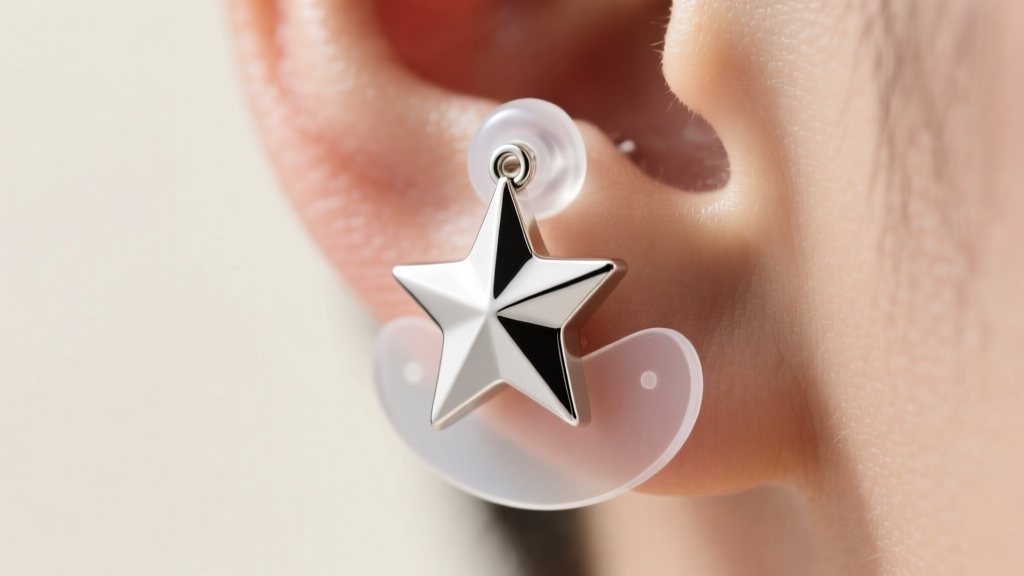
The standard metal butterfly clutch is the enemy of heavy earrings. Its small surface area concentrates the pulling force onto a tiny point on the back of your earlobe. To properly support big star earrings, swap your backs for:
- Wide Silicone Discs: These 10mm to 12mm flat discs distribute the weight across a broader area of the lobe.
- Jumbo Metal Ear Nuts: These feature a metal plate with a silicone insert, offering maximum grip and support.
- Adhesive Lobe Patches: Products like Lobe Wonder are hidden stickers applied to the back of the earlobe to provide a reinforced anchor point for heavy posts.
Matching Star Silhouettes to Your Face Shape
Not all stars are created equal. The geometry of the star should complement your natural facial structure. Use this framework to select the right silhouette.
| Face Shape | Ideal Star Silhouette | Why It Works | Styles to Avoid |
|---|---|---|---|
| Round | Elongated Shooting Stars, Linear Star Drops | Vertical lines draw the eye downward, creating the illusion of a longer, more oval face shape. | Wide, chunky 5-point stars that add horizontal volume to the cheeks. |
| Square | Soft-Edged Celestial Stars, Curved Starbursts | Rounded or softened points help balance and soften a strong, angular jawline. | Sharp, geometric, spiky starbursts that mimic and exaggerate sharp angles. |
| Heart | Asymmetrical Stars, Bottom-Heavy Dangles | Volume at the bottom of the earring balances a narrower chin and draws attention to the neck. | Top-heavy studs or wide hoops with star charms that emphasize a broader forehead. |
| Oval | Classic Chunky 5-Point Studs, Star Hoops | Oval faces are highly versatile and can pull off bold, wide, and perfectly symmetrical proportions. | Extremely long drops that might over-elongate an already balanced face. |

The Styling Framework: Balancing the 'One Statement' Rule
When wearing big star earrings, the jewelry is the protagonist of your outfit. The most common beginner mistake is competing with the earrings through busy necklines or chaotic ear stacks.
Curating the Ear Stack
If your main lobe piercing is occupied by a massive 2-inch star drop, your upper lobe and cartilage piercings should play a supporting role. Pair your statement stars with:
- Micro-Huggies: A tiny, 8mm plain gold or silver huggie in the second-hole piercing adds a subtle gleam without stealing focus.
- Single Gemstone Studs: A 2mm diamond or sapphire stud in the third hole bridges the gap between the ear and the main star.
- Minimalist Cuffs: A plain, unadorned helix cuff keeps the celestial theme grounded in modern minimalism.
Navigating Necklines and Hair
Big star earrings require physical clearance. High collars, turtlenecks, and ruffled blouses will snag on the points of the stars, potentially bending the metal or tearing your clothing. Opt for V-necks, scoop necks, or strapless tops to provide a clean canvas. If you have long hair, sweeping it into a sleek low bun or a side-swept updo ensures the earrings remain visible and prevents the star points from tangling in your strands.
Care, Maintenance, and Storage
Oversized earrings are prone to bending and tarnishing if not stored correctly. Because of their large surface area, sterling silver and vermeil stars are exposed to more oxygen and moisture, accelerating oxidation.
- The Polish: Keep a treated jewelry polishing cloth on hand. Wipe down the stars after every wear to remove skin oils and environmental pollutants.
- The Storage: Never toss big star earrings into a communal jewelry box where they can scratch softer pieces or get bent under heavier items. Store them flat in individual anti-tarnish ziplock bags or lay them flat in a lined drawer with dedicated compartments.
- The Snag Check: Periodically run a cotton ball over the points of your star earrings. If the cotton catches, the metal has developed a microscopic burr that needs to be gently filed with a jeweler's buffer to prevent it from catching on your hair or clothes.
By prioritizing structural integrity, choosing biocompatible metals, and respecting the geometry of your face shape, you can confidently integrate big star earrings into your everyday rotation. The key to mastering statement jewelry is understanding the mechanics behind the magic.


