Best Earring Sizes for Face Shapes: 2026 Hoop & Drop Guide
Find your perfect earring size by face shape—2026 guide with exact hoop diameters, drop lengths & styling tips. Look balanced & confident instantly. Get.


The Architecture of Adornment: Why Millimeters Matter
Finding the perfect pair of earrings goes far beyond selecting your preferred metal or gemstone. It is fundamentally an exercise in architectural proportion and visual balance. As we navigate the 2026 jewelry landscape, the industry has shifted heavily toward proportion-aware styling, moving away from one-size-fits-all trends. When determining the best earring sizes for different face shapes, we must evaluate the intersection of precise millimeter measurements, physical gram weight, and individual facial geometry.
According to principles outlined by the American Academy of Facial Plastic and Reconstructive Surgery, the human face is generally divided into horizontal thirds and vertical fifths. Earrings act as a framing mechanism for these proportions. A 15mm huggie hoop will interact entirely differently with a strong, angular jawline than it will with a soft, tapered chin. This guide breaks down the exact dimensions, gauge requirements, and structural considerations you need to make an informed purchase.
Decoding the Best Earring Sizes for Different Face Shapes
To master earring proportionality, we must look at specific measurements. Here is how to match exact earring dimensions to the four primary facial structures.
Oval Faces: The Universal Canvas
Oval faces are characterized by balanced proportions, where the length of the face is roughly one and a half times the width. Because the skeletal structure is naturally symmetrical, oval faces can support nearly any earring size. However, to maintain this natural harmony, the ideal hoop diameter sits between 20mm and 30mm.
- Studs: 6mm to 10mm solitaires (diamond or moissanite) sit perfectly without overwhelming the lobe.
- Drops: Linear drops measuring 25mm to 40mm highlight the cheekbones without dragging the face downward.
- Avoid: Extremely wide, oversized chandeliers (50mm+ in width) that obscure the natural jawline and widen the face artificially.
Round Faces: Elongation and Angles
Round faces have similar width and length measurements with softer, curved jawlines. The primary styling objective here is visual elongation. The worst mistake you can make is echoing the face's natural geometry with small, round jewelry.
- Hoops: Skip standard 20mm round hoops. Instead, opt for elongated oval hoops or squared hoops measuring 30mm to 40mm in length.
- Dangles: Look for sharp, geometric dangles or linear bar earrings that drop at least 45mm to 60mm below the lobe. This creates a vertical line that visually slims and lengthens the face.
- Avoid: 10mm to 15mm round studs and tight circular huggies, which emphasize facial width.
Square Faces: Softening the Jawline
A square face features a broad forehead and a strong, angular jawline with the width of the forehead, cheekbones, and jaw being roughly equal. The goal is to soften the masseter muscles and draw the eye upward.
- Hoops: Curved, medium-sized hoops in the 25mm to 35mm range introduce necessary curves to contrast the angular bone structure.
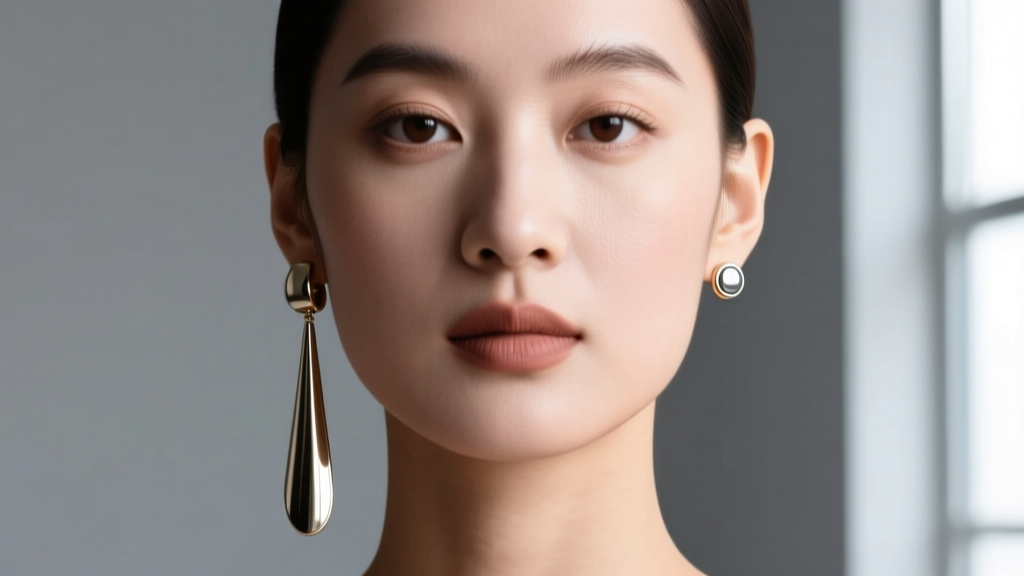
- Drops: Teardrop or pear-shaped dangles measuring 30mm to 50mm in length are ideal. The rounded bottom of the teardrop softens the lower third of the face.
- Avoid: Square or rectangular geometric drops, and very short, wide studs that sit flush against the lobe, as they mirror and exaggerate the jaw's sharpness.
Heart Faces: Balancing the Forehead and Chin
Heart-shaped faces feature a wider forehead and cheekbones that taper down to a narrow, pointed chin. The styling objective is to add visual weight to the lower half of the face to create equilibrium.
- Chandeliers & Drops: Bottom-heavy designs are your best friend. Look for teardrops or chandelier earrings that are widest at their base, measuring 20mm to 30mm in width and 35mm to 50mm in length.
- Studs: If you prefer studs, choose wider, horizontal geometric shapes or clustered floral designs (10mm to 14mm wide) rather than tall, vertical marquise cuts.
- Avoid: Inverted triangle shapes or top-heavy dangles that draw all the visual weight upward, further emphasizing the forehead.
Exact Millimeter Dimensions & Hoop Diameters
To eliminate the guesswork when shopping online, reference this structural sizing chart. These measurements represent the optimal visual weight for each facial geometry.
| Face Shape | Ideal Hoop Diameter | Ideal Drop Length | Optimal Stud Width | Best Geometric Silhouette |
|---|---|---|---|---|
| Oval | 20mm - 30mm | 25mm - 40mm | 6mm - 10mm | Any (Versatile) |
| Round | 30mm - 40mm (Elongated) | 45mm - 60mm | 4mm - 8mm (Angular) | Linear, Rectangular |
| Square | 25mm - 35mm (Curved) | 30mm - 50mm | 8mm - 12mm (Round) | Teardrop, Oval |
| Heart | 15mm - 25mm (Bottom-heavy) | 35mm - 50mm | 10mm - 14mm (Wide) | Chandelier, Pear |
Material Weight, Gauge Sizes, and Lobe Health
Understanding the best earring sizes for different face shapes is incomplete without addressing the physical mechanics of the jewelry. Visual size does not always equal physical weight, but when dealing with drops and dangles over 30mm, structural integrity becomes critical.
Standard lobe piercings are typically done at 20-gauge (0.81mm) or 18-gauge (1.02mm). If you are purchasing elongated 50mm drop earrings for a round face, you must check the gram weight and the wire thickness.
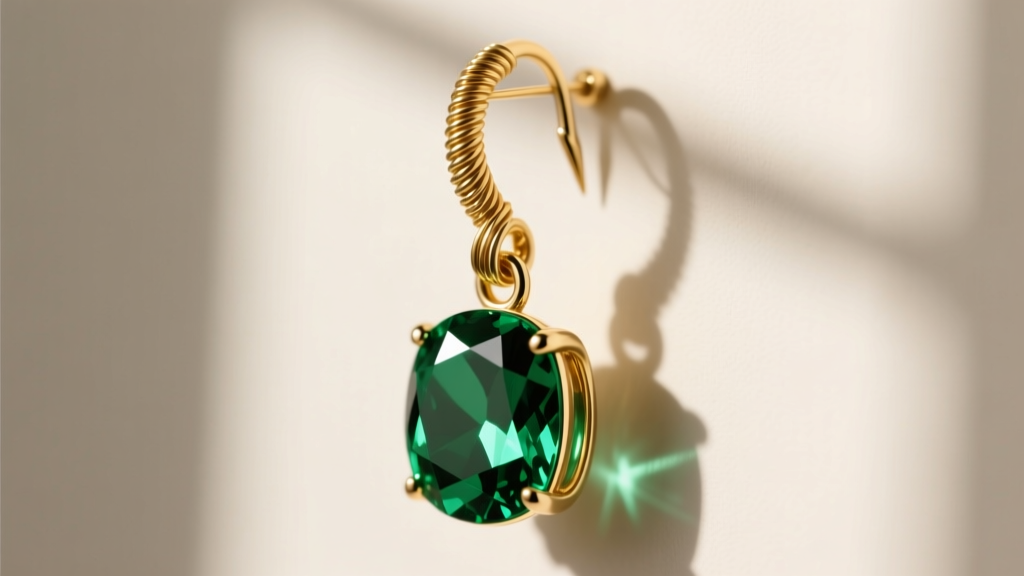
"Any earring exceeding 8 grams in physical weight will cause lobe creep and stretching over time if hung on a standard 20-gauge wire. For heavy, face-elongating dangles, always seek out 18-gauge or 16-gauge (1.29mm) structural wires, or opt for lever-back closures that distribute the tension across a wider surface area of the earlobe."
Furthermore, material density matters. According to the GIA Gem Encyclopedia, different gemstones carry vastly different specific gravities. A 30mm dangle featuring solid cubic zirconia will weigh significantly less than one featuring natural sapphire or high-density glass. If you require a large, 40mm+ earring to balance a round or heart-shaped face but suffer from sensitive, easily stretched lobes, look for hollow-tube gold hoops or lightweight titanium frameworks. Titanium (Grade 23 Ti-6Al-4V) offers exceptional tensile strength at a fraction of the weight of 14k gold, allowing for larger, dramatic silhouettes without the physical drag.
Common Sizing Mistakes to Avoid
Even when you select the correct millimeter size for your face shape, environmental and anatomical factors can ruin the proportion. Avoid these common purchasing errors:
- Ignoring Hair Volume and Length: A 35mm drop earring designed to elongate a round face will be completely swallowed by thick, shoulder-length curls. If you wear your hair down frequently, you must increase your target drop length by 15mm to 20mm to ensure the jewelry remains visible and functional.
- Mismatching Neck Length: The negative space between your earlobe and your collarbone is crucial. If you have a shorter neck, wearing 60mm chandelier earrings (even if they suit your heart-shaped face) will create visual clutter and make your neck appear non-existent. Cap your drop length at 35mm and rely on width at the base for balance.
- Overlooking the Closure Type: Large, heavy hoops (35mm+) meant to soften square faces will warp and lose their perfect circular shape if they utilize thin, flimsy post-and-butterfly closures. Always look for saddle-backed hinges or clicker mechanisms in thicker gauges to maintain the structural geometry of the hoop.
Expert Verdict: Proportion is Personal
Ultimately, identifying the best earring sizes for different face shapes requires a blend of objective millimeter guidelines and subjective styling. Use the dimensional charts above as your foundational baseline. When shopping, always check the product specifications for exact drop lengths and hoop diameters rather than relying on scaled model photography. By marrying precise structural data with your unique facial architecture, you can curate a collection that enhances your natural geometry flawlessly.


