The Engineering Behind Big Gold Stud Earrings: Weight, Karats & Fit
Discover the metallurgy and ergonomic engineering of big gold stud earrings. Learn about karat hardness, post gauges, and secure backing mechanisms.

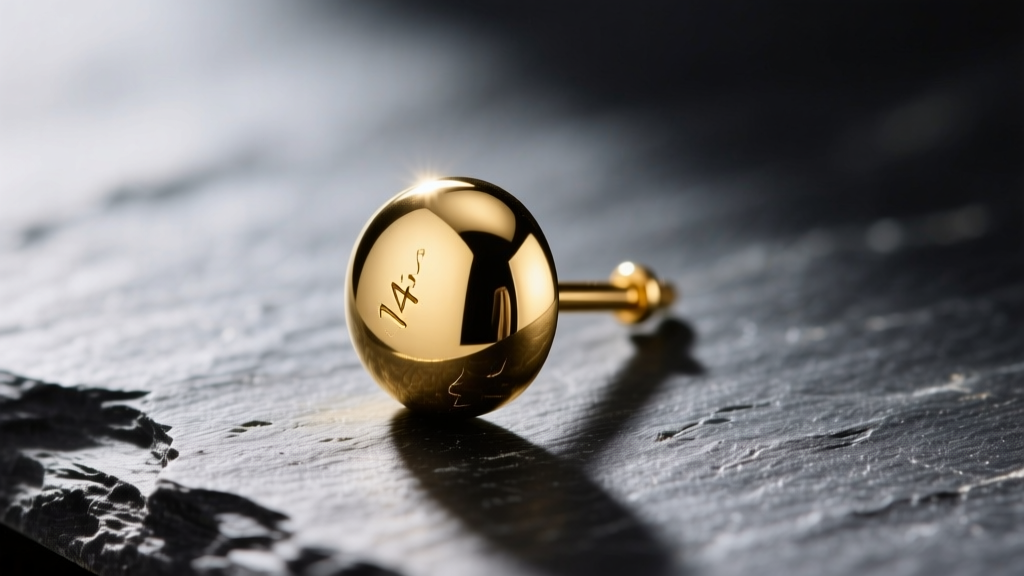
When consumers search for big gold stud earrings, they are typically looking for pieces that make a bold visual statement—usually defined in the jewelry industry as studs exceeding 10mm in diameter or weighing more than 4 grams per ear. However, scaling up a stud earring is not simply a matter of pouring more metal into a mold. The transition from a delicate 4mm everyday stud to a 15mm statement piece introduces complex structural, metallurgical, and ergonomic challenges. In 2026, as jewelry buyers become increasingly educated on material longevity, understanding the engineering behind oversized gold jewelry is essential for making a lasting investment.
This expert deep dive explores the precise metallurgy, manufacturing techniques, and mechanical physics required to produce high-quality large gold studs that sit flush, resist warping, and protect the earlobe from long-term damage.
The Metallurgy of Oversized Studs: Why Karat Matters
The purity of gold is measured in karats, but in the context of large surface-area jewelry, purity is inversely proportional to structural integrity. Pure 24-karat gold is exceptionally malleable, registering a mere 25 to 30 on the Vickers Hardness (HV) scale. If a 15mm flat disc were crafted from 24k gold, the sheer weight of the earring combined with the softness of the metal would cause it to bend, warp, or dent under minimal pressure, such as resting your head against a pillow.
To create durable big gold stud earrings, metallurgists must alloy the gold with metals like copper, silver, and zinc. This not only alters the color but fundamentally changes the crystalline structure of the metal, increasing its yield strength.
| Gold Karat | Purity (%) | Vickers Hardness (HV) | Suitability for Large Studs (>12mm) |
|---|---|---|---|
| 24K | 99.9% | ~25 HV | Poor. High risk of warping and scratching. |
| 22K | 91.6% | ~70 HV | Fair. Acceptable for domed shapes, poor for flat discs. |
| 18K | 75.0% | ~120 HV | Excellent. Optimal balance of rich color and structural rigidity. |
| 14K | 58.5% | ~145 HV | Superior. Maximum durability for heavy, oversized geometric shapes. |
According to the Gemological Institute of America (GIA), the specific alloy mix also dictates the metal's work-hardening properties. For large studs, 14k and 18k yellow or rose gold alloys provide the necessary tensile strength to support heavy front-facing designs without the post snapping at the solder joint.
Structural Engineering: Die-Striking vs. Casting
How a large gold stud is manufactured dictates its density, weight, and lifespan. The vast majority of commercial jewelry is produced via lost-wax casting. While casting is excellent for intricate, three-dimensional designs, it introduces microscopic porosity into the gold as the molten metal cools. For a large, flat gold stud, this porosity creates weak points that can lead to micro-fractures over time.
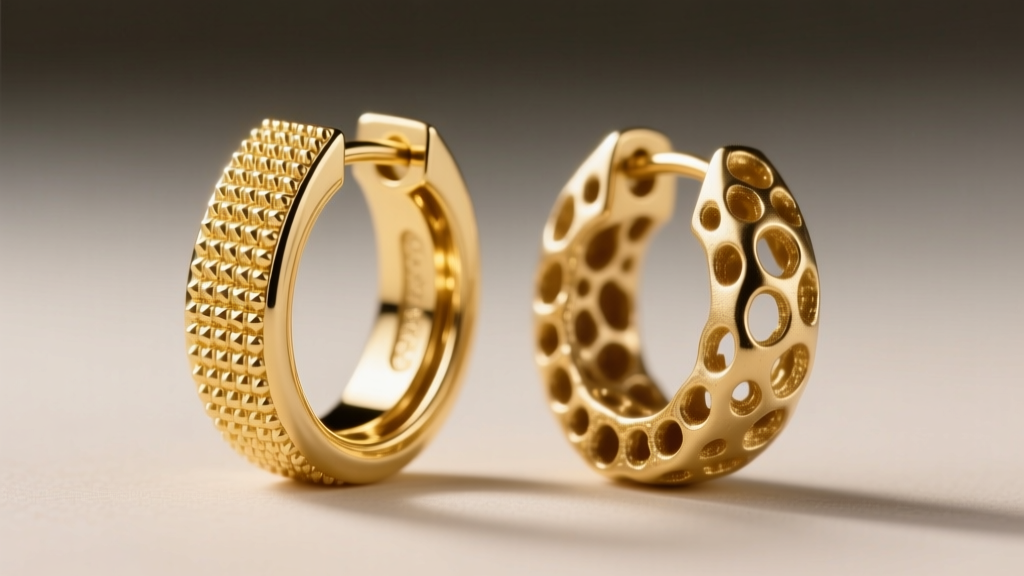
Premium big gold stud earrings are often die-struck. In this process, a sheet of gold alloy is subjected to immense hydraulic pressure—often exceeding 50 tons—forcing the metal into a steel die. This pressure compresses the molecular grain structure of the gold, eliminating porosity and aligning the crystalline matrix.
The result? A die-struck 14mm gold stud is significantly denser and up to 30% stronger than a cast equivalent. This allows manufacturers to mill the earring slightly thinner, reducing the overall weight on the earlobe while actually increasing the structural rigidity of the piece. When evaluating large studs, always ask the jeweler if the face of the earring is die-struck or cast.
The Physics of the Post: Gauge, Length, and Solder Placement
The most common failure point in oversized gold studs is the post. A standard earring post is 20-gauge (0.81mm thick). When you attach a 6-gram, 16mm gold front to a 20-gauge post, you create a severe lever arm. The torque generated by the weight of the gold face causes the thin post to bend, leading to the dreaded 'pendulum effect' where the earring constantly droops and rotates on the ear.
Optimal Post Specifications for Heavy Studs
- Gauge Thickness: Large studs require a minimum of 18-gauge (1.02mm) or 16-gauge (1.29mm) posts to resist torsional stress and bending.
- Post Length: Standard posts are 8mm to 9mm. Big gold stud earrings require 10mm to 12mm posts to accommodate the thickness of the earlobe plus the wider base of the heavy earring head.
- The High-Solder Technique: In a perfectly balanced stud, the post is soldered dead-center. However, for heavy, oversized studs, master jewelers use a 'high-solder' or '12 o'clock' placement. By attaching the post slightly above the true center of gravity, the weight of the bottom half of the earring pulls it downward, forcing the face to sit perfectly flush against the earlobe rather than tilting forward.
Advanced Backing Systems to Prevent Lobe Droop
The backing mechanism is the unsung hero of heavy earring ergonomics. Standard 5mm 'butterfly' friction backs are entirely inadequate for big gold stud earrings. They provide a surface area that is too small, causing the backing to dig into the neck and fail to support the forward weight of the gold.
To maintain a flush, comfortable fit, experts recommend the following backing systems:
- La Pousette (Locking) Backs: These mechanical backs feature a spring-loaded clutch that locks securely onto a grooved post. They distribute pressure evenly and will not slide off, making them ideal for heavy gold pieces.
- Jumbo Silicone O-Rings: Measuring 8mm to 10mm in diameter, these provide a wide, cushioned barrier that prevents the earring from drooping while protecting the skin behind the ear.
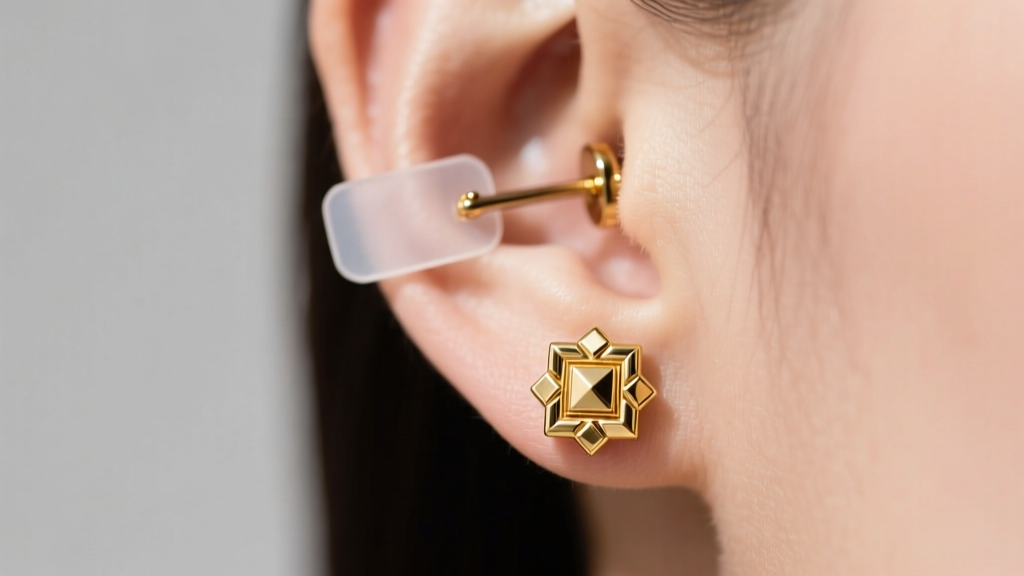
- Earlobe Support Patches: For vintage or exceptionally heavy 22k gold studs, adhesive silicone support patches (like LobeWonder) can be applied to the back of the earlobe to distribute the mechanical load and prevent tissue stretching over time.
Buyer’s Framework: Evaluating Big Gold Stud Earrings
When investing in large-scale gold studs, the price per gram is only one metric of value. The World Gold Council notes that the craftsmanship required to engineer heavy jewelry often commands a premium over raw material costs. Use this checklist to evaluate your next purchase:
'A large gold stud should feel substantial in the hand, but the true test is the post. If the post is thin and the backing is a standard butterfly clutch, the earring will fail ergonomically, no matter how beautiful the gold finish is.' — Master Bench Jeweler
- Verify the Alloy: Ensure the piece is stamped 14K or 18K. Avoid 22K or 24K for flat, oversized geometric shapes unless they are heavily domed for structural support.
- Inspect the Solder Joint: Look at where the post meets the earring back. There should be a generous, smooth bead of solder (often laser-welded in modern 2026 manufacturing) with no visible pitting or gaps.
- Test the Center of Gravity: Hold the earring by the post between your thumb and forefinger. If the top heavily outweighs the bottom, the post was soldered too low, and the earring will droop when worn.
- Demand Proper Backings: If the retailer only supplies standard friction backs, budget an additional $25-$40 to purchase aftermarket La Pousette or jumbo silicone clutches to protect your earlobes.
By prioritizing metallurgical hardness, die-struck density, and ergonomic post mechanics, you can confidently select big gold stud earrings that offer both striking visual impact and lifelong structural durability.


