Black Cross Earrings Men: Troubleshooting Tarnish, Fit & Allergies
Fix fading, allergies, and stretching with our troubleshooting guide to black cross earrings men. Learn PVD vs plating, gauge sizes, and metal grades.


Black cross earrings are a cornerstone of men's jewelry, offering a sharp, versatile aesthetic that ranges from subtle gothic undertones to sleek, modern minimalism. However, the market is flooded with poorly manufactured pieces that lead to three major frustrations: the black finish rubbing off to reveal cheap brass, sudden skin irritation, and heavy dangles stretching the earlobe. If you are shopping for black cross earrings men or trying to salvage a favorite pair that has seen better days, understanding the metallurgy and mechanics behind them is critical. This guide bypasses generic style advice to deliver actionable, expert-level troubleshooting for the most common failure points in men's dark-toned ear jewelry.
The Core Problem: Why Your Black Finish is Fading
The most frequent complaint regarding black men's earrings is the inevitable shift from deep black to a patchy, gunmetal grey. This happens because "black metal" is rarely solid; it is almost always a surface treatment applied over a base metal. To troubleshoot this, you must identify which manufacturing process was used on your earrings.
Electroplating vs. PVD Coating
Most fast-fashion and mid-tier black cross earrings utilize electroplating, typically using black rhodium or ruthenium. While initially brilliant, electroplated layers are microscopically thin (often less than 0.5 microns). The natural acidity of male skin oils, combined with friction from pillows and hoodies, strips this plating in 3 to 6 months.
The permanent solution is PVD (Physical Vapor Deposition). PVD coating vaporizes titanium carbonitride in a vacuum chamber, bonding it to the base metal at a molecular level. PVD black finishes are up to 10 times more durable than electroplating and can withstand daily gym sessions and sweat without fading. When shopping, explicitly look for "PVD black" or "IP black" (Ion Plating) in the product specifications.

Finish Durability & Material Matrix
| Finish Type | Base Metal | Estimated Lifespan | Sweat Resistance | Price Range |
|---|---|---|---|---|
| Electroplated (Black Rhodium) | Sterling Silver / Brass | 3 - 8 Months | Low | $25 - $80 |
| Oxidized (Chemical Patina) | Sterling Silver | 1 - 2 Years (Requires upkeep) | Medium | $40 - $120 |
| PVD / Ion Plating | 316L Steel / Titanium | 5+ Years | High | $45 - $150 |
| Solid Black Zirconia Ceramic | Ceramic (No coating) | Lifetime | High | $60 - $200 |
Troubleshooting Skin Irritation & "Green Ear" Syndrome
If your earlobe is itching, flaking, or turning green, the black coating on your cross earring has likely worn away at the friction points (the post and the back of the stud), exposing the underlying alloy. According to the Mayo Clinic, nickel is the most common culprit for contact dermatitis in jewelry, and cheap brass bases often contain high nickel content or copper, which oxidizes green when exposed to sweat.
The Hypoallergenic Upgrade Path
To permanently solve this, you must abandon plated base metals. Implement the following decision framework for your next purchase:
- For Sensitive Skin (The Gold Standard): Seek out solid ASTM F136 Implant-Grade Titanium with a PVD black finish. Titanium is entirely nickel-free and biocompatible, meaning it is the exact metal used in medical bone screws.
- For Heavy Sweaters/Athletes: Choose 316L Surgical Stainless Steel with PVD coating. While 316L contains trace amounts of nickel, the PVD coating acts as an impenetrable barrier. However, if you have a severe, clinically diagnosed nickel allergy, stick strictly to titanium or solid 14k black gold.
- The Ceramic Alternative: High-tech black zirconia ceramic is completely inert, non-metallic, and naturally black all the way through. It cannot tarnish or cause allergic reactions.
Fixing Gauge Mismatches and Lobe Stretching
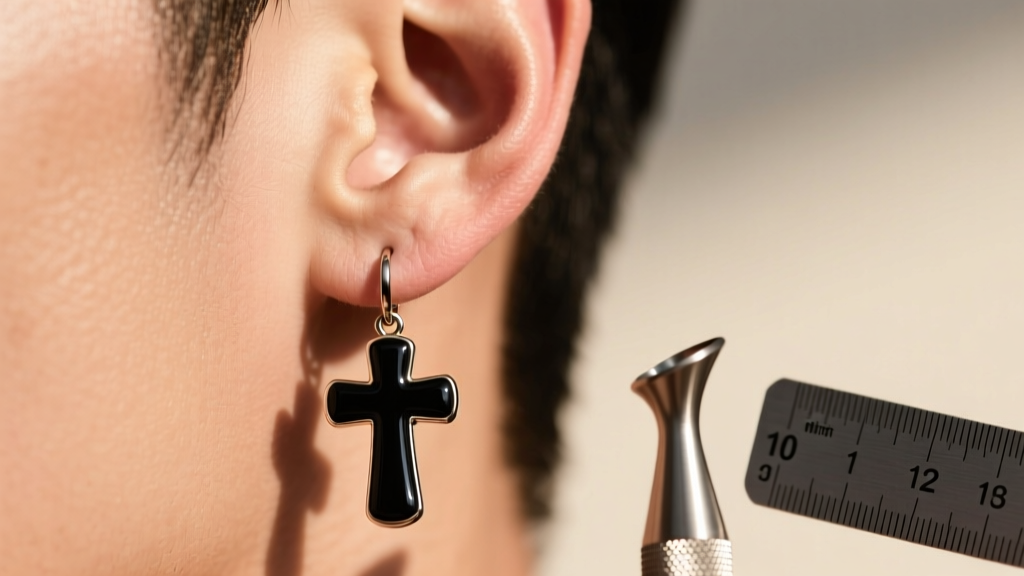
A poorly fitted earring post will cause micro-tears in the fistula (the piercing hole), leading to chronic soreness and eventual lobe drooping. Men's standard lobe piercings are typically done at 20G (0.81mm) or 18G (1.02mm). Many manufacturers of men's fashion jewelry mistakenly use thicker 16G (1.29mm) or 14G (1.63mm) posts designed for cartilage or body piercing, forcing the metal through a hole that is too small.
Weight Distribution in Dangle Crosses
If you prefer a dangle or drop cross earring over a stud, weight becomes a critical structural issue. The Gemological Institute of America (GIA) and jewelry metallurgists note that continuous wear of heavy earrings alters the collagen structure of the earlobe over time.
"Any dangle earring exceeding 7 grams will begin to exert downward pressure that exceeds the natural tensile recovery of standard earlobe tissue. For men wearing heavy materials like solid steel or large onyx stones, switching to a hollow-backed casting or a lightweight titanium framework is essential to prevent the 'cheese-cutter' stretching effect."
Troubleshooting Steps for Heavy Crosses:
- Check the weight specifications before buying. Keep daily-wear dangles under 5 grams.
- If you already own a heavy black cross dangle, limit wear to 4-6 hour intervals.
- Use a supportive silicone backing (like a flat disc pad) rather than a standard butterfly back to distribute the weight across a wider surface area of the back of the lobe.
Securing the Backs: Stop Losing Your Earrings
Men are statistically more likely to lose earrings due to friction from towels, helmets, and changing shirts. The standard "butterfly" friction back relies on a small metal spring mechanism that degrades over time, losing its grip on the post notch.
Upgrading Your Hardware
If you are losing your black cross studs, troubleshoot the backing mechanism immediately:
- Screw-Back Posts: The most secure option. The post is threaded, and the backing screws on. This requires buying a specific threaded earring set, but it guarantees the earring will not fall off during sleep or sports.
- Silicone O-Rings / Flat Discs: If you have standard straight posts, discard the metal butterfly backs. Purchase 1mm silicone O-rings from a jewelry supply store. They grip the post via high-friction elastomer tension and are virtually impossible to knock off accidentally.
- Latch-Backs for Hoops/Cliques: If your cross is integrated into a hoop or clicker, ensure the hinge features a "snap-fit" closure. If the closure feels loose, a jeweler can gently tighten the tension pin with specialized pliers.
Expert Maintenance Protocol for Black Finishes
Improper cleaning is the fastest way to ruin a black finish. Many men make the mistake of using silver polish, ultrasonic cleaners, or alcohol-based solutions on their black earrings. Silver polish contains mild abrasives that will strip black rhodium and oxidized patinas instantly. Ultrasonic vibrations can cause PVD coatings to micro-fracture if the base metal was poorly prepped.
The Safe Cleaning Routine:
- Use a few drops of pH-neutral dish soap (like Dawn) mixed with lukewarm water.
- Soak the earrings for 3 minutes to break down sebum and dead skin cells.
- Gently agitate with a baby-soft toothbrush (never a medium or hard bristle brush).
- Rinse with distilled water to prevent hard water calcium spots.
- Dry immediately with a clean, lint-free microfiber cloth. Leaving them to air dry can trap moisture against the post, accelerating base-metal corrosion if the plating is compromised.
By understanding the metallurgy of PVD coatings, respecting the gauge and weight limits of your anatomy, and upgrading your backing hardware, you can ensure your black cross earrings remain a permanent, trouble-free fixture in your wardrobe.


