Hoop Earrings Men Gold: Technical Guide to Alloys & Gauges
Discover the technical specs for hoop earrings men gold. We analyze karat alloys, gauge thickness, clasp mechanics, and 2026 market pricing.

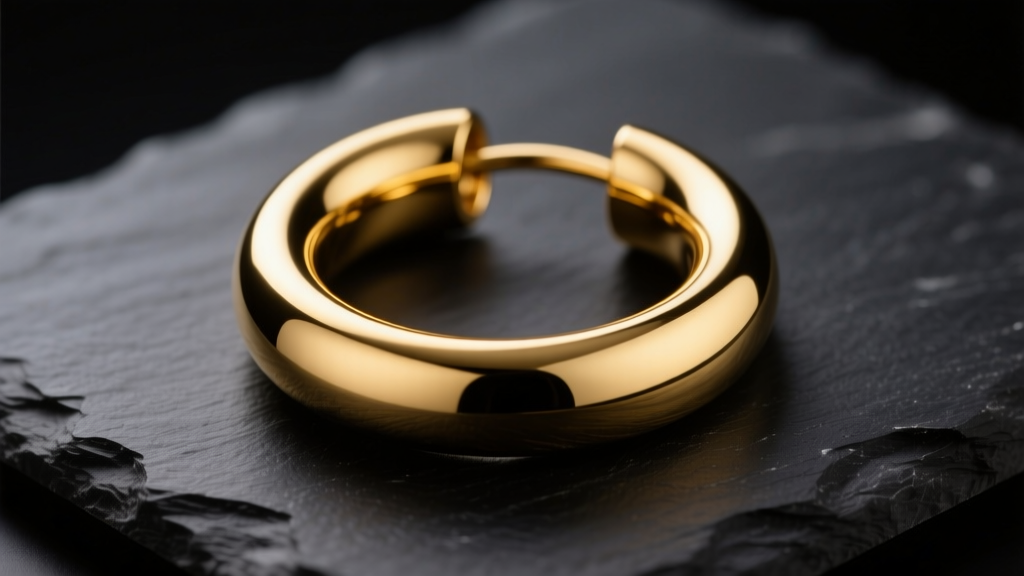
The Metallurgy of Men's Gold Hoops: 14K vs. 18K vs. 22K
The technical specifications behind hoop earrings men gold dictate that structural integrity must balance aesthetic purity with mechanical durability. Pure 24-karat gold possesses a Vickers hardness (HV) of merely 25-30, making it entirely unsuitable for continuous hoop structures which rely on metal memory and tensile strength to maintain their circular geometry and secure the lobe. Consequently, the industry relies on precise alloying to achieve the necessary mechanical properties.
According to the Gemological Institute of America (GIA), alloying gold with copper, silver, and zinc fundamentally alters its crystalline lattice structure, increasing its yield strength. For men's hoops, which are frequently subjected to higher mechanical stress due to heavier gauge requirements and active lifestyles, the choice of karat is a critical engineering decision.
14K Gold (58.3% Au): The Structural Workhorse
With a Vickers hardness ranging from 120 to 150 HV (depending on heat treatment and specific copper-to-silver ratios), 14K gold offers the highest tensile strength among standard jewelry alloys. The higher copper content not only provides structural rigidity but also increases the alloy's resistance to deformation. However, this copper concentration makes 14K gold susceptible to stress corrosion cracking if exposed to chlorine or bromine, a vital consideration for daily wearers.
18K Gold (75.0% Au): The Luxury Standard
18K gold typically exhibits a Vickers hardness of 125 to 170 HV. Modern metallurgical techniques, including precise annealing and quenching protocols, allow manufacturers to achieve a hardness in 18K gold that rivals 14K, while retaining the deep, rich color saturation demanded in the luxury market. For hoop earrings men gold, 18K is the optimal choice for hinged segment rings where the clasp mechanism requires precise machining without the brittleness associated with lower-karat alloys.
22K Gold (91.6% Au): The Liability
While 22K gold (HV ~60-80) is prized in specific cultural markets, it is mechanically inadequate for men's hoop earrings exceeding 12mm in diameter. The metal lacks the elastic limit required to withstand the lateral torque applied during insertion and removal, leading to permanent ovalization of the hoop over time.
Gauge Thickness and Structural Integrity
When evaluating hoop earrings men gold, gauge thickness is the primary determinant of both visual weight and biomechanical compatibility. The American Wire Gauge (AWG) system is inversely proportional to thickness; a lower number indicates a thicker wire. The Association of Professional Piercers (APP) provides stringent guidelines on jewelry dimensions to prevent tissue migration and tearing.
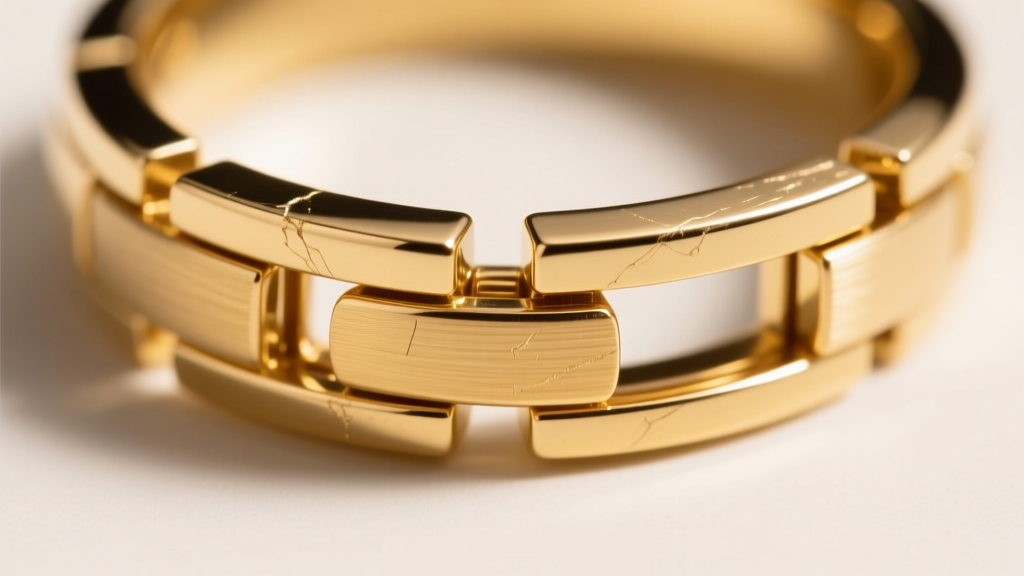
Men's earlobe tissue is generally denser and requires wider jewelry to prevent the 'cheese-cutter effect,' where a thin wire slowly migrates through the tissue under the weight of the gold. Below is the technical breakdown of standard gauges used in men's gold hoops:
- 16-Gauge (1.2mm): Standard for initial lobe piercings and cartilage (helix/tragus). Rarely used for heavy men's gold hoops due to the high density of gold; a 16G solid gold hoop can still cause migration if the diameter is large enough to create pendulum momentum.
- 14-Gauge (1.6mm): The baseline for standard men's lobe hoops. Provides adequate surface area to distribute the weight of a 12mm-15mm diameter hoop.
- 12-Gauge (2.0mm): The sweet spot for men's fashion hoops. Offers a bold, masculine profile while maintaining structural rigidity in 14K and 18K alloys without requiring stretched lobes.
- 10-Gauge (2.4mm) to 8-Gauge (3.0mm): Reserved for stretched lobes or intentionally heavy, statement-making continuous rings. A 20mm diameter hoop in 8-gauge solid 18K gold weighs approximately 4.8 grams per earring, requiring robust tissue density to prevent lobe elongation over time.
Clasp Mechanics: Engineering the Closure
The closure mechanism is the most frequent point of failure in any hoop earring. In men's gold hoops, the clasp must withstand higher torque and lateral stress. Understanding the mechanical limitations of each clasp type is essential for long-term durability.
| Clasp Type | Mechanism | Best Gauge Application | Primary Failure Mode |
|---|---|---|---|
| Hinged Segment Ring (HSR) | Tension pin and machined groove | 10G - 6G | Groove wear causing accidental release |
| Clicker (Hinged) | Spring-loaded internal latch | 16G - 12G | Spring fatigue and debris obstruction |
| Continuous (Endless) | Friction-fit post into hollow tube | 18G - 14G | Post deformation and tube stretching |
| Captive Bead Ring (CBR) | Tension of the ring holding a bead | 12G - 0G | Loss of ring tension and bead ejection |
For solid gold applications, the Hinged Segment Ring (HSR) is the superior engineering choice for thicker gauges (10G and below). The mating surfaces of the pin and the receiving groove are CNC-machined to tolerances of less than 0.05mm. However, if the gold alloy is too soft (e.g., improperly annealed 18K), the repeated impact of the pin seating into the groove will eventually cause 'peening'—a deformation of the gold that leads to a loose fit and accidental opening.
The Continuous Ring, while aesthetically seamless, relies entirely on the elastic limit of the gold wire. To insert a continuous ring, the wearer must bend the wire laterally. If the gold is work-hardened during manufacturing, this repeated bending will induce metal fatigue, ultimately resulting in a catastrophic snap at the junction of the post and the hoop body.
Biomechanics: Sizing and Proportions for Male Anatomy
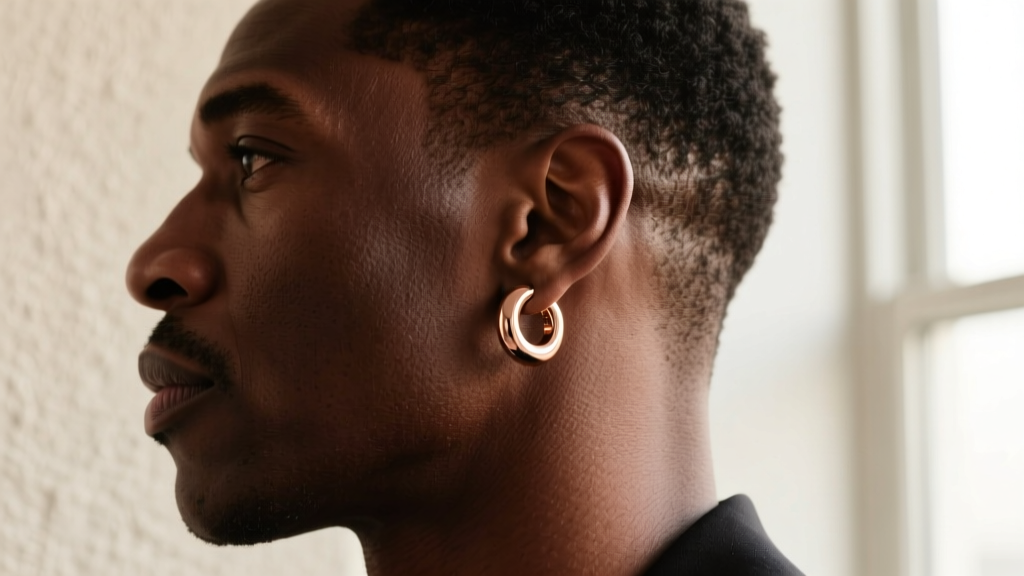
The Inner Diameter (ID) of a hoop earring is arguably more critical than the Outer Diameter (OD) when fitting male anatomy. The ID must account for the thickness of the earlobe plus a minimum clearance of 3mm to 5mm to accommodate natural tissue swelling, temperature-induced vascular expansion, and sleeping pressure.
A common error in men's jewelry sizing is selecting a hoop based on visual proportions without calculating the lobe-to-helix clearance. A 15mm ID hoop on a thick male lobe (which can easily exceed 10mm in depth) leaves only 5mm of clearance. This creates a high-friction environment where the back of the hoop constantly rubs against the neck or jawline, accelerating localized wear on the gold alloy and increasing the risk of contact dermatitis if the wearer has a sensitivity to the copper or nickel (though nickel-free is standard in 2026) content in the alloy.
Expert Sizing Formula: Measure the lobe thickness at the piercing site. Add 4mm for standard clearance, or 6mm if the wearer frequently sleeps on the side of the piercing. This sum equals your minimum required Inner Diameter (ID).
2026 Market Pricing and Authenticity Verification
As of 2026, with global gold spot prices stabilizing at historic highs, the pricing architecture for solid gold men's hoops has shifted from brand-centric premiums to material-weight transparency. Reputable manufacturers now price hoop earrings men gold using a transparent formula: (Current Spot Price × Weight in Troy Ounces) + Manufacturing Premium + Gemstone/Setting Labor.
For a standard pair of 12-gauge, 15mm ID solid 14K gold hinged hoops weighing 4.2 grams total, the intrinsic melt value is directly tethered to the daily spot market. Buyers should expect to pay a manufacturing premium of 150% to 300% over the melt value to account for CNC machining, hand-polishing, and the precise tolerancing required for the clasp mechanisms.
Verification Protocols
Given the influx of heavy gold-plated tungsten or brass counterfeits in the e-commerce space, visual inspection of '14K' or '18K' hallmarks is no longer sufficient. Tungsten possesses a specific gravity (19.3 g/cm³) nearly identical to 24K gold (19.32 g/cm³), making the traditional 'weight test' obsolete.
Professional verification requires X-ray Fluorescence (XRF) spectrometry. XRF analysis penetrates the surface layer to determine the exact elemental composition of the alloy, confirming the precise percentage of gold, copper, and silver, and ensuring the absence of restricted heavy metals like lead or cadmium, which are strictly regulated under 2026 international jewelry safety standards.
Maintenance and Stress Corrosion Prevention
Maintaining the structural integrity of gold alloy hoops requires an understanding of chemical vulnerabilities. The most severe threat to 14K and 18K gold hoops is stress corrosion cracking (SCC). This phenomenon occurs when the copper and zinc elements in the gold alloy are exposed to halogens (chlorine, bromine) while the metal is under physical tension—such as when a continuous hoop is slightly bent to fit the ear.
To prevent SCC, wearers must remove gold hoops before entering chlorinated pools or hot tubs. For routine maintenance, ultrasonic cleaners utilizing a mild, non-ammoniated alkaline solution are highly effective at removing sebum and dead skin cells from the microscopic crevices of hinged clasps, ensuring the tension pin remains unobstructed and the closure mechanism functions flawlessly for decades.


