Bold Gold Earrings: Metallurgy, Weight Distribution, and Lobe Care
Discover the technical side of bold gold earrings. Learn how karat alloys, weight distribution, and clasp engineering impact comfort and lobe health.

The Engineering of Statement Jewelry
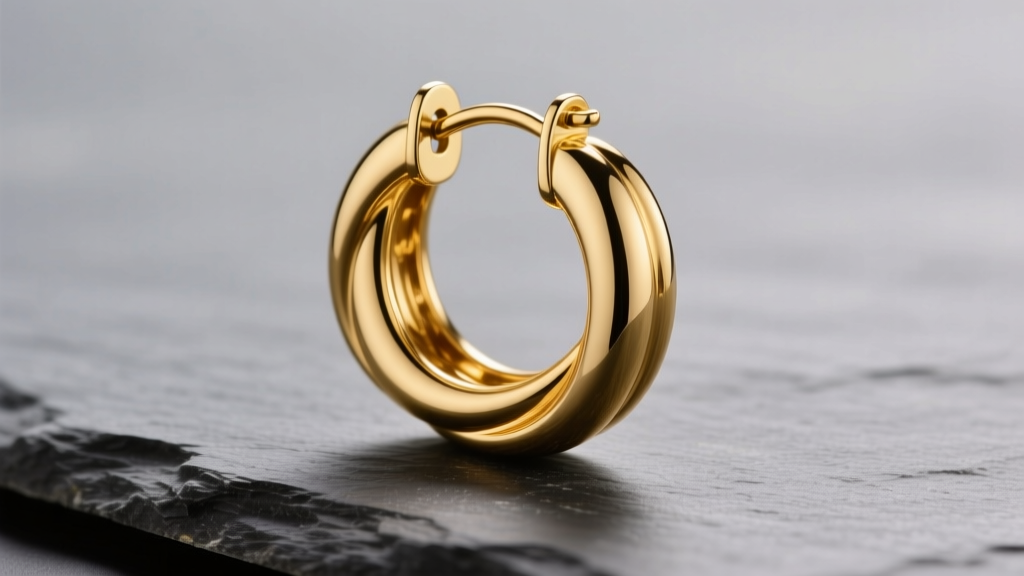
When collectors and enthusiasts invest in bold gold earrings, the focus is often placed entirely on aesthetic volume, spatial geometry, and surface finish. However, from a jewelry engineering perspective, designing and wearing oversized gold pieces presents a complex array of metallurgical and biomechanical challenges. A standard gold stud earring typically weighs between 1 and 3 grams. In contrast, true statement pieces—such as sculptural drop earrings, thick tube hoops, or oversized geometric dangles—frequently range from 8 to 25 grams per earring. At this mass, the jewelry ceases to be a mere accessory and becomes a structural load that interacts directly with human tissue.
Understanding the technical specifications of heavy gold jewelry is critical for both designers and consumers. Without proper consideration of alloy hardness, post gauge thickness, and clasp tension, bold gold earrings can quickly lead to warped metal, compromised closures, and irreversible earlobe elongation. This guide provides a deep dive into the material science and biomechanics required to safely design, wear, and maintain substantial gold ear adornments.
Metallurgy and the Vickers Hardness Scale
The most common misconception in luxury jewelry is that higher karat gold is universally superior. While 24-karat gold (99.9% pure) holds the highest melt value and offers a rich, unalloyed yellow hue, it is catastrophically unsuited for bold gold earrings. Pure gold is highly malleable, registering a mere 25 to 30 on the Vickers Hardness (HV) scale. A 15-gram hoop crafted from 24k gold would warp under its own weight when resting on a table, and the post would easily bend when inserted into the ear.
To achieve the structural integrity required for heavy earrings, gold must be alloyed with metals like copper, silver, zinc, and sometimes palladium. The karat selection directly dictates the tensile strength and yield point of the final piece:
- 22-Karat Gold (91.6% Gold): Registers around 70-90 HV. While prized in Middle Eastern and South Asian markets for its deep color, it is generally too soft for large, heavy hoops unless the design utilizes extreme structural thickness, which adds prohibitive weight.
- 18-Karat Gold (75.0% Gold): Registers between 110-125 HV. This is the standard for high-end luxury earrings. It offers an excellent balance of rich color and structural durability, suitable for bold drop earrings and moderately heavy hoops up to 12 grams.
- 14-Karat Gold (58.5% Gold): Registers between 130-150 HV. The higher copper and zinc content drastically increases the alloy's rigidity. For oversized, structural bold gold earrings that exceed 15 grams, 14k gold is the optimal material to prevent clasp distortion and post bending.
"The structural viability of a gold earring is not determined by its mass, but by the cross-sectional geometry of its weakest point—usually the post or the hinge—relative to the Vickers hardness of its specific alloy." — Gemological Institute of America (GIA) Manufacturing Guidelines.
Biomechanics: The Cheese-Cutter Effect and Fistula Stress
The human earlobe is composed of adipose tissue, collagen, and a network of microvasculature, lacking any cartilaginous support. When a heavy earring is suspended from the piercing fistula (the healed skin tube), gravity exerts a constant downward force. The biomechanical risk here is localized tissue necrosis and elongation, commonly referred to in dermatology as the "cheese-cutter effect."
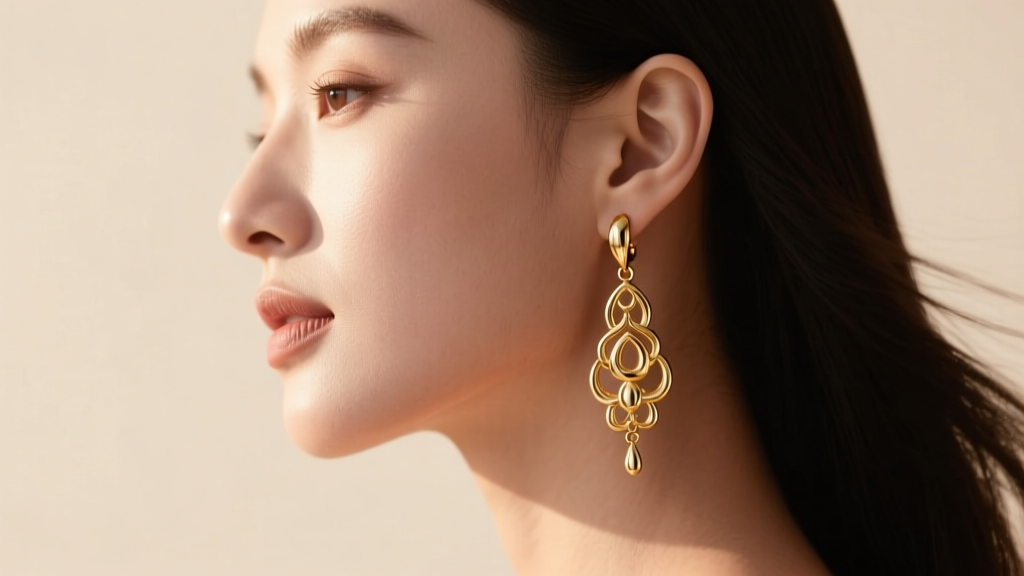
Pressure is defined as Force divided by Area (P = F/A). A standard earring post is 20-gauge (0.81mm in diameter). If a bold gold earring weighing 18 grams is suspended from a 20-gauge post, the surface area bearing the load is minuscule. Over time, this concentrated pressure restricts blood flow to the inferior edge of the fistula, causing the tissue to slowly tear and stretch downward.
To mitigate this, expert jewelers engineer bold gold earrings with thicker posts or specialized wire configurations. Upgrading the post to a 16-gauge (1.29mm) or 14-gauge (1.63mm) thickness exponentially increases the surface area distributing the weight, significantly reducing the localized pressure on the earlobe. For collectors with standard 20-gauge piercings, utilizing silicone earlobe support patches (such as LobeWonder) creates an artificial secondary load-bearing surface, distributing the gold's mass across the back of the earlobe rather than concentrating it entirely on the fistula.
Clasp Engineering: Securing High-Mass Gold
A bold gold earring is only as secure as its closure mechanism. The kinetic energy generated by a heavy earring during normal movement (walking, turning the head) places immense shear stress on the clasp. Standard friction push-backs (butterfly backs) are entirely inadequate for earrings exceeding 5 grams, as the tension of the metal scroll will inevitably loosen, leading to catastrophic loss.
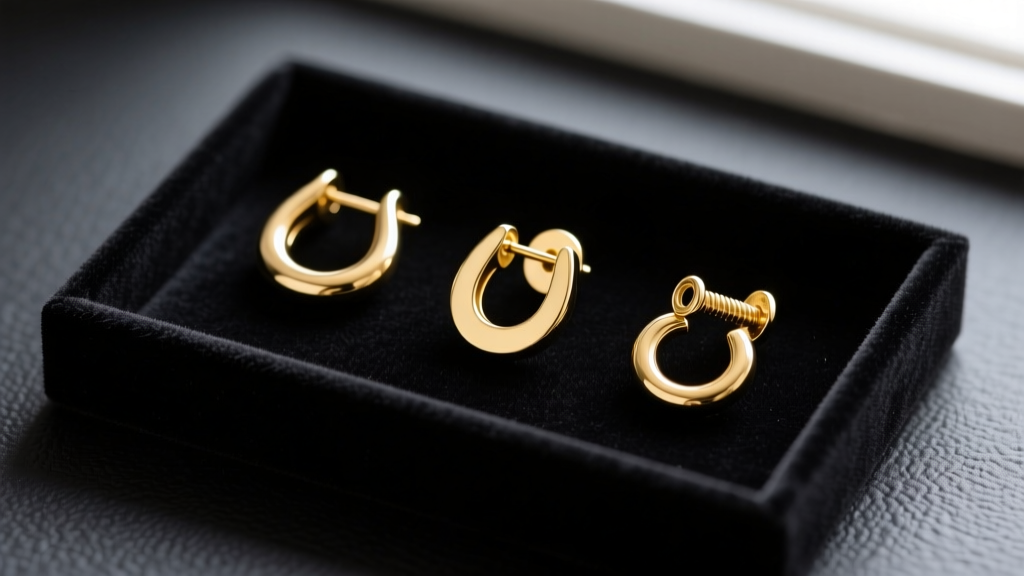
High-end manufacturers utilize specialized, mechanically secure closures designed to handle specific weight thresholds. Below is a technical comparison of the primary closure systems used in heavy gold jewelry:
| Clasp Mechanism | Max Weight Capacity | Security Rating | Primary Application |
|---|---|---|---|
| Omega-Back (Clip) | Up to 15g | High | Heavy button earrings, large dome studs. Uses a hinged, spring-loaded paddle that clamps against the post. |
| Saddleback (Snap) | Up to 25g | Very High | Thick tube hoops. Features a contoured hinge that snaps into a precision-milled groove, locking the hoop flush. |
| Screw-Back | Up to 20g | Maximum | High-value diamond/gold drops. The threaded post requires a screw-on backing, eliminating pull-out risk entirely. |
| Leverback (French) | Up to 10g | Moderate | Dangle earrings. Relies on gravity to keep the hinged wire closed; requires a secondary silicone stopper for heavy pieces. |
When evaluating vintage or contemporary bold gold earrings, always inspect the hinge tolerances. A well-engineered saddleback hoop should produce a distinct, audible "click" when closed, indicating precise CNC milling. If the closure feels spongy or requires manual alignment to shut, the structural integrity is compromised.
Preventing Lobe Elongation: Clinical and Practical Solutions
Even with optimal gauge thickness and secure clasps, continuous wear of heavy gold will eventually cause tissue fatigue. The American Society of Plastic Surgeons notes that acquired earlobe clefts and elongation are increasingly common, driven largely by the prolonged use of heavy statement jewelry. Once the fistula stretches beyond a 45-degree angle, surgical excision and suturing are the only methods to restore the original anatomy.
To preserve lobe health while enjoying substantial gold pieces, adhere to the following protocol:
- The 8-Hour Rule: Never wear bold gold earrings exceeding 10 grams for more than 8 consecutive hours. Remove them immediately upon returning home to allow tissue reperfusion.
- Rotational Wear: Alternate heavy statement pieces with lightweight, 18-gauge titanium or 14k gold sleepers to allow the collagen matrix in the fistula to contract and recover.
- Support Garments: For events requiring all-day wear of 20g+ sculptural pieces, utilize medical-grade silicone adhesive supports that anchor the earring post to the broader surface area of the earlobe.
Investment Dynamics: Pricing Bold Gold in 2026
As we navigate the 2026 precious metals market, the pricing architecture of bold gold earrings requires careful analysis. According to the World Gold Council, the spot price of gold has seen significant upward momentum over the last decade, making heavy gold jewelry a dual-purpose acquisition: an aesthetic statement and a tangible asset.
However, consumers must differentiate between raw melt value and manufacturing premiums. A pair of solid 14-karat bold gold earrings weighing 30 grams combined contains approximately 17.5 grams of pure gold. While the intrinsic melt value is easily calculable based on daily spot prices, the retail cost encompasses CAD modeling, investment casting, ultrasonic cleaning, and hand-polishing. For complex, hollowed-out geometric designs (often called "electroformed" or "hard gold" pieces), the manufacturing premium can exceed the melt value by 300% due to the specialized electroplating baths required to create high-volume, low-weight structures. Conversely, solid cast hoops carry a much lower premium over melt, making them the superior choice for buyers prioritizing long-term intrinsic value retention alongside structural durability.


