The Bullet to the Bone Golden Earring: A Technical Deep Dive
Explore the technical specs, casting methods, and cartilage gauge requirements for the avant-garde bullet to the bone golden earring in this expert guide.

Deconstructing the Avant-Garde: Where Ballistics Meet Anatomy
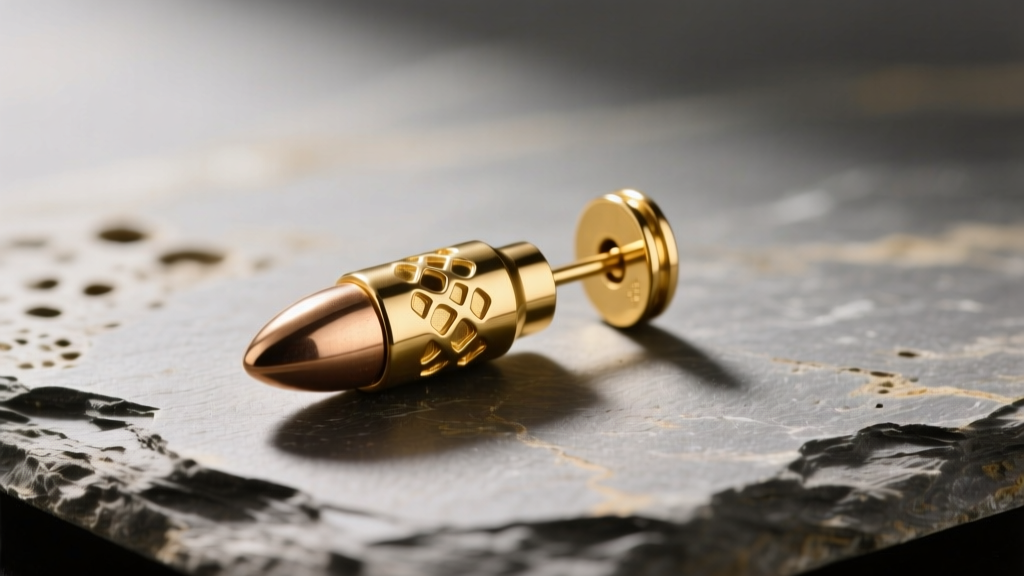
The bullet to the bone golden earring represents a masterclass in dark luxury and industrial-gothic jewelry design. Far from a simple novelty piece, this specific motif requires an intricate synthesis of micro-sculpting, advanced metallurgy, and biomechanical engineering. The design juxtaposes the sharp, manufactured precision of a ballistic casing with the organic, porous irregularity of carved osteological textures. For jewelry artisans and collectors alike, understanding the technical execution of this piece is critical to ensuring both its aesthetic longevity and its safety when worn in cartilage piercings.
In the contemporary fine jewelry landscape of 2026, the demand for macabre yet luxurious body modification pieces has surged. However, the transition from a digital 3D model to a wearable, heavy-gold cartilage earring introduces severe structural challenges. This guide dissects the exact material grades, casting protocols, and anatomical requirements necessary to execute the bullet to the bone golden earring without compromising the integrity of the piercing or the metal.
Metallurgy and the Lost-Wax Casting Challenge
Capturing the microscopic Haversian canals (the natural pore structure of real bone) alongside the crisp, machined rim of a bullet casing requires a highly specific gold alloy. Many commercial jewelers default to 18k yellow gold for its rich color and high purity. However, 18k gold possesses a Vickers Hardness (HV) of approximately 125, making it entirely unsuitable for this specific design.
The sharp edges of the bullet motif will quickly deform, scratch, and lose their crispness if cast in 18k gold. Furthermore, the delicate, web-like ridges of the bone texture are prone to snapping under the tensile stress of daily wear. To achieve the necessary durability, master casters utilize a specialized 14k gold alloy, often hardened with palladium or a precise silver-copper matrix, pushing the hardness to 160-180 HV. According to the Gemological Institute of America (GIA), alloying gold with these specific base metals not only increases durability but also alters the melting flow, allowing the molten gold to fill the microscopic crevices of the bone texture mold before prematurely solidifying.
Alloy Comparison for High-Detail Motifs
| Gold Alloy | Vickers Hardness (HV) | Suitability for Bone Texture | Edge Retention (Bullet Casing) |
|---|---|---|---|
| 24k Pure Gold | ~60 HV | Poor (Tears easily) | Unacceptable |
| 18k Yellow Gold | ~125 HV | Fair (Prone to micro-fractures) | Poor (Edges dull quickly) |
| 14k Palladium White | ~170 HV | Excellent (High tensile strength) | Excellent |
| 14k Hard Yellow | ~165 HV | Very Good | Very Good |
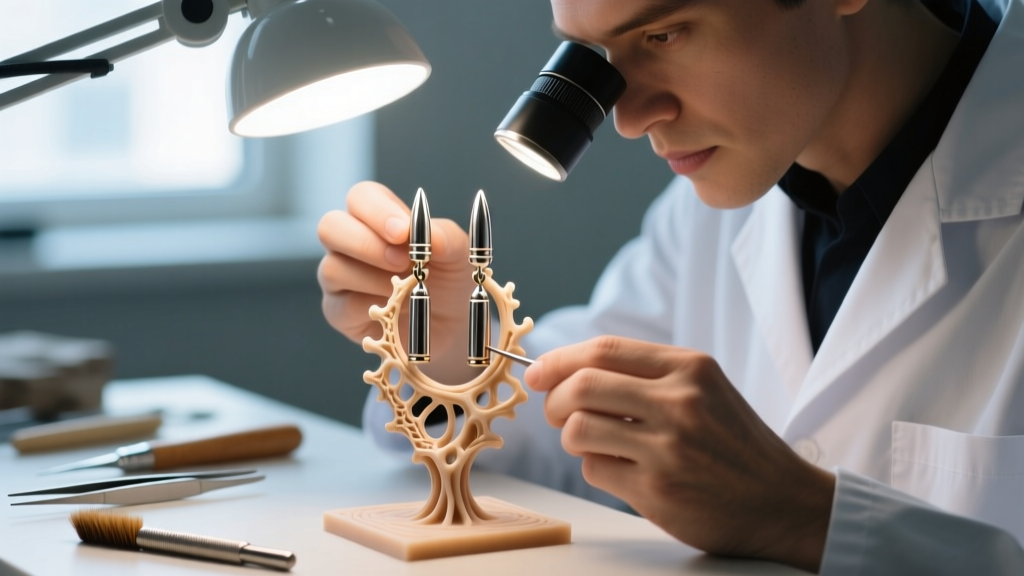
The casting process itself relies on a modified lost-wax technique. Artisans often use high-resolution resin 3D printing with organic noise algorithms to generate the bone texture, ensuring no two pieces are identical. The burnout schedule of the investment powder must be meticulously controlled; if the temperature ramps too quickly, the resin leaves a carbon ash residue that becomes permanently trapped in the porous bone texture, resulting in black, unpolishable pits in the final gold piece.
Biomechanics: Weight Distribution on the Cartilage
The most critical failure point of the bullet to the bone golden earring is not the metal, but the human body. A solid 14k gold earring of this volume and density typically weighs between 5.5 and 8.2 grams. When suspended from a standard earlobe, this weight is manageable. However, this motif is overwhelmingly designed for cartilage placements, such as the conch, helix, or forward helix.
Cartilage lacks the vascular elasticity of the earlobe. If a heavy earring is inserted into a standard 18-gauge (1.0mm) or 20-gauge (0.8mm) piercing, the continuous downward pull of gravity combined with the kinetic energy of head movements will trigger the 'cheese-cutter effect.' The thin wire will slowly slice through the cartilage, leading to severe migration, rejection, and permanent tissue scarring.
According to the Association of Professional Piercers (APP), heavy decorative ends require a minimum of 14g (1.6mm) or 12g (2.0mm) thickness to distribute weight safely and prevent migration in cartilage piercings.
Therefore, a technically sound bullet to the bone golden earring must be engineered around a 14g or 12g post. The post itself should ideally be crafted from ASTM F136 implant-grade titanium to reduce the overall weight of the assembly while providing maximum biocompatibility, with the heavy gold decorative end attaching to the front.
Securing the Piece: Threadless vs. Internally Threaded
Given the substantial weight of the gold bullet and bone motif, the connection mechanism between the decorative end and the post is a vital point of engineering. External threading is entirely contraindicated; the sharp threads will tear the fistula (the piercing channel) during insertion and harbor bacteria.
Jewelers must choose between internally threaded and threadless (press-fit) systems. For a piece of this specific mass, threadless systems are vastly superior. A threadless pin relies on the tension of a slightly bent pin pressing against the inner wall of the titanium post. To support a 7-gram gold end, the pin must be bent to a precise 12-to-15-degree angle. If the bend is too shallow, the heavy earring will dislodge when the wearer removes a sweater or towel-dries their hair. If the bend is too aggressive, the pin will warp the titanium post upon insertion.
- Pin Material: The pin must be cast in a spring-hard gold alloy or machined from titanium to ensure it retains its bent tension over years of use.
- Post Length: Custom flat-back labret posts (usually 6mm to 8mm for healed conches) are required to ensure the heavy decorative end sits flush against the ear without excessive leverage.
- Backing Profile: A wide, flat titanium disc (3mm or 4mm diameter) is necessary on the back of the ear to distribute the compressive force of the heavy front piece across a wider area of the posterior cartilage.
Maintenance of Porous Textures and Failure Modes
The aesthetic brilliance of the bullet to the bone golden earring lies in its gritty, porous bone texture, but this exact feature makes it a magnet for sebum, dead skin cells, and environmental debris. Unlike a high-polish gold hoop that can be wiped clean with a microfiber cloth, the micro-crevices of the bone motif require rigorous maintenance protocols.
Failure to clean the porous texture will result in a hardened, dark buildup that mimics tarnish but is actually organic matter. Because the texture is intentionally rough, mechanical polishing with a jeweler's rouge wheel is impossible without erasing the design entirely. Therefore, chemical and ultrasonic cleaning methods are mandatory.
Expert Cleaning Protocol
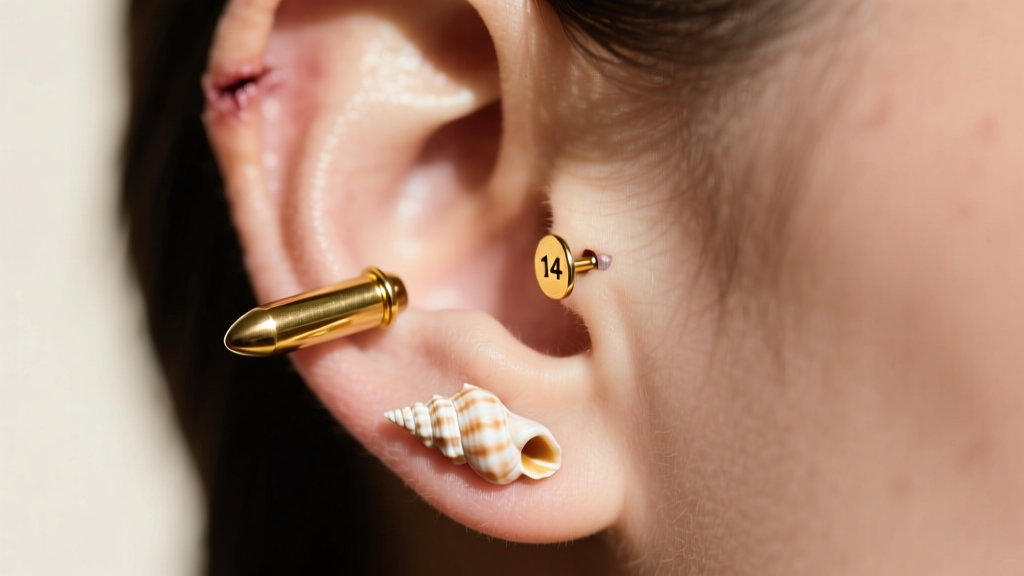
To maintain the brilliance of the gold and the hygiene of the piercing, owners should employ a 40kHz ultrasonic jewelry cleaner. Fill the tank with warm water and a few drops of mild, ammonia-free enzymatic dish detergent. The enzymatic action breaks down the protein bonds of trapped sebum, while the ultrasonic cavitation creates microscopic vacuum bubbles that implode inside the tiny bone pores, blasting debris out without scratching the gold.
After a three-minute ultrasonic bath, the piece should be gently agitated with a soft-bristled baby toothbrush, rinsed in distilled water, and dried with compressed air. Avoid using harsh chemical dips or silver polishes, as these can strip the alloyed metals from the 14k gold surface, leaving the bone texture with a permanent, uneven copper stain.
Sourcing and Authenticity Verification
Due to the high cost of solid gold and the labor-intensive casting process, authentic bullet to the bone golden earrings command a premium price, typically ranging from $850 to $1,800 depending on the exact weight and the artisan's reputation. The market is currently flooded with 'gold vermeil' or gold-plated brass imitations. While these may look identical upon first purchase, the porous bone texture will trap moisture against the base brass metal, causing rapid oxidation. This results in a green-black corrosion that permanently ruins the piece and can cause severe contact dermatitis.
When sourcing this avant-garde piece, always demand a solid gold hallmark, a detailed weight specification in grams, and documentation of the post material. For further reading on safe body jewelry materials and standards, consult the APP Jewelry Materials Guide. By prioritizing technical precision over mass-produced aesthetics, collectors can safely enjoy the striking, dark luxury of this unique intersection between ballistics and anatomy.


