Butterfly Hoop Earrings: Technical Guide to Fit, Weight & Alloys
Discover the engineering behind butterfly hoop earrings. We analyze weight distribution, clasp mechanics, and hypoallergenic alloys for daily wear.

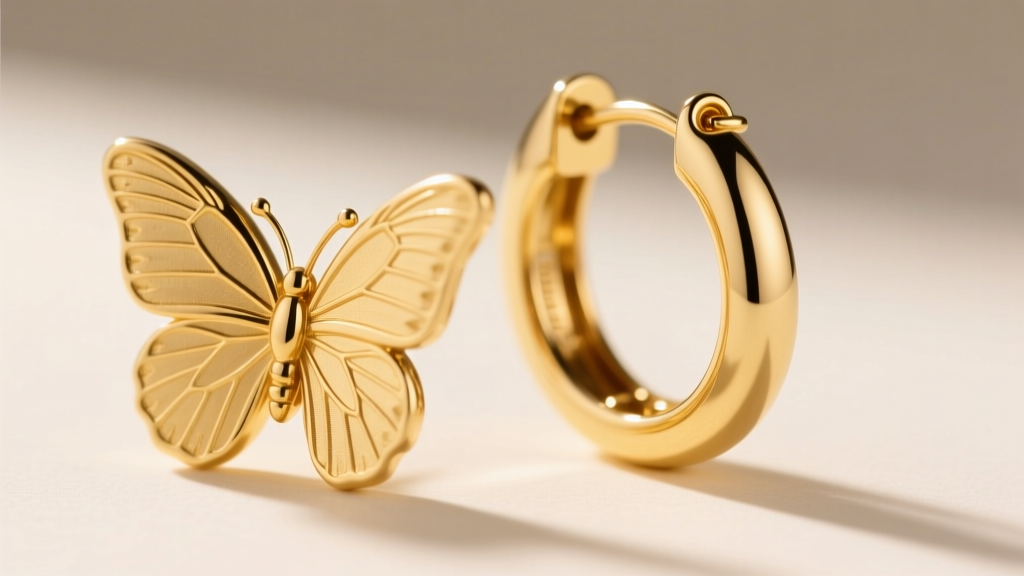
Butterfly hoop earrings represent a fascinating intersection of organic aesthetics and structural engineering. While standard circular hoops distribute mass evenly around the earlobe, introducing a three-dimensional motif like a butterfly fundamentally alters the physics of the jewelry. As of 2026, advancements in micro-casting and CAD (Computer-Aided Design) have allowed jewelers to create hyper-detailed wing structures, but these design leaps bring new challenges regarding weight distribution, tensile stress on the piercing, and alloy integrity.
This expert deep dive dissects the technical specifications you must evaluate when selecting or designing butterfly hoop earrings, moving beyond basic style advice into the metallurgy and biomechanics of daily wear.
The Physics of Winged Hoops: Weight Distribution & Gauge Limits
A standard hoop earring operates as a balanced pendulum. The center of gravity sits directly below the piercing axis, minimizing torque. However, butterfly hoop earrings typically feature an asymmetrical or bottom-heavy mass distribution. When the butterfly motif is positioned at the base of the hoop, it creates a concentrated gravitational pull. If the wings extend laterally, they introduce rotational torque every time the wearer turns their head.
This dynamic directly impacts the required wire gauge. The Association of Professional Piercers (APP) notes that standard lobe piercings are typically performed at 18-gauge (1.0mm) or 16-gauge (1.2mm). For lightweight, plain hoops, 18-gauge is sufficient. However, for motif-heavy butterfly hoops exceeding 4 grams per earring, an 18-gauge wire acts as a fulcrum, leading to the dreaded "cheese-cutter effect" where the thin metal slowly migrates through the earlobe tissue.
- 18-Gauge (1.0mm): Acceptable only for micro-butterfly hoops (under 15mm diameter) weighing less than 3 grams.
- 16-Gauge (1.2mm): The technical minimum for medium-to-large butterfly hoops (20mm-35mm) to prevent lobe elongation.
- 14-Gauge (1.6mm): Required for oversized, solid-metal statement hoops or designs featuring pavé diamond wings.
Metallurgy & Casting: Why 3D Motifs Demand Specific Alloys
Creating the intricate venation and delicate antennae of a butterfly requires precision casting, usually via the lost-wax method. In 2026, high-resolution 3D resin printing has largely replaced hand-carved wax models, allowing for microscopic detail. However, the transition from digital model to physical metal introduces structural vulnerabilities, specifically porosity and alloy brittleness.
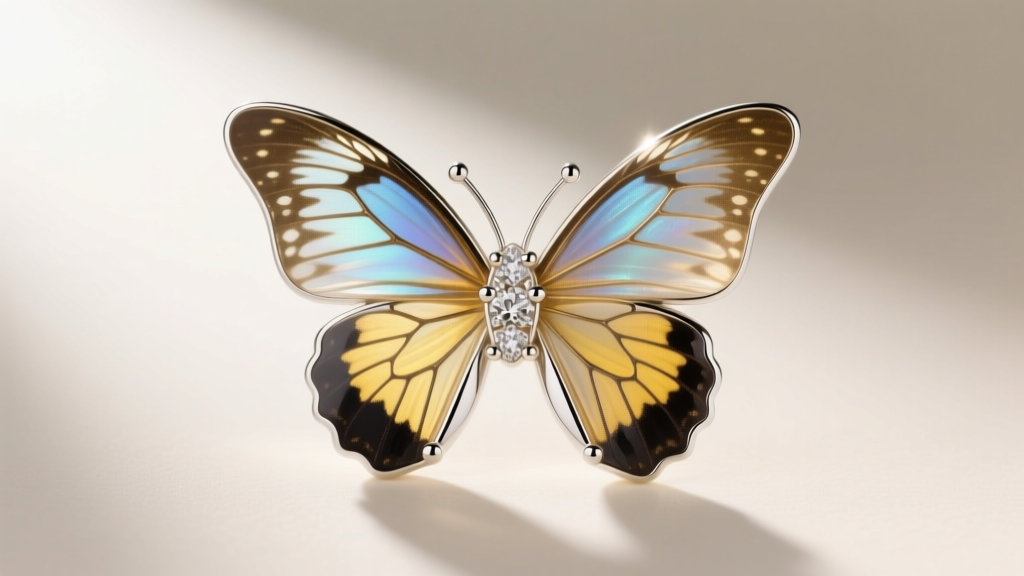
14k vs. 18k Gold for Intricate Wing Details
According to the Gemological Institute of America (GIA), the purity of gold dictates its hardness and malleability. 24k gold is too soft for jewelry, so it is alloyed with metals like copper, silver, and zinc.
18k Gold (75% pure): While prized for its rich color and hypoallergenic properties, 18k gold is relatively soft. If a butterfly hoop features thin, protruding antennae or delicate wing tips in 18k gold, they are highly susceptible to bending or snapping upon impact.
14k Gold (58.3% pure): The higher alloy content in 14k gold increases its tensile strength and hardness. For butterfly hoops with fragile protruding elements, 14k gold is technically superior. It holds the crisp edges of the wing scales during the polishing phase and resists deformation during daily wear.
The Porosity Problem in Deep Crevices
When molten metal cools in the deep crevices of a butterfly wing design, gas bubbles can become trapped, creating microscopic voids known as porosity. Low-quality manufacturing leaves these voids near the surface, appearing as tiny pits that trap sebum, dead skin, and bacteria. Always inspect the recessed areas of the butterfly wings under a jeweler's loupe; the surface should be completely dense and mirror-smooth, indicating proper centrifugal or vacuum casting techniques.
Clasp Mechanics: Securing Asymmetrical Designs
The clasp on a butterfly hoop must do more than close the circuit; it must bear the brunt of the motif's kinetic energy. A weak clasp will warp under the swinging weight of the butterfly wings, eventually failing to lock and resulting in lost jewelry.
| Clasp Type | Best Application | Weight Limit | Structural Integrity |
|---|---|---|---|
| Hinged Saddle Back | Standard Lobe Hoops | Up to 8g | High (if snap-fit is calibrated) |
| Clicker (Segment Ring) | Cartilage / Helix Hoops | Up to 12g | Very High (mechanical lock) |
| Continuous (Seamless) | Minimalist / Lightweight | Up to 4g | Low (relies on metal tension) |
| Omega Back with Hoop | Heavy Statement Wings | Up to 15g | Maximum (dual-support friction) |
For butterfly hoops intended for the cartilage or helix, the clicker mechanism is the undisputed technical choice. The hinged segment features a machined groove that snaps securely into a corresponding ridge on the opposite post. Unlike seamless rings, which can be pulled open by the weight of a heavy butterfly charm catching on clothing, a properly manufactured clicker requires deliberate lateral pressure to open, ensuring the motif remains safely anchored.
Lobe Health: Preventing Elongation from Motif-Heavy Hoops
The aesthetic appeal of a large butterfly resting against the neck is undeniable, but the biomechanical toll on the earlobe is significant. Prolonged wear of bottom-heavy hoops causes micro-tears in the fistula (the piercing channel), leading to gradual elongation and eventual migration.
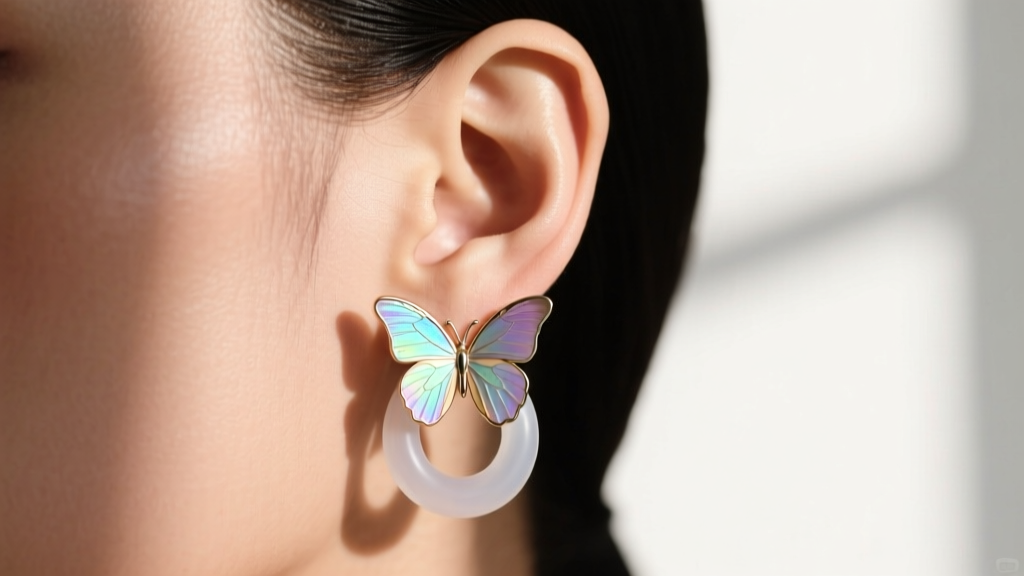
To mitigate this without sacrificing the design, jewelry engineers and piercers recommend a few technical interventions:
- Silicone Support Discs (Earlifters): Placing a medical-grade silicone o-ring or disc behind the earlobe increases the surface area bearing the earring's weight. This disperses the downward force of the butterfly motif across a wider radius of tissue, preventing the wire from cutting into the back of the piercing.
- Hollow-Form Construction: High-end jewelers utilize electroforming or hollow-casting techniques for the butterfly wings. By creating a hollow, shell-like structure, the visual volume of the wings is maintained while reducing the overall mass by up to 60%. This drastically lowers the gravitational pull on the lobe.
- Titanium Grade 5 (Ti-6Al-4V): For those with heavy, gemstone-encrusted butterfly hoops, upgrading the structural wire to Grade 5 Titanium provides immense strength-to-weight ratios. It is significantly lighter than gold or platinum, yet possesses superior yield strength, preventing the hoop from warping into an oval shape under stress.
Expert Buying Checklist: What to Inspect Before Purchasing
When evaluating butterfly hoop earrings, whether from an independent artisan or a luxury house, run through this technical checklist to ensure you are acquiring a structurally sound piece:
- The Antennae Stress Test: Gently attempt to wiggle the antennae or the most delicate wing tips. They should not flex independently of the main body; excessive flex indicates weak solder joints or thin casting.
- Clasp Tension Calibration: Open and close the hoop five times. The clasp should produce a definitive, audible "click" upon closure. If it slides shut with a soft, muted friction, the tolerances are too loose, and the hoop will eventually open on its own.
- Interior Wire Polish: Run a cotton swab along the inside of the hoop wire that passes through the ear. It must be perfectly smooth. Any microscopic burrs left from the casting sprue will act like a file against your healing or sensitive fistula tissue.
- Enamel Verification: If the butterfly wings feature colored enamel, determine if it is vitreous (fired glass) or cold (epoxy resin). Vitreous enamel is highly durable and UV-resistant, whereas cold enamel will yellow and chip within a few years of exposure to sunlight and cosmetics.
By understanding the metallurgy, physics, and biomechanics that govern butterfly hoop earrings, you can curate a collection that is not only visually stunning but engineered for lifelong wearability and tissue health.


