A Beginner's Guide to Buying Antique Sapphire Earrings
Discover how to identify, evaluate, and buy authentic antique sapphire earrings. Learn era-specific hallmarks, pricing, and synthetic vs. natural tips.

The Allure of Antique Sapphire Earrings: Why Eras Matter
For novice collectors, the world of estate jewelry can feel like navigating a minefield. When you begin searching for antique sapphire earrings, you are not just buying a gemstone; you are purchasing a piece of wearable history. By strict definition, 'antique' jewelry must be at least 100 years old. This means a true antique piece today was crafted no later than the mid-1920s, placing it firmly in the Victorian, Edwardian, or early Art Deco periods.
Understanding the distinct characteristics of these eras is your first line of defense against mislabeled reproductions. Each period utilized specific metalworking techniques, gemstone cuts, and closure mechanisms that serve as built-in authentication markers.
Decoding the Eras: Victorian, Edwardian, and Art Deco
Victorian (1837–1901): Romance, Gold, and Foil-Backs
Victorian earrings were predominantly crafted in 15k or 18k yellow gold, as platinum was not yet widely used in jewelry. Sapphires from this era were often cabochon-cut or featured early step-cuts. A critical feature of early Victorian and Georgian pieces is the closed-back setting. Jewelers would place a thin sheet of colored foil behind the sapphire to enhance its hue and reflect light.
Expert Warning: If you acquire foil-backed antique sapphire earrings, never submerge them in water or use ultrasonic cleaners. Moisture will trap inside the closed back, tarnishing the foil and permanently clouding the stone's appearance.
Edwardian (1901–1915): Platinum and Millegrain Lace
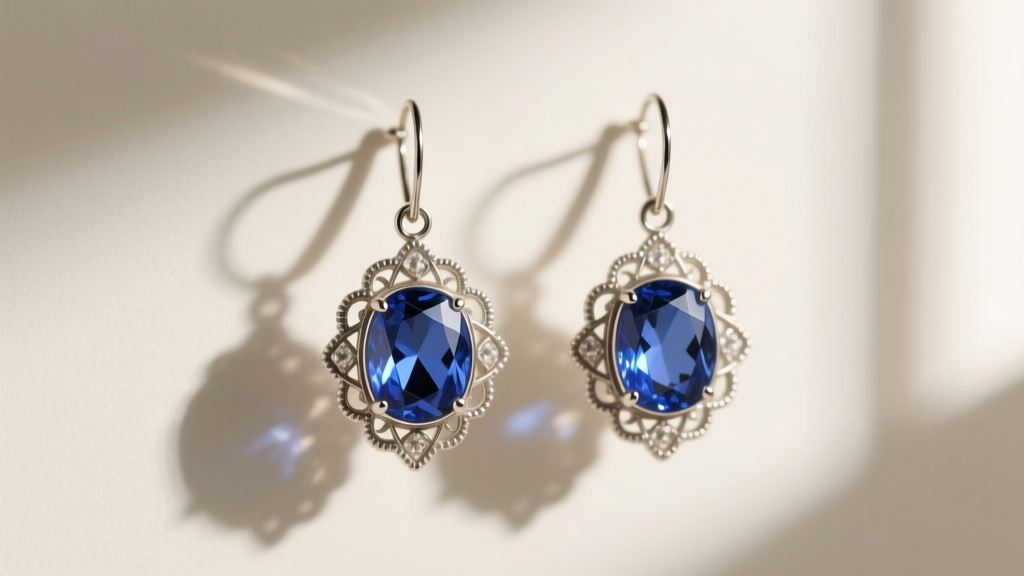
The Edwardian era introduced the widespread use of platinum, allowing for incredibly delicate, lace-like filigree designs. Sapphires were frequently used as vibrant blue accents to contrast with the era's favored Old European Cut diamonds. Look for millegrain—tiny, beaded edges along the metalwork created with a specialized knurling tool. This hand-applied detail is a hallmark of authentic Edwardian craftsmanship and is incredibly difficult to replicate perfectly in modern cast reproductions.
Art Deco (1920–1935): Geometry and Calibré-Cuts
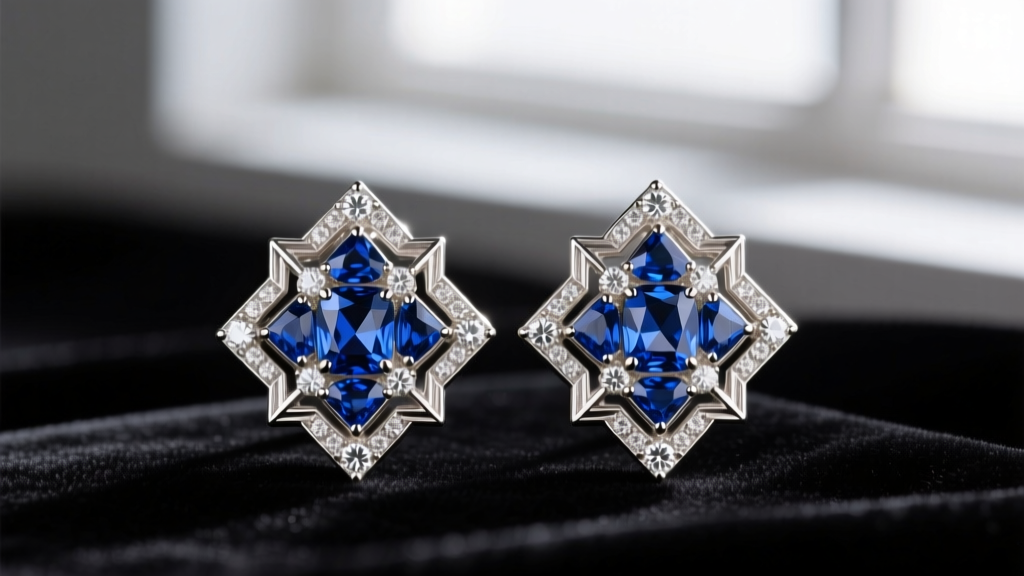
Art Deco abandoned the swirling garlands of the Edwardian era in favor of bold, architectural geometry. The defining feature of high-end Art Deco sapphire earrings is the calibré-cut. These are sapphires custom-cut and faceted to fit perfectly into a specific geometric channel or outline, leaving no gaps between the stones and the metal. If the sapphires in a supposed 1920s geometric earring are standard round or oval cuts sitting in prong settings, it is likely a later reproduction.
Natural vs. Synthetic: The 1920s Linde Star Trap
One of the most common beginner traps when buying antique sapphire earrings is the assumption that all antique sapphires are natural. The Verneuil flame-fusion process, patented in 1902, made synthetic sapphires commercially viable and widely available by the 1920s. In fact, many authentic Art Deco earrings feature synthetic sapphires because they were cheaper and possessed a flawless, vibrant blue that appealed to the bold Deco aesthetic.
An authentic 1920s earring with a synthetic stone is still an antique, but it should be priced significantly lower than one with a natural, mined sapphire. To tell the difference, a gemologist will look for curved striae (growth lines) and gas bubbles under a loupe, which indicate flame-fusion synthetics.
The Linde Star Trap: If you encounter a dealer selling 'Art Deco' star sapphire earrings, walk away. Synthetic Linde Star sapphires were not introduced until 1947. Any star sapphire earring claiming to be from the 1920s or 1930s is either a franken-piece (a newer stone set in an old mounting) or an outright forgery.
A Buyer’s Anatomy Checklist: Closures and Wear
The hardware of the earring provides vital clues to its age and authenticity. Here is what to inspect:
- Screw-Backs: Patented in 1894, screw-back closures dominated the market from the 1900s through the 1950s. If an earring has original, unaltered screw-backs, it is a strong indicator of early 20th-century origin.
- Shepherd Hooks: Simple wire hooks were common in the Victorian era but lack security. Many original hooks have been lost to time.
- Post Conversions: Most modern buyers prefer post-and-butterfly closures. Consequently, many antique earrings have been 'converted.' Inspect the base of the post with a 10x loupe. If you see a blob of solder or a slight bend where a screw-back was removed and a modern post attached, the piece has been altered. This is normal, but it should slightly lower the collector value compared to an unaltered piece.
- Gauge Thickness: Modern earring posts are typically 20-gauge or 18-gauge. Original antique wires and early converted posts are often thicker (16-gauge) or slightly irregular in shape due to hand-drawing techniques.
Decoding Hallmarks: Your Proof of Origin
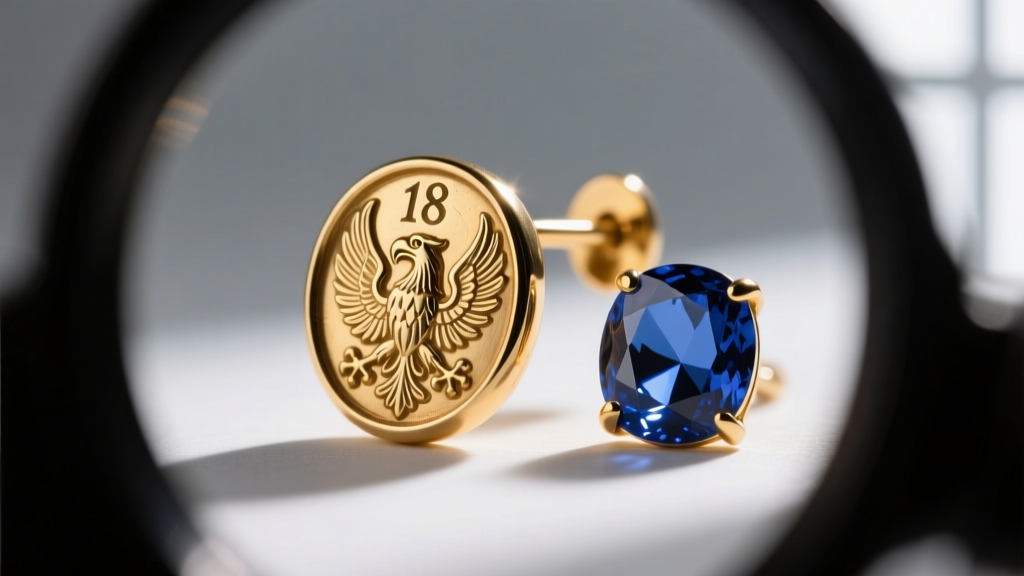
Hallmarks are the ultimate cheat code for antique jewelry authentication. However, they are often microscopic and hidden on the ear wire or the back of the setting. According to the Lang Antiques University, you should look for the following:
- French Eagle Head: Indicates 18k gold or platinum, used in France from 1838 onward (and specifically for platinum post-1919).
- British Leopard’s Head: The mark of the London Assay Office, often accompanied by a date letter and a purity mark (like the lion passant for sterling silver or the crown and 18 for 18k gold).
- American Marks: The US did not have a strict, standardized hallmarking system like Europe. American pieces from the early 1900s might simply be stamped '14K' or 'Plat', or bear the maker's mark of a house like Tiffany & Co. or Marcus & Co.
Pricing Guide: What Should You Actually Pay?
Pricing for antique sapphire earrings varies wildly based on the era, the presence of natural vs. synthetic stones, and the quality of the accompanying diamonds. Below is a realistic 2026 market framework for authentic, wearable pieces in good condition.
| Era | Estimated Price Range (USD) | Key Value Drivers |
|---|---|---|
| Victorian (1837–1901) | $800 – $3,500 | Foil-back condition, 15k/18k gold purity, old mine cut diamond accents. |
| Edwardian (1901–1915) | $1,500 – $6,500+ | Intricacy of platinum filigree, millegrain work, natural cornflower blue sapphires. |
| Art Deco (1920–1935) | $1,200 – $8,000+ | Calibré-cut precision, natural vs. synthetic sapphires, signed maker marks (e.g., Cartier, Boucheron). |
As noted by the Gemological Institute of America (GIA), the geographic origin of a natural sapphire (such as Kashmir, Burma, or Ceylon) can exponentially increase the value, though determining origin requires advanced laboratory testing and is rarely found in standard commercial antique pieces.
Final Thoughts for the Novice Collector
Buying antique sapphire earrings is an exercise in patience and observation. Always carry a 10x triplet loupe when shopping in person, and request high-resolution macro photography of the closures, settings, and stone inclusions when buying online. Do not be afraid to ask dealers for a recent gemological report, especially for pieces priced above $3,000. By understanding the structural nuances of the Victorian, Edwardian, and Art Deco periods, you can confidently build a collection that is as historically significant as it is beautiful.


