How to Wear Earrings With Different Hairstyles: A Buyer's Guide
Discover how to wear earrings with different hairstyles. This buyer's guide covers secure backs, snag-free metals, and ideal styles for all cuts.

Understanding how to wear earrings with different hairstyles goes far beyond simple color coordination. It is fundamentally an exercise in physics, material science, and ergonomic design. When you purchase earrings, you are not just buying a decorative object; you are buying a mechanical fastener that must interact seamlessly with your hair's texture, weight, and styling products. A heavy chandelier earring might look stunning on a mannequin, but paired with a thick, wavy lob, it becomes a tangled nightmare. Conversely, a delicate 22-gauge stud will completely disappear behind a blunt bob. This comprehensive buyer's guide will teach you exactly what to look for regarding gauge thickness, backing mechanisms, and gemstone settings to ensure your jewelry complements your hair rather than fighting it.
The Physics of Hair and Jewelry: Why Weight and Backing Matter
Before selecting a style, you must evaluate the structural integrity of the earring's post and backing system. Hair creates friction and drag, especially when moving or taking off over-the-head garments. Standard butterfly friction backs (the typical push-on clutch) are notoriously unreliable for thick or long hair. The hair strands wedge between the clutch and the earlobe, slowly pushing the backing off the post over the course of the day.
What to Look For in Earring Backs
- La Pousette (Push-Pull) Backs: These feature a tiny internal locking mechanism that clicks into a groove on the earring post. They are the gold standard for wearing heavy drops with thick, long hair, as hair cannot accidentally dislodge them.
- Screw Backs: The post is threaded, and the backing screws on. While highly secure, they can be frustrating to fasten if you have long acrylic nails or limited dexterity.
- Leverbacks: Ideal for dangle earrings, the hinged wire snaps securely into a catch. Look for leverbacks with a secondary safety latch if you plan to wear them with hair worn down.
Gauge Thickness and Structural Integrity
Standard lobe piercings are typically 20-gauge (0.81mm) or 18-gauge (1.02mm). If you frequently wear heavy statement pieces that will be pulled by thick hair, insist on 18-gauge or even 16-gauge (1.29mm) posts. Thicker wire resists bending and prevents the earring from drooping forward, which is a common failure mode when heavy hair rests against the earlobe.
Updos and Pixie Cuts: Maximizing Visibility
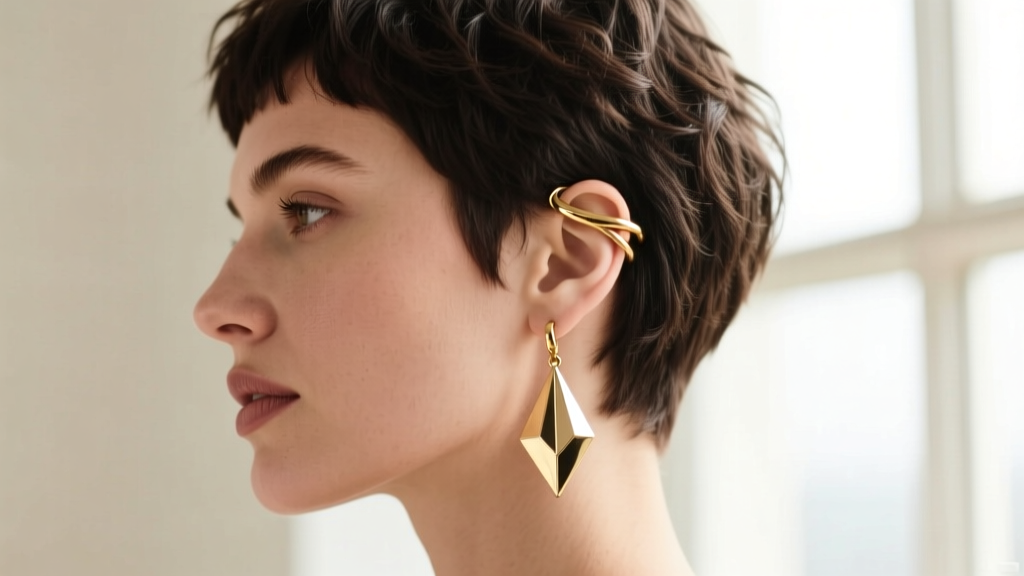
When the ears are fully exposed—whether through a sleek ballerina bun, a high ponytail, or a cropped pixie cut—the ear becomes a primary focal point. This is the ideal scenario for architectural, high-visibility pieces that would otherwise be hidden or tangled.
Best Purchases for Exposed Ears
Ear Cuffs and Cartilage Chains: For those who want the look of multiple piercings without the commitment, ear cuffs are excellent. Look for cuffs made from 14k or 18k solid gold with an adjustable tension band. Avoid cheap alloy cuffs, as the constant pressure required to keep them on the cartilage can cause contact dermatitis or leave green oxidation marks on exposed skin.
Chandeliers and Shoulder-Dusters: With an updo, you can wear elongated dangles (3 inches or longer) without fear of them catching on your collarbone or hair. When buying chandeliers, check the articulation points. The joints should move freely but not feel loose or rattly. High-quality brands use laser-welded jump rings rather than simply pinched metal loops, ensuring the delicate chains won't separate when brushed against.
Wearing Hair Down: Avoiding the Snag Trap
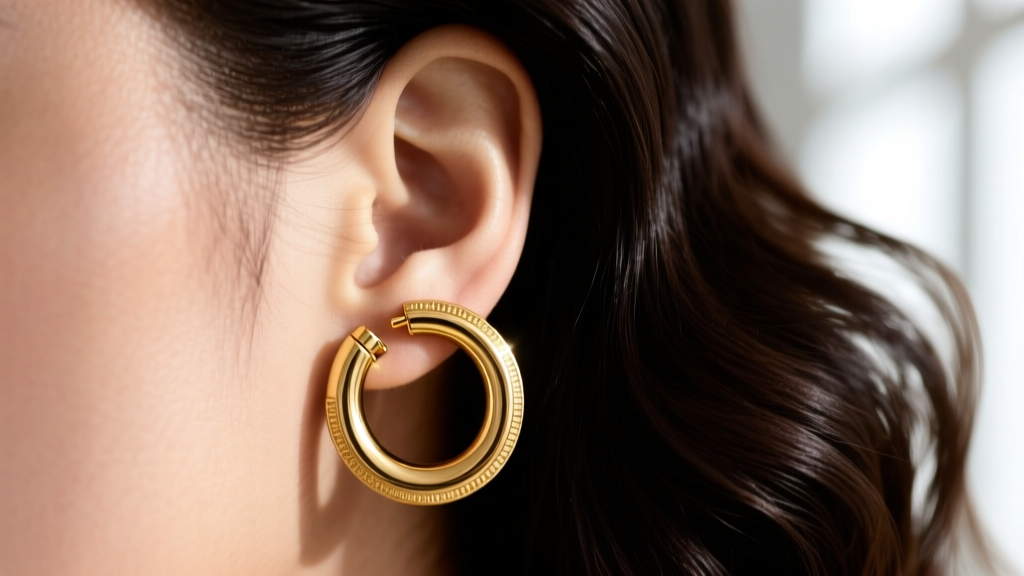
Wearing hair down creates a high-friction environment. Hair cuticles act like microscopic Velcro, catching on any protruding metal or sharp edge. If you are buying earrings specifically for wearing with loose, wavy, or curly hair, your primary goal is to eliminate snag points.
The Snag Risk Matrix
| Earring Style | Snag Risk Level | Why It Happens & What to Buy Instead |
|---|---|---|
| Prong-Set Stones | High | Tiny metal prongs catch on hair strands. Buy instead: Bezel-set stones where the metal fully encircles the gem. |
| Fishhook Wires | High | The open end of the wire hooks onto hair when pulling shirts off. Buy instead: French wires with a secure silicone stopper or leverbacks. |
| Filigree / Intricate Cutouts | Medium-High | Hair weaves into the tiny metal gaps and knots. Buy instead: Solid metal drops or smooth enamel designs. |
| Seamless Huggies | Low | The clasp is hidden and flush against the metal. Buy: Huggies with a continuous hinge and flush closure. |
When shopping for hoops to wear with hair down, avoid large, thin wire hoops. Hair wraps around the thin wire and bends it out of its perfect circle, eventually causing metal fatigue and snapping. Opt for tubular hoops or huggies with a thicker cross-section (at least 2mm thick) which can withstand the tensile stress of tangled hair.
The Messy Bun & Half-Up Styles: Balancing Proportions
Half-up styles and messy buns create a casual, textured look that frames the face while leaving some hair to fall around the ears. This requires earrings that are substantial enough to be seen through the falling strands, but streamlined enough not to tangle.
Geometric Drops and Bar Earrings: Linear bar earrings (typically 1.5 to 2.5 inches long) are perfect here. Their smooth, straight lines easily slide out of hair tangles without catching. When purchasing bar earrings, look for a matte or brushed finish. High-polish finishes show every micro-scratch caused by friction against hair and environmental dust, whereas brushed finishes gracefully mask daily wear and tear.
Mid-Sized Hoops (20mm - 30mm): This size sits right at the jawline, drawing attention to the face without dipping low enough to get lost in the hair draped over the shoulders. Ensure the post is welded at a 90-degree angle to the hoop so it sits perfectly flush against the lobe, preventing the hoop from flipping upside down when brushed by hair.
Material Considerations for High-Friction Environments
Friction is the enemy of plated jewelry. If you wear your hair down daily, the constant rubbing of hair against your earlobes will accelerate the wear of gold vermeil or gold-plated earrings. According to the Gemological Institute of America (GIA), pure gold is too soft for daily wear, which is why it is alloyed with metals like copper and zinc. However, the microscopic layer of gold on plated jewelry (often less than 0.5 microns) will rub off within months in high-friction environments, exposing the base metal underneath.
Expert Tip: If you have sensitive skin and wear your hair down frequently, the friction can push exposed base metals into the skin, triggering allergic reactions. The American Academy of Dermatology (AAD) notes that nickel is a primary culprit for contact dermatitis. Always opt for hypoallergenic solid metals to prevent this.
What to Buy for Longevity
- Solid 14k or 18k Gold: The gold color goes all the way through. It will not flake or wear off from hair friction.
- Implant-Grade Titanium (ASTM F136): If you are on a budget or have severe metal allergies, ASTM F136 titanium is lightweight, incredibly strong, and completely impervious to friction wear and tarnish.
- Platinum: The ultimate choice for diamond settings. It is denser than gold and develops a soft patina rather than wearing away, making it ideal for securing expensive stones in high-drag environments.
Quick Reference Buyer's Checklist
Before adding any earring to your cart, run it through this specialized checklist based on your primary hairstyle:
- For Hair Worn Down: Are the stones bezel-set? Is the hoop seamless or tubular? Are there any open filigree gaps?
- For Updos/Pixie Cuts: Is the piece visually substantial enough to stand alone? If it's an ear cuff, is the tension adjustable for all-day comfort?
- For Heavy/Thick Hair: Is the post at least 18-gauge? Does it feature a La Pousette or screw-back locking mechanism?
- For Active/Tangled Hair: Is the metal solid (14k+ gold, platinum, or titanium) rather than plated, to withstand constant friction?
By prioritizing mechanical security and material durability over fleeting trends, you can build an earring collection that works in perfect harmony with your hair, ensuring your jewelry remains secure, untangled, and beautifully displayed regardless of how you choose to style it.