The Ultimate Guide to Buying Gold Dragonfly Earrings
Discover what to look for when buying gold dragonfly earrings. Learn about karats, enamel techniques, and sizing in our expert jewelry guide.

The Allure of the Dragonfly Motif in Fine Jewelry
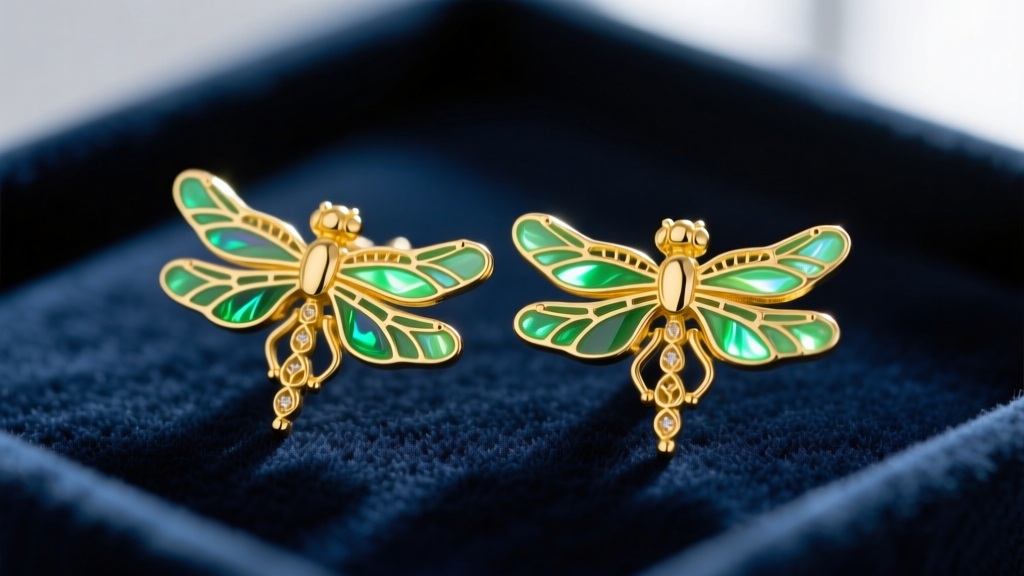
The dragonfly has been a symbol of change, adaptability, and joy across various cultures for centuries. In jewelry design, it represents a mastery of organic forms and intricate craftsmanship. When you begin searching for the perfect gold dragonfly earrings, you are not just looking for a pretty accessory; you are investing in a miniature sculpture. Unlike simpler geometric studs, insect motifs require a jeweler to balance delicate aesthetics with structural integrity. This comprehensive buying guide will walk you through the exact metallurgical specs, enamel techniques, and anatomical considerations you need to know before making a purchase.
Decoding the Gold: 14K vs. 18K for Insect Motifs
The karat weight of your gold dragonfly earrings dictates both their color and their structural durability. While many buyers default to 18K gold for its rich, buttery yellow hue and higher purity (75% gold), it is not always the best choice for intricate insect wings.
The Metallurgy of Wingtips and Antennae
Dragonfly designs feature elongated, fragile wings and thin antennae. Pure gold is exceptionally soft, and 18K gold (with a Vickers hardness of roughly 90-110 HV) can easily bend if the earring is dropped or caught on a sweater. Conversely, 14K gold (58.5% gold) is alloyed with metals like copper, silver, or zinc, raising its hardness to approximately 120-140 HV. According to the Federal Trade Commission Jewelry Guides, 14K is highly favored for detailed, structural jewelry pieces because it resists warping. If your dragonfly earrings feature wide, sweeping wings with minimal support struts, 14K gold is the superior choice for longevity.
Enamel Techniques: Bringing the Wings to Life
The most breathtaking gold dragonfly earrings utilize enamel to mimic the iridescent, translucent quality of real insect wings. As noted by the Victoria and Albert Museum, the Art Nouveau era (late 19th to early 20th century) popularized the use of complex enameling to create lifelike nature motifs. Today, you will encounter three primary enamel techniques in the market.
| Enamel Technique | Visual Effect | Durability | Price Tier |
|---|---|---|---|
| Plique-à-jour | Stained-glass translucency (no metal backing) | Fragile; requires careful handling | Fine ($1,500+) |
| Guilloché | Translucent enamel over engraved geometric patterns | Moderate; can chip on hard impact | Demi-Fine to Fine ($400 - $1,200) |
| Champlevé | Opaque or translucent enamel in carved troughs | High; metal framework protects enamel | Demi-Fine ($200 - $600) |
When inspecting plique-à-jour pieces, hold the earring up to the light. The gold framework should act like the lead in a stained-glass window, with the enamel suspended entirely without a metal backing. This is the holy grail of dragonfly wing enameling.
Gemstone Pairings: Eyes, Bodies, and Accents
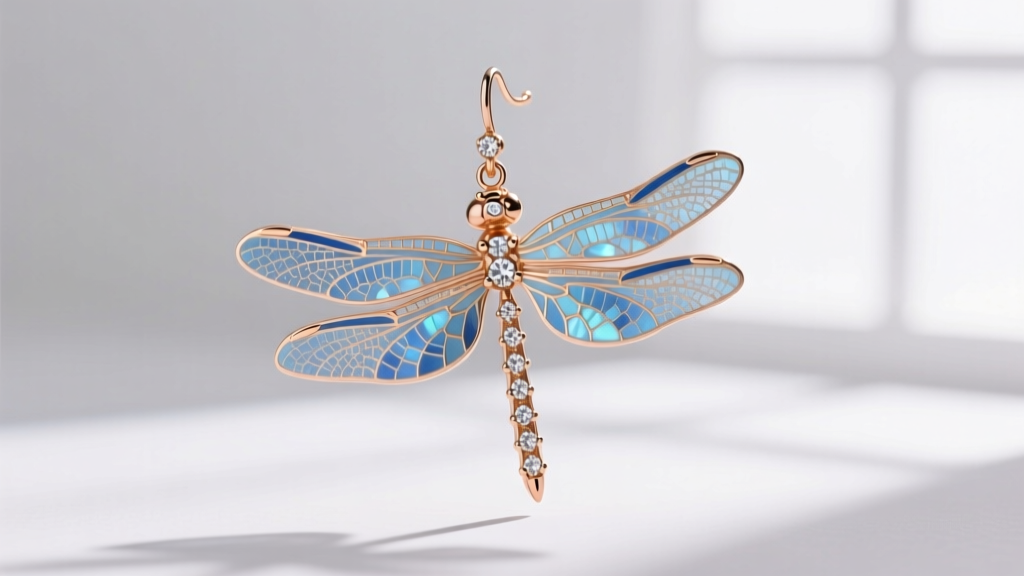
High-end gold dragonfly earrings rarely rely on gold and enamel alone. The thorax, abdomen, and compound eyes are often set with precision-cut gemstones. When evaluating these accents, look for stones that enhance the natural iridescence of the insect.
- Demantoid Garnet: Prized for its high dispersion (fire), demantoid garnet mimics the light-scattering properties of a real dragonfly wing. A vibrant green body set with demantoid is a hallmark of luxury pieces.
- Opal: Ethiopian or Australian opals provide a play-of-color that shifts as you move, perfectly capturing the shifting hues of an insect in flight.
- Tsavorite Garnet & Sapphire: Often used for the eyes or abdominal segments, these stones offer high refractive indexes and excellent scratch resistance (sapphire ranks 9 on the Mohs scale).
Avoid pieces where the gemstones are glued in (common in fashion jewelry under $100). Authentic fine jewelry will use prong, bezel, or flush settings to secure the stones.
Sizing, Gauge, and Ear Placement
The anatomy of your ear and the dimensions of the earring are critical for both comfort and visual proportion. Dragonfly earrings generally fall into three categories: studs, dangles, and ear cuffs.
Proportions and Post Gauges
For stud earrings, a wingspan between 10mm and 18mm is ideal for standard earlobes. Anything larger may droop unless the piece features a specialized backing like a la pousette (a locking mechanism with a spring-loaded notch) or an omega clip to distribute the weight. Standard lobe posts should be 20-gauge (0.81mm) or 19-gauge (0.91mm).
For dangle or drop earrings, the total length usually ranges from 25mm to 45mm. Ensure the jump ring connecting the dragonfly to the ear wire allows for fluid, 360-degree movement so the wings catch the light dynamically.
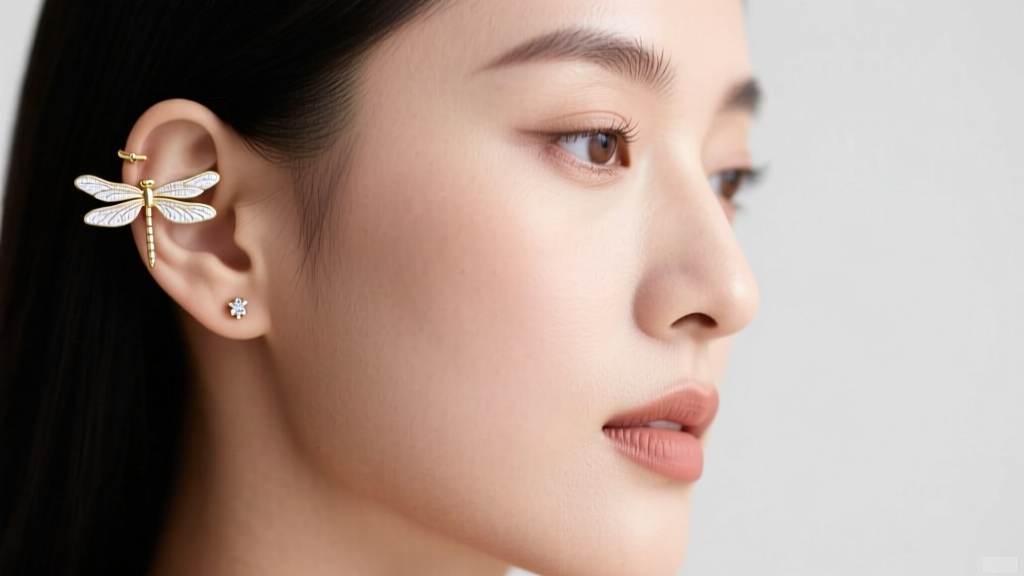
For cartilage and helix placements, smaller, contoured dragonfly cuffs or flat-back labret studs are preferred. Cartilage jewelry requires a thicker post for stability and to prevent the "cheese-cutter effect." Look for 18-gauge (1.02mm) or 16-gauge (1.29mm) posts made of implant-grade titanium or solid 14K gold to ensure biocompatibility during healing or long-term wear.
Authenticity Checks and Final Buying Tips
Before finalizing your purchase, perform a few critical authenticity checks. First, inspect the hallmark. Genuine pieces will be stamped with "14K", "18K", "585", or "750", usually located on the post or the back of the clutch. Second, examine the casting quality. High-quality lost-wax casting will yield crisp, defined veins on the dragonfly wings. If the details look muddy or the edges are rounded and soft, the piece was likely mass-produced using cheap rubber molds rather than precision master waxes.
Finally, consider the backing mechanism. A beautiful gold dragonfly is an investment, and losing it due to a weak friction back is a preventable tragedy. Always upgrade to screw-backs or locking la pousette clutches, especially for dangle styles that experience more kinetic movement throughout the day. By focusing on structural metallurgy, authentic enameling, and proper gauge sizing, you will secure a piece of wearable art that lasts a lifetime.


