Heavy Metal Earring Alloys: Material Guide & Songs by Golden Earring
Explore implant-grade earring materials, from ASTM titanium to 18k gold. A deep dive into metallurgy, gauges, and biocompatibility.

When curating a permanent or long-term jewelry collection, understanding the metallurgy of your pieces is non-negotiable. Just as the driving basslines in iconic songs by Golden Earring have maintained their acoustic integrity for decades, high-quality earring materials must maintain their structural and chemical integrity against the harsh, saline environment of the human body. The term 'heavy metal' in jewelry does not refer to weight, but to the specific transition metals and alloys used to craft body-safe, durable earrings. This guide bypasses marketing fluff to examine the exact ASTM standards, failure modes, and biomechanical properties of modern earring materials.
The 'Heavy Metal' Standard: ASTM Grades Explained
The phrase 'surgical steel' is largely a marketing invention with no standardized metallurgical definition. For earrings—especially those worn in unhealed cartilage piercings or worn 24/7 by individuals with contact dermatitis—you must look for specific ASTM (American Society for Testing and Materials) certifications.
ASTM F136: Implant-Grade Titanium
The gold standard for initial piercings and sensitive ears is Ti6Al4V ELI (Extra Low Interstitial) titanium, certified under ASTM F136. This alloy contains aluminum and vanadium for tensile strength but is processed to minimize oxygen and iron impurities. It is entirely nickel-free, highly resistant to chloride-induced pitting (from sweat and sebum), and possesses a modulus of elasticity that closely mimics human bone, reducing stress shielding in cartilage piercings.
ASTM F138: Implant-Grade Steel
If you prefer the aesthetic of steel, you must seek 316LVM (Low Vacuum Melted) steel certified under ASTM F138. The 'VM' process traps impurities and inclusions, creating a cleaner steel. However, 316LVM still contains 10-14% nickel. While the chromium oxide passive layer usually prevents nickel leaching, individuals with severe nickel allergies may still experience reactions during prolonged wear in high-friction areas like the tragus or conch.
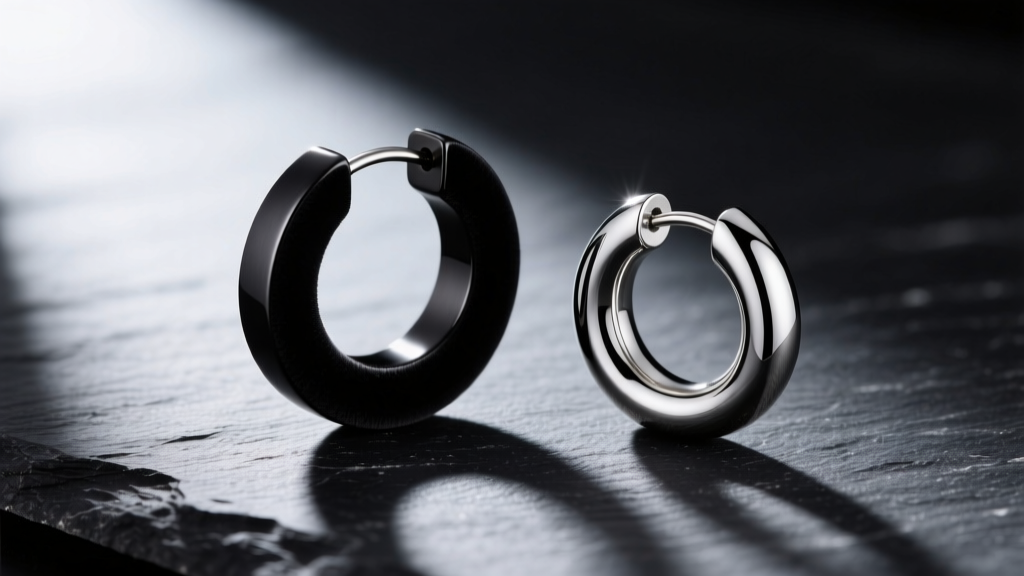
Material Breakdown & Properties
Below is a comparative matrix of the most common biocompatible metals used in high-end earring manufacturing, detailing their elemental composition and practical applications.
| Material | Standard / Purity | Nickel Content | Anodizable? | Best Application |
|---|---|---|---|---|
| Titanium (Ti6Al4V ELI) | ASTM F136 | 0% (Trace only) | Yes (Limited colors) | Initial piercings, heavy gauge lobes |
| Niobium | UNS R04200 (99.9% Pure) | 0% | Yes (Full spectrum) | Seamless hoops, cartilage rings |
| 316LVM Steel | ASTM F138 | 10% - 14% | No | Healed lobe studs, fashion huggies |
| 14k / 18k Gold | Alloyed (No Cadmium/Nickel) | Varies (Usually 0%) | No | Permanent jewelry, fine cartilage studs |
Niobium: The Hypoallergenic Shapeshifter
Niobium is an elemental transition metal, meaning it is not an alloy and cannot be broken down into smaller reactive components. For earring makers, its most valuable property is its reaction to anodization. By submerging niobium earrings in an electrolytic bath and applying specific voltages, the surface oxide layer thickens, refracting light to produce vivid colors without using dyes or platings.
- 18 Volts: Yields a deep, iridescent purple.
- 55 Volts: Produces a vibrant, metallic teal.
- 95 Volts: Creates a bright, emerald green.
- 115+ Volts: Results in a matte, gunmetal black.
Because niobium is softer than titanium, it is the premier choice for seamless segment rings and clickers that require bending to open and close, making it ideal for daith and rook piercings where hinge mechanisms fail.
Karat Gold: Alloying for Durability
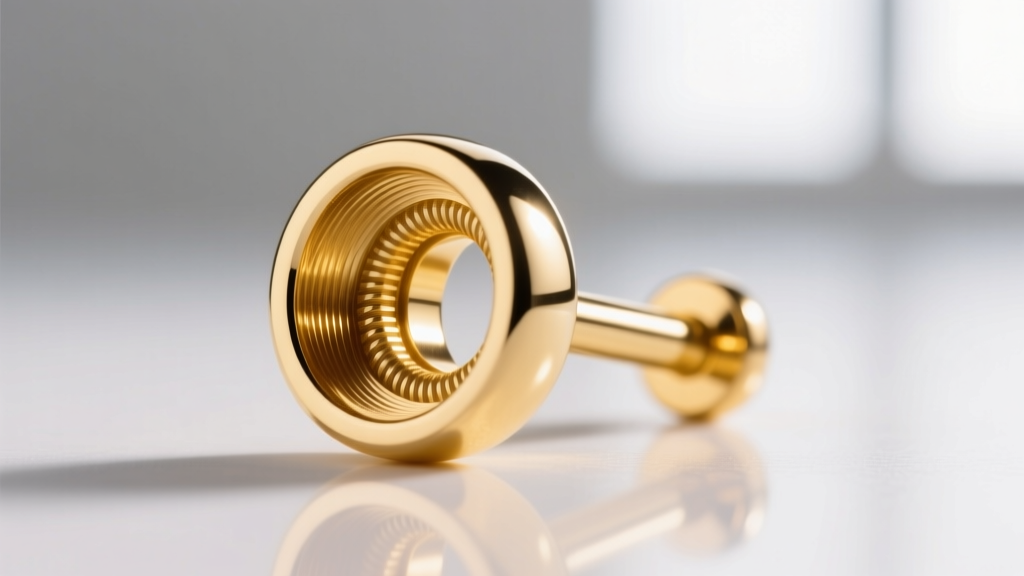
Pure 24-karat gold is entirely unsuitable for earring posts or wire. With a Mohs hardness of just 2.5, a 24k gold earring post will bend under the minor pressure of sleeping, and gemstone settings will easily deform, leading to stone loss. High-quality body jewelry relies on 14k (58.5% gold) or 18k (75% gold) alloys.
The Biocompatibility of Gold Alloys
The Association of Professional Piercers strictly advises against white gold alloys that use nickel as a whitening agent. Reputable manufacturers use palladium or silver to achieve a white gold finish. Furthermore, cadmium and zinc must be strictly controlled, as cadmium is highly toxic and zinc can cause galvanic reactions in the presence of bodily fluids. When purchasing gold cartilage studs, always verify that the alloy is 'nickel-free' and 'cadmium-free' rather than just assuming karat weight guarantees safety.
Failure Modes: Galvanic Corrosion and Contact Dermatitis
One of the most common, yet least understood, failure modes in earring wear is galvanic corrosion. This occurs when two dissimilar metals (e.g., a titanium post and a stainless steel backing) come into contact within an electrolyte (the saline environment of a healing fistula or sweat). This creates a microscopic battery, causing the more anodic metal to corrode rapidly, releasing metal ions into the tissue and triggering severe contact dermatitis.
Expert Rule: Never mix metals in a single piercing assembly. If your earring post is ASTM F136 titanium, the backing, threading, and gemstone setting must also be titanium or compatible precious metals. Avoid steel friction backs on titanium posts entirely.
Gauge Sizing and Biomechanics
Material strength is irrelevant if the gauge (thickness) of the earring is biomechanically inappropriate for the piercing site. The 'cheese-cutter effect' occurs when a wire that is too thin is subjected to downward gravitational force or accidental snagging, causing it to slice through the tissue.
- 20G (0.81mm) & 18G (1.0mm): Acceptable only for standard, fully healed lobe piercings worn in lightweight studs. Never use for cartilage or heavy dangle earrings.
- 16G (1.2mm): The standard baseline for cartilage (helix, tragus, conch) and nostril piercings. Provides enough structural rigidity to resist bending during sleep.
- 14G (1.6mm): Highly recommended for industrial barbells, daith piercings, and stretched lobes. The increased surface area distributes pressure, minimizing migration and rejection risks.
Conclusion: Investing in Metallurgical Integrity
Whether you are selecting a simple 16G titanium labret stud for a healing conch or an anodized niobium clicker for a curated ear project, the material dictates the longevity and safety of the piece. By demanding ASTM-certified metals, understanding the risks of mixed-metal galvanic corrosion, and respecting gauge biomechanics, you ensure your jewelry remains as timeless and resilient as the classic rock anthems that inspired its heavy metal namesake.


