The Ultimate Guide to Buying Implant Grade Titanium Earrings
Discover what to look for when buying implant grade titanium earrings. Learn about ASTM F-136, threading, gauges, and top brands for sensitive ears.

When it comes to ear piercings, the jewelry you choose dictates not only your aesthetic but the long-term health of your tissue. As we navigate the body jewelry market in 2026, the shift away from mystery metals and low-grade alloys has made implant grade titanium earrings the undisputed gold standard for both fresh piercings and sensitive, healed ears. However, the term "titanium" is frequently hijacked by fast-fashion brands selling plated brass or low-grade surgical steel.
This comprehensive buying guide cuts through the marketing noise. We will break down the exact metallurgical standards, threading mechanics, and sizing metrics you need to know to purchase authentic, biocompatible titanium earrings that will last a lifetime.
Decoding the Alloys: ASTM F-136 vs. ASTM F-67
Not all titanium is created equal. In the medical and body modification industries, titanium is categorized by specific ASTM (American Society for Testing and Materials) standards. Understanding the difference between the two primary grades is the first step in making an informed purchase.
ASTM F-136 (Ti6Al4V ELI)
This is the premier alloy for body jewelry, commonly referred to as Titanium 6Aluminum 4Vanadium, Extra Low Interstitial. According to ASTM International, this specific alloy is engineered for surgical implants. The "Extra Low Interstitial" designation means that impurities like oxygen, nitrogen, and carbon are strictly minimized, resulting in a metal that is exceptionally strong, highly corrosion-resistant, and 100% nickel-free. If you are buying jewelry for a fresh cartilage or lobe piercing, F-136 is the only acceptable standard.
ASTM F-67 (Commercially Pure Titanium)
Often labeled as CP Titanium, this is unalloyed titanium. While it is also biocompatible and nickel-free, it is significantly softer than F-136. It is generally acceptable for healed piercings but is not recommended for initial piercings or threaded components, as the softer metal can strip or warp under the pressure of insertion.
The Threading Hierarchy: Protecting Your Fistula
The fistula (the tube of healed tissue inside your piercing) is delicate. The mechanical connection between the earring post and the decorative end plays a massive role in preventing micro-tears and subsequent irritation bumps.
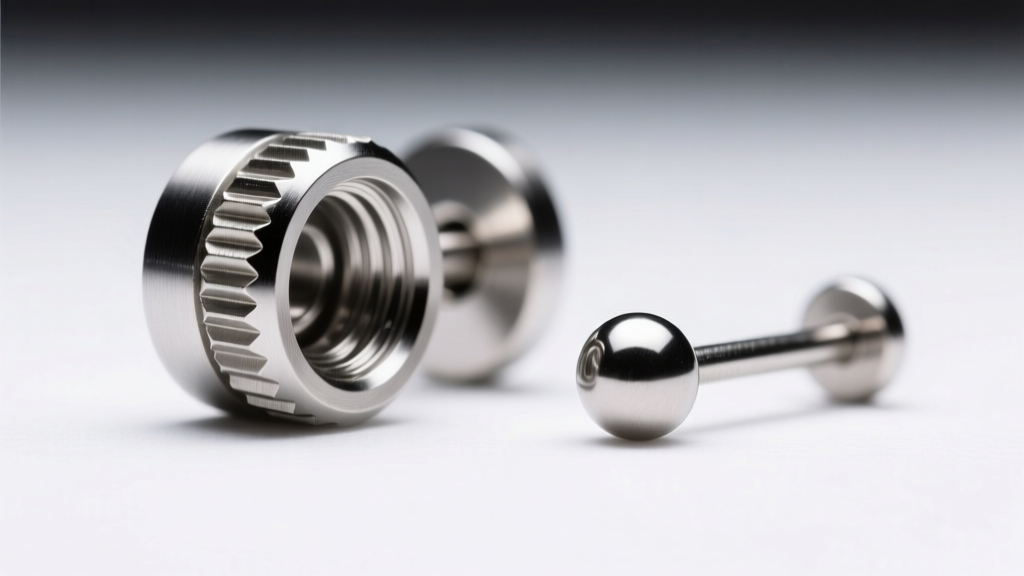
- External Threading (Avoid): The screw pattern is on the post itself. Forcing this through a piercing acts like a cheese wire, scraping and tearing the fistula. This is a hallmark of cheap, mass-produced jewelry.
- Internal Threading (Excellent): The screw pattern is on the decorative end, and the post is completely smooth. The post glides through the tissue without causing trauma. This is the standard for high-end brands like BVLA and Anatometal.
- Threadless / Push-Pin (Excellent): Pioneered by NeoMetal, this system uses a slightly bent pin that creates tension inside a hollow, smooth post. It is entirely seamless upon insertion and offers superior security for active lifestyles.
Precision Sizing: Gauges and Post Lengths
Buying implant grade titanium earrings requires precise anatomical measurements. A post that is too long will catch on hair and clothing, leading to migration, while a post that is too short will compress the tissue, causing necrosis or severe swelling.
| Piercing Placement | Standard Gauge | Standard Post Length (Swelling) | Standard Post Length (Healed) |
|---|---|---|---|
| Standard Lobe | 18g or 16g | 5/16" (8mm) | 1/4" (6mm) or 5/16" (8mm) |
| Helix / Flat | 16g | 5/16" (8mm) to 3/8" (10mm) | 1/4" (6mm) to 5/16" (8mm) |
| Tragus | 16g | 5/16" (8mm) | 3/16" (5mm) to 1/4" (6mm) |
| Conch | 16g or 14g | 3/8" (10mm) to 1/2" (12mm) | 1/4" (6mm) to 5/16" (8mm) |
| Daith / Rook | 16g | 5/16" (8mm) | 5/16" (8mm) |
Note: Always consult with a professional piercer to measure your specific anatomy, as ear thickness varies wildly between individuals.
The "Surgical Steel" Myth and Nickel Allergies
Many consumers mistakenly believe that "surgical steel" or "316L stainless steel" is hypoallergenic. In reality, 316L steel contains between 8% and 12% nickel. While the nickel is bound in the alloy, the corrosive environment of a healing wound (which includes saline, sweat, and dead cells) can cause nickel ions to leach into the tissue. This triggers contact dermatitis, delayed healing, and hypertrophic scarring. The Association of Professional Piercers (APP) explicitly recommends against using steel for initial piercings due to these exact risks. Implant grade titanium, conversely, contains zero nickel, making it the only truly safe option for reactive skin.
Anodization: Safe Color Without Compromise
If you want colored jewelry, you must understand how the color is applied. High-end titanium earrings are never painted, plated, or coated. Plating (like gold PVD over cheap metal) can chip and introduce unknown alloys into your piercing.
Authentic titanium color is achieved through anodization. This is an electrolytic process that thickens the natural oxide layer on the surface of the titanium. By altering the voltage, the oxide layer refracts light differently, producing vibrant colors (like gold, rose, blue, or purple) without introducing any foreign dyes or metals. If a vendor sells "gold-plated titanium," walk away. Look for vendors who anodize in-house or sell factory-anodized pieces from reputable mills.
Where to Buy: Navigating the Market and Avoiding Fakes
The market is currently flooded with dropshippers selling zinc alloy or brass earrings mislabeled as titanium. To guarantee you are purchasing genuine implant grade titanium earrings, adhere to the following buying framework:
1. Verify the Brand
Stick to legacy body jewelry manufacturers that provide mill certificates for their materials. Top-tier brands include:
- BVLA: Known for solid 14k/18k gold ends and impeccable F-136 titanium posts. Pricing ranges from $40 to $150+ per piece.
- Anatometal: The workhorse of the industry, offering precise internal threading and flawless mirror finishes. Posts range from $15 to $35.
- NeoMetal: The undisputed king of threadless (push-pin) titanium jewelry. Excellent for secure, everyday wear ($20 to $60).
- Maria Tash: Offers luxury, diamond-set titanium and gold options, heavily focused on ergonomic, forward-facing stud designs ($80 to $500+).
2. Check the APP Vendor List
The Association of Professional Piercers maintains a vetted list of jewelry manufacturers that meet their strict biocompatibility and polishing standards. If a brand is not APP-compliant, it is a gamble.
3. The Magnet and Weight Test
While you cannot perform destructive testing on jewelry you haven't bought, be highly suspicious of titanium earrings that are exceptionally cheap (e.g., $5 for a pack of 10 on mass-market sites). Genuine F-136 titanium is expensive to machine and polish. Furthermore, titanium is paramagnetic; if a strong neodymium magnet aggressively snaps to your "titanium" earring, it is likely steel or a ferrous alloy.
Final Buying Checklist
Before adding to your cart, ensure the jewelry meets these criteria:
- Explicitly labeled as ASTM F-136 or Ti6Al4V ELI (not just "titanium").
- Features internal threading or a threadless mechanism.
- Has a mirror polish (no visible tool marks or scratches, which harbor bacteria).
- Is sold by an APP-approved manufacturer or a reputable professional piercing studio.
- Color is achieved via anodization, not plating or paint.
Investing in authentic implant grade titanium earrings is an investment in your body. By prioritizing metallurgical purity and mechanical precision, you ensure that your piercings remain healthy, vibrant, and irritation-free for decades to come.