Expert Care Guide for the Band Golden Earring Style
Discover expert cleaning and maintenance tips for the band golden earring. Learn how to polish, store, and protect gold hoops from tarnish and daily scratches.

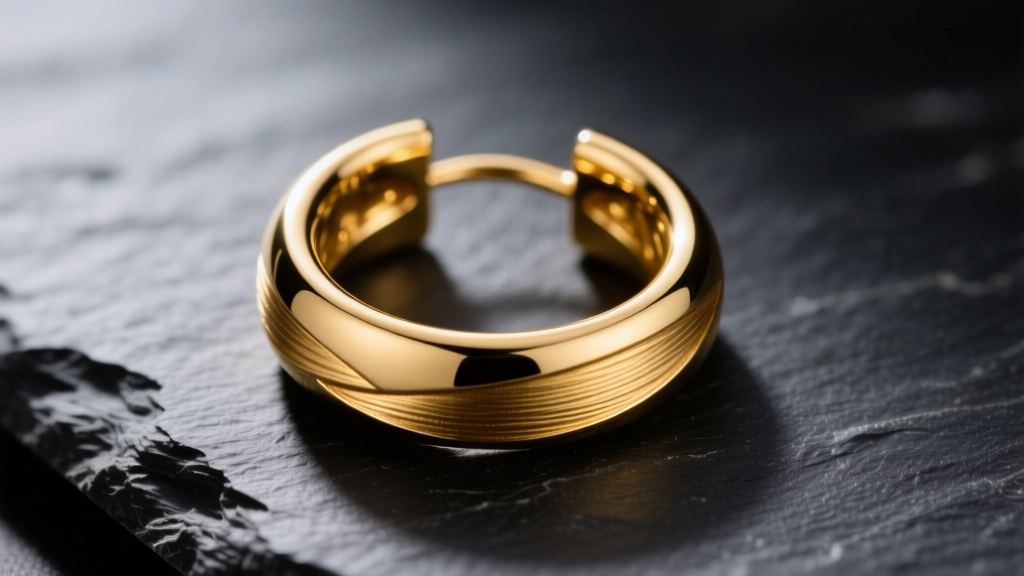
The Anatomy and Appeal of the Band Golden Earring
The minimalist, chunky silhouette of the band golden earring has cemented itself as a modern jewelry staple. Whether styled as a seamless huggie, a thick clicker hoop, or a continuous sleeper, this specific earring architecture relies on a high-polish finish and structural integrity to make its impact. Unlike delicate filigree or gemstone-heavy drops, a solid gold band reflects light across a continuous, unbroken surface. This means that even microscopic scratches, sebum buildup, or water spots are immediately visible to the naked eye. Maintaining the mirror-like finish and mechanical reliability of your gold bands requires a specialized approach that goes far beyond a quick wipe with a generic jewelry cloth.
In this comprehensive guide, we break down the metallurgical realities of gold alloys, the intricate mechanics of band hinges, and the exact chemical protocols required to keep your earrings looking pristine. According to the Gemological Institute of America (GIA), gold is inherently a soft, malleable metal, meaning that daily wear introduces friction and environmental contaminants that can degrade both the aesthetic and structural quality of your jewelry if left unmanaged.
Understanding Your Gold: 14k vs. 18k Band Durability
Before applying any cleaning solution, you must identify the karat weight of your band golden earring. Pure 24k gold is far too soft for daily-wear hoops; it would bend and warp under the slightest pressure. Therefore, jewelers alloy gold with metals like copper, silver, and zinc to increase its tensile strength.
The Vickers Hardness Scale
The durability of your earrings is measured on the Vickers hardness scale (HV). A standard 14k gold band (58.5% pure gold) typically registers around 135 HV, making it highly resistant to the micro-dents caused by accidental bumps against steering wheels or desk edges. Conversely, an 18k gold band (75% pure gold) registers closer to 115 HV. While 18k gold offers a richer, deeper yellow hue and superior hypoallergenic properties, it is significantly more prone to surface scratching. If your band earrings are 18k, you must be exceptionally vigilant about storing them separately from harder gemstones like diamonds or sapphires, which can easily gouge the softer gold surface.
Hinge and Clasp Mechanics: The Hidden Dirt Traps
The most overlooked aspect of maintaining the band golden earring is the hinge and clasp mechanism. Thick band huggies and clickers usually utilize a hidden barrel hinge and a tension-based snap closure. The post itself is typically forged at 16-gauge (1.2mm) or 18-gauge (1.0mm) to support the weight of the thick band.
Over time, the microscopic gap between the hinge barrel and the interlocking post becomes a trap for dead skin cells, cosmetic lotions, and natural sebum. This buildup not only creates a breeding ground for bacteria—which can lead to contact dermatitis or earlobe irritation—but it also degrades the tension of the snap closure. If your band earring no longer produces a satisfying, secure 'click' when closed, it is likely due to compacted debris inside the hinge rather than a structural failure of the metal.
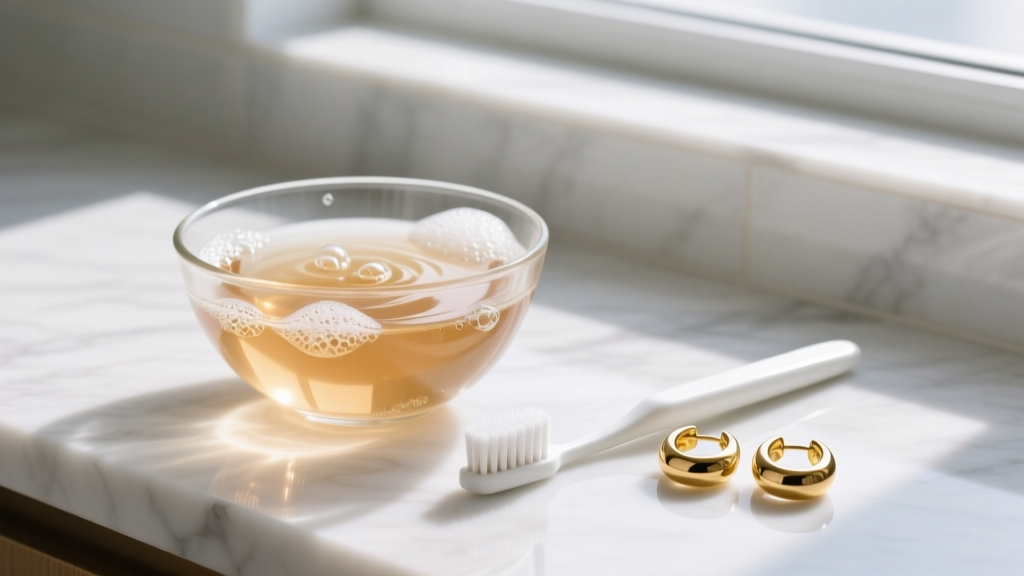
Step-by-Step Deep Cleaning Protocol
To safely remove accumulated oils and environmental pollutants without dulling the high-polish finish, follow this precise cleaning methodology recommended by industry professionals.
1. The Pre-Soak
Fill a small glass bowl with distilled water heated to approximately 98°F (36°C). Tap water contains chlorine and trace minerals that can leave microscopic calcified deposits on high-karat gold. Add three drops of a pH-neutral, lotion-free dish detergent (such as original blue Dawn). Avoid soaps with added moisturizers or citrus extracts, as the citric acid can interact unpredictably with the copper alloys in 14k gold.
2. Agitation and Hinge Clearing
Submerge the band golden earring for exactly five minutes. This softens the sebum without compromising the metal. Using a brand-new, extra-soft baby toothbrush, gently brush the exterior of the band using linear, rather than circular, motions. Circular brushing can create microscopic swirl marks that catch the light and dull the mirror finish. To clean the hinge barrel, use a wooden toothpick or a soft interdental brush. Never use a metal pin or safety pin, as steel is harder than gold and will permanently scratch the interior mechanism.
3. The Rinse and Dry
Rinse the earrings under a gentle stream of lukewarm distilled water. Do not air-dry your gold bands; as the water evaporates, it will leave behind mineral spots that obscure the polish. Instead, use a hair dryer on the 'cool' setting to blow the water out of the hinge mechanism, followed by a gentle pat-down with an untreated, lint-free microfiber cloth.
Chemical Agents: What to Use and What to Avoid
Not all cleaning solutions are safe for the band golden earring. Below is a breakdown of common household and commercial agents and their effects on gold alloys.
| Cleaning Agent | Chemical Profile | Verdict for Gold Bands |
|---|---|---|
| pH-Neutral Dish Soap | Mild surfactants, neutral pH | Highly Recommended. Safely lifts oils without reacting with copper or silver alloys. |
| Baking Soda Paste | Sodium bicarbonate, abrasive | Avoid. The micro-abrasive particles will create a matte, scratched finish on high-polish bands. |
| Ultrasonic Cleaners | High-frequency sound waves | Use with Caution. Excellent for solid bands, but can shatter hollow-tube band earrings or loosen tension settings. |
| Commercial Silver Dips | Thiourea, strong acids | Never Use. Formulated for silver sulfide removal; will strip the alloyed metals from your gold, causing permanent pitting. |
| Isopropyl Alcohol | Solvent, rapid evaporation | Safe for Occasional Sanitizing. Good for wiping the post, but prolonged soaking can dry out hinge lubricants. |
Proper Storage to Prevent Micro-Scratches
How you store the band golden earring is just as critical as how you clean it. Gold's malleability means it is easily scratched by other jewelry. Tossing your bands into a communal jewelry box guarantees a network of fine surface scratches within weeks.
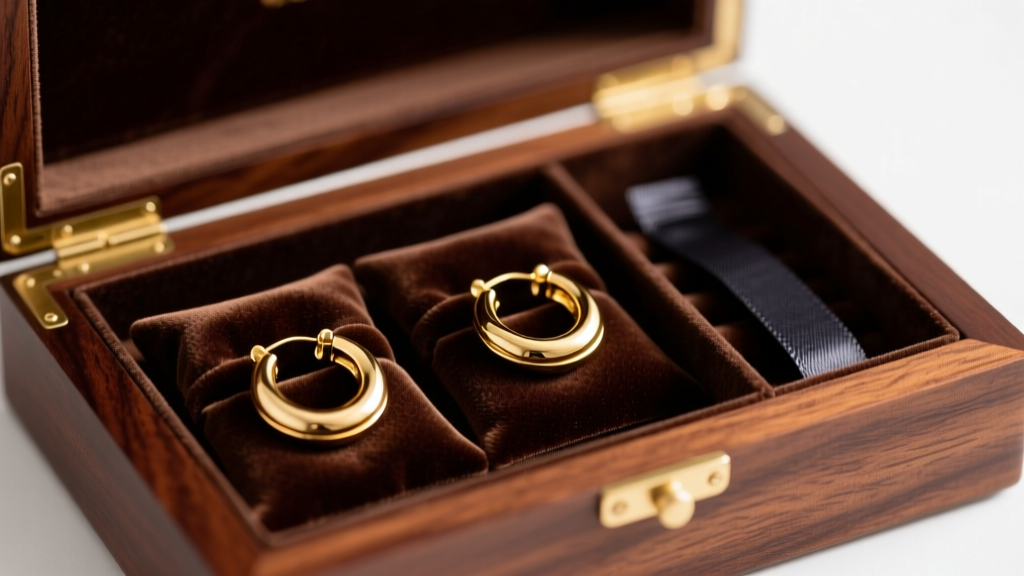
Each band earring should be stored in its own individual soft velvet or anti-tarnish flannel pouch. Furthermore, because gold alloys (particularly 14k and lower) contain copper and silver, they are susceptible to oxidation when exposed to sulfur in the air. While gold itself does not tarnish, the alloyed metals can develop a dull, darkened film over time. Placing a 3M anti-tarnish strip inside your jewelry box or storage drawer will absorb airborne sulfur compounds, keeping your bands brilliantly polished for months between deep cleanings. The Jewelers of America organization consistently emphasizes that climate-controlled, low-humidity storage environments drastically extend the pristine condition of polished gold alloys.
When to Seek Professional Jeweler Services
While diligent home care will maintain the daily brilliance of your earrings, mechanical wear and tear eventually require professional intervention. If the post of your band earring becomes bent, do not attempt to bend it back into place yourself. Repeatedly flexing gold alloy work-hardens the metal, making it brittle and prone to snapping entirely. A professional jeweler can anneal the metal—carefully heating it to relieve internal stress—before reshaping it.
Additionally, if your band golden earring features a satin or brushed finish rather than a high polish, home cleaning will gradually smooth out the textured grooves. A jeweler can use specialized wire-brushing tools or sandblasting equipment to restore the original matte texture without removing excess metal. Schedule a professional inspection and ultrasonic deep clean every 12 to 18 months to ensure the structural integrity of the hinge and clasp remains uncompromised, guaranteeing your favorite bands stay secure and stunning for a lifetime.


