Cat Eye Earrings: Gemology, Cabochon Settings & Sizing Guide
Master the technical details of cat eye earrings. Explore chrysoberyl chatoyancy, cabochon setting mechanics, gauge sizing, and authentication tips.

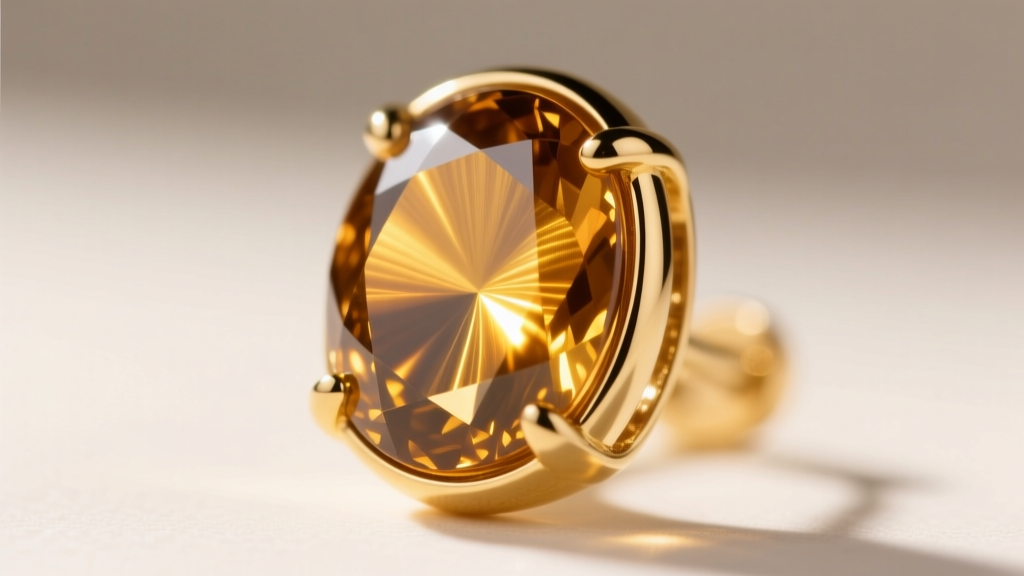
The Gemological Science of Chatoyancy in Cat Eye Earrings
When discussing authentic cat eye earrings, we are strictly referring to the chrysoberyl species (BeAl2O4). While the market is flooded with quartz, apatite, and tourmaline variants, true chrysoberyl remains the undisputed king of chatoyant gemstones. According to the Gemological Institute of America (GIA), chrysoberyl ranks at an impressive 8.5 on the Mohs hardness scale, making it exceptionally durable for daily-wear ear jewelry. Its specific gravity ranges from 3.71 to 3.75, meaning these stones possess a noticeable, satisfying heft that directly impacts earring hardware requirements.
The optical phenomenon known as chatoyancy (from the French 'chat oeil', or cat's eye) is caused by dense, parallel needle-like inclusions—typically rutile (TiO2) or ilmenite. When light strikes these microscopic tubes, it reflects perpendicularly, creating a single, sharp band of light across the dome of the stone. In high-grade chrysoberyl, this 'eye' will open and close dynamically as the earring moves through ambient light, a feature that lesser species simply cannot replicate with the same crispness.
Lapidary Requirements: Why the Cabochon Cut is Mandatory
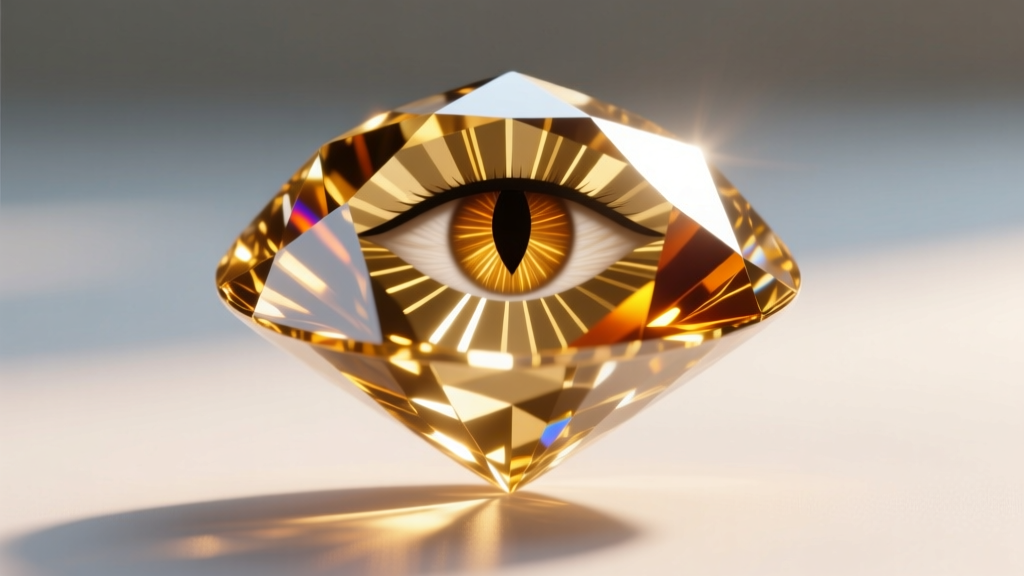
To maximize the chatoyant effect, lapidaries must cut chrysoberyl en cabochon. Faceting destroys the optical alignment required for the eye to form. However, not all cabochons are created equal. The geometry of the cut dictates the quality of the eye seen in your earrings.
Dome Height and Base Orientation
- Base Parallelism: The flat base of the cabochon must be cut perfectly parallel to the inclusion tubes. If the lapidary cuts the base at even a slight angle, the eye will appear diagonal or off-center, severely diminishing the stone's value.
- Dome Proportions: A high, rounded dome is required to focus the reflected light into a tight, singular line. Low-domed or 'buff-top' cuts will result in a wide, blurry, or diffused band of light.
- Symmetry: The eye must sit perfectly dead-center on the apex of the dome. An off-center eye indicates poor rough orientation during the pre-forming stage.
For earrings, matched pairs of cabochons are notoriously difficult to source. Because rough chrysoberyl is rarely uniform, lapidaries often sacrifice yield to ensure the two stones used in a pair of drop earrings share identical body color, dome height, and eye sharpness.
Setting Mechanics: Bezel vs. Prong for Cabochons
Setting a cabochon for ear jewelry requires a fundamentally different approach than setting faceted diamonds or sapphires. The smooth, rounded girdle of a cabochon offers no natural resting place for prongs.
The Superiority of the Bezel Setting
For cat eye earrings, a full or half-bezel setting is the industry standard. A bezel involves a continuous metal wall that is burnished over the sloping edge of the cabochon. This provides three critical advantages:
- Security: Chrysoberyl is hard but possesses distinct cleavage planes. A prong applying uneven pressure can cause internal stress fractures. A bezel distributes tension evenly.
- Profile Protection: Earrings are prone to snagging on hair and clothing. Prongs can catch and bend, releasing the stone. A flush bezel wall eliminates snag points.
- Optical Framing: A highly polished 18k yellow gold bezel acts as a mirror, bouncing additional light into the sides of the translucent chrysoberyl, intensifying the honey or apple-green body color.
When evaluating bezel settings, check the wall thickness. For stones over 8mm, the gold or platinum bezel wall should be at least 0.4mm thick to withstand the torque applied when the earring is handled or cleaned.
Hardware Specifications: Wire Gauges and Weight Distribution
Because chrysoberyl is a dense material, and gold bezels add significant mass, cat eye drop earrings can easily exceed 4 to 6 grams per ear. Standard lightweight earring hardware will fail under this load, leading to stretched piercings or bent wires.
| Earring Style | Recommended Wire/Post Gauge | Max Weight per Ear | Hardware Notes |
|---|---|---|---|
| Stud (Post & Friction Back) | 18g (1.0mm) or 16g (1.2mm) | 3.5 grams | Requires jumbo silicone or wide-disk metal backs to prevent earlobe drooping. |
| French Wire (Drop) | 20g (0.8mm) hard-tempered | 5.0 grams | Must use 'hard' or 'half-hard' temper wire. Dead-soft 20g will warp. |
| Leverback | 18g (1.0mm) post | 7.0 grams | Best for heavy cabochons. The enclosed wire prevents loss if the earring pulls forward. |
| Ear Cuff / Cartilage | 19g (0.9mm) tension band | 4.0 grams | Cartilage cannot support heavy drops; use smaller 6mm cabochons for cuff designs. |
As of 2026, many bespoke jewelers are utilizing titanium or niobium for the structural posts of heavy gold cat eye earrings. These aerospace-grade metals offer superior tensile strength at a fraction of the weight of 14k gold, allowing for larger, more dramatic cabochon drops without sacrificing lobe comfort.
Authentication: Spotting Imitations and Synthetics
The high price per carat of fine chrysoberyl has led to a market saturated with imitations. According to mineralogical data from Mindat.org, distinguishing natural chrysoberyl from lookalikes requires observing specific optical and physical traits.
The Fiber-Optic Glass Deception
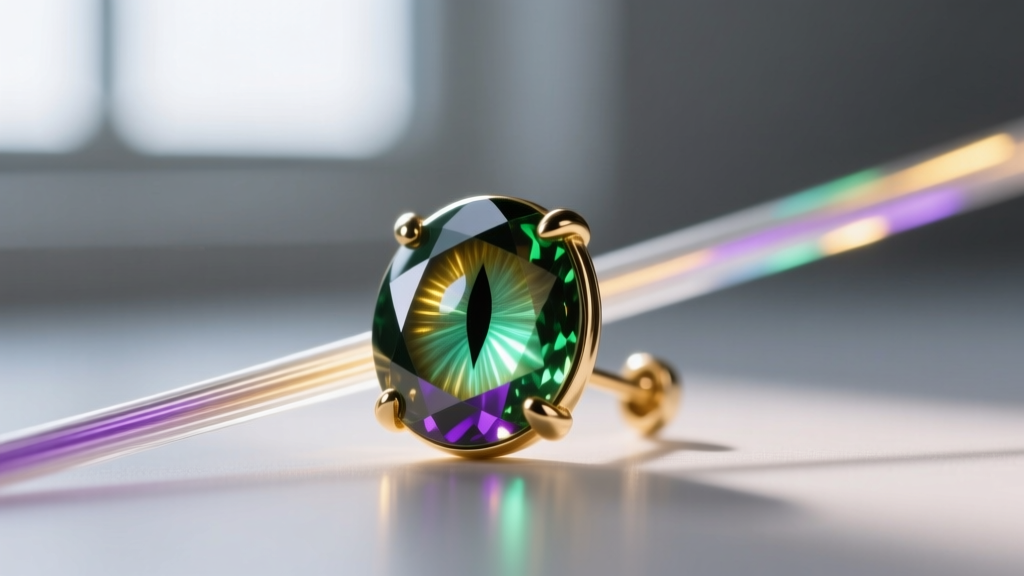
The most common imitation is fiber-optic glass (often sold as 'cathedral glass'). While it exhibits a striking cat eye effect, it is entirely synthetic. Under a 10x jeweler's loupe, fiber-optic glass will reveal a hexagonal or grid-like pattern on the flat base. Furthermore, glass imitations often display multiple 'eyes' or a band of light that is too perfectly uniform and lacks the natural milky translucency of genuine chrysoberyl.
Quartz and Apatite Substitutes
- Quartz Cat's Eye: Often darker, more opaque, and lacking the vibrant honey or mint-green hues of chrysoberyl. Quartz has a lower refractive index (1.54 vs 1.74), making the eye appear less brilliant.
- Apatite Cat's Eye: While apatite can show excellent chatoyancy, it is a 5 on the Mohs scale. It is entirely unsuitable for earrings that might be bumped or dropped, as it will easily scratch and abrade at the girdle.
Care, Maintenance, and Ultrasonic Safety
True chrysoberyl cat eye earrings are remarkably resilient. Unlike emeralds or opals, untreated chrysoberyl contains no fracture-filling oils or delicate water structures. This means your earrings can generally be safely cleaned in a standard ultrasonic jewelry cleaner using a mild alkaline solution. However, if the earrings are set with secondary accent stones (like micro-pavé diamonds or fragile pearls), ultrasonic cleaning should be avoided to prevent loosening the secondary settings. For routine maintenance, a soft-bristled brush with warm water and a drop of dish soap is sufficient to remove sebum and cosmetic buildup from the bezel walls, restoring the stone's maximum light return.


