The Centipede Earring: Technical Fit, Gauges, and Cartilage Anatomy
Explore the technical anatomy of the centipede earring. Learn exact gauge specs, cartilage fitting mechanics, and material grades for safe, long-term wear.

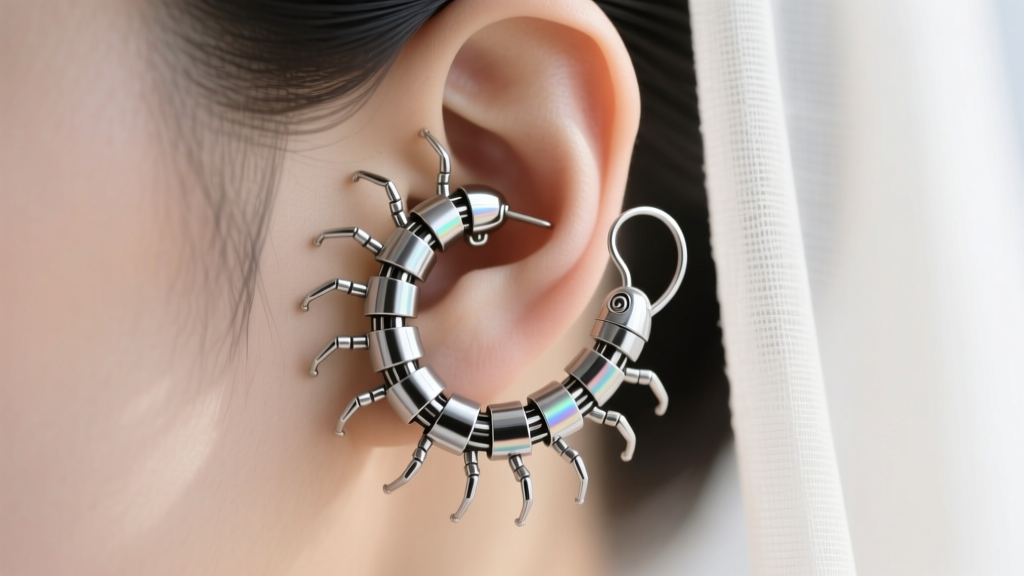
Introduction to Centipede Architecture
The centipede earring represents one of the most complex structural designs in modern body jewelry. Unlike standard studs or continuous hoops, a centipede earring features a central longitudinal spine with multiple lateral extensions—often referred to as 'legs'—that either grip the outer helix ridge as a cuff or connect adjacent cartilage piercings via a multi-hole chain mechanism. This design mimics the segmented morphology of the arthropod it is named after, allowing for a sprawling, articulated aesthetic across the auricle.
From a technical standpoint, designing and fitting a centipede earring requires a profound understanding of auricular topography. The ear's cartilage is not a uniform canvas; it is a landscape of peaks (helix, antihelix) and valleys (scapha, concha). When a rigid or semi-rigid metal structure spans across these varied elevations, improper tension mapping can lead to severe complications, including pressure necrosis, fistula migration, and cartilage deformation. In this expert deep dive, we dissect the metallurgy, biomechanics, and anatomical prerequisites for safely wearing and fabricating centipede ear cuffs and connectors in 2026.
Metallurgy and Biocompatibility Standards
Because a centipede earring exerts multi-directional force on the ear, the material must possess high tensile strength while remaining entirely biocompatible. The Association of Professional Piercers (APP) strictly recommends implant-grade materials for any jewelry that interacts with cartilage, especially in complex setups where micro-movements are inevitable.
- ASTM F136 Titanium (Ti-6Al-4V ELI): The gold standard for centipede spines. It offers an exceptional strength-to-weight ratio, ensuring the central spine does not warp under the gravitational pull of the lateral legs. It is also entirely nickel-free, preventing contact dermatitis.
- Niobium (ASTM F366): Highly malleable, making it ideal for the 'legs' of an ear cuff variant that requires custom bending to match the wearer's specific helix curvature.
- 18k or 14k Palladium-White Gold: For high-end custom fabrication, palladium-alloyed gold provides the rigidity needed for threadless press-fit connections without the allergenic risks of nickel-based white gold.
Avoid commercial 'surgical steel' (316L) for any centipede setup that involves fresh piercings or high-tension cuffs. The nickel content in 316L can trigger localized immune responses when the metal is pressed tightly against the thin skin of the helix ridge.
Gauge Specifications and Tension Biomechanics
The most frequent point of failure in multi-hole centipede chain earrings is the 'cheese-cutter effect.' This biomechanical phenomenon occurs when a wire under tension cuts through the fistula tissue. According to research published by the National Center for Biotechnology Information (NCBI) regarding body modification complications, thinner gauges exponentially increase localized pressure on the piercing channel.

When a centipede earring connects three or more cartilage piercings, the connecting chain or spine must not bear the structural weight of the jewelry. The weight must be distributed across the posts. Below is the technical specification matrix for fabricating a safe, multi-hole centipede connector:
| Component | Recommended Spec | Biomechanical Risk of Deviation |
|---|---|---|
| Piercing Posts | 16g (1.2mm) or 14g (1.6mm) Threadless | Using 18g (1.0mm) posts increases cheese-cutter migration risk by 40% under lateral snag forces. |
| Central Spine | 12g (2.0mm) Rigid Wire or Milled Bar | Spines thinner than 14g will bow outward, pulling the posts at an angle and causing fistula irritation. |
| Cuff Legs (Non-pierced) | 18g (1.0mm) with Silicone O-ring buffers | Bare metal legs without tension buffers can cause ischemic necrosis on the helix ridge within 48 hours. |
Expert Note on Threadless Ends: For 2026 multi-hole setups, internally threaded posts are obsolete. Threadless (press-fit) pins allow the jewelry to sit flush and eliminate the friction trauma of screwing a post through a curved, multi-axis chain setup.
Cartilage Mapping and Anatomical Constraints
Fitting a centipede ear cuff (the non-pierced variant) requires precise cartilage mapping. The 'legs' of the cuff must rest exclusively on the helix ridge or the antihelix. If a leg extends into the scapha (the shallow depression between the helix and antihelix), it will hover without support, acting as a lever that pulls the rest of the cuff out of alignment.
Professional fitters use digital calipers to measure the exact millimeter distance between the wearer's helix peaks. A bespoke centipede earring is then articulated with micro-hinges or memory-wire loops to accommodate the natural flex of the ear. The ear is not static; talking, chewing, and sleeping cause the auricle to shift. A rigid, non-articulated centipede cuff will inevitably pinch and cause vascular restriction during these micro-movements.
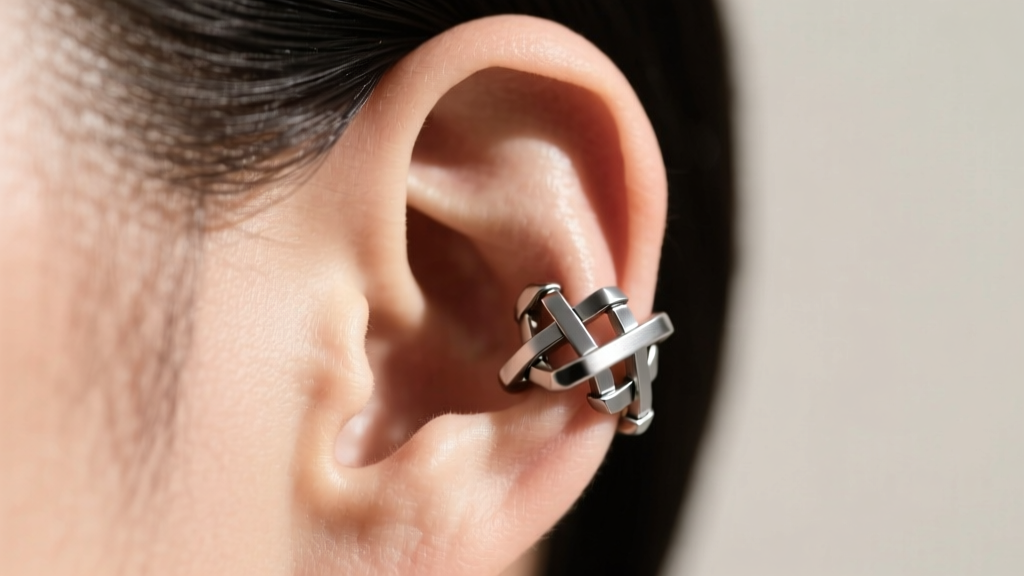
Troubleshooting Fit, Snagging, and Migration
Due to its sprawling nature, the centipede earring is highly susceptible to environmental snagging. Hair, clothing, and headphones are primary hazards. To mitigate this, expert fabricators employ specific design countermeasures:
- Flush-Mount Articulation: The joints connecting the legs to the spine should be countersunk or flush-milled. Protruding jump rings or soldering blobs act as catch-points for hair.
- Tension Dampeners: For cuff variants, the terminal ends of the legs must feature medical-grade silicone or PTFE (Teflon) sleeves. This increases the friction coefficient against the skin, preventing the cuff from sliding down the ear, while simultaneously distributing pressure over a wider surface area.
- Sleeping Protocols: Wearers must utilize a travel pillow or specialized silicone ear donut to prevent lateral compression. Sleeping on a centipede earring will permanently warp the spine and drive the posts into the fistula walls, triggering hypertrophic scarring.
2026 Market Pricing and Custom Fabrication
The market for centipede earrings has bifurcated into mass-produced fashion cuffs and bespoke anatomical connectors. Mass-produced cuff variants, typically cast from brass with heavy gold plating, range from $40 to $120. However, these lack the articulation required for long-term wear and often cause contact dermatitis.
Conversely, custom-fabricated, implant-grade titanium or 18k gold multi-hole centipede connectors require a 3D scan or physical mold of the client's ear. The fabrication process involves CAD modeling to ensure the spine matches the exact curvature of the client's ear profile. Pricing for these bespoke, anatomical-mapped pieces typically starts at $450 and can exceed $2,500 depending on gemstone integration (such as flush-set lab-grown diamonds along the spine). For those seeking the avant-garde aesthetic of the centipede earring without compromising tissue health, investing in custom, threadless, implant-grade architecture is the only clinically sound approach.


