How to Choose and Style Dangle Gold Earrings for Your Face Shape
Learn how to choose, fit, and style dangle gold earrings. Expert guide on gold karats, earlobe support, gauge sizes, and face shape matching.

The Physics of Dangle Gold Earrings: Karat, Gauge, and Gravity
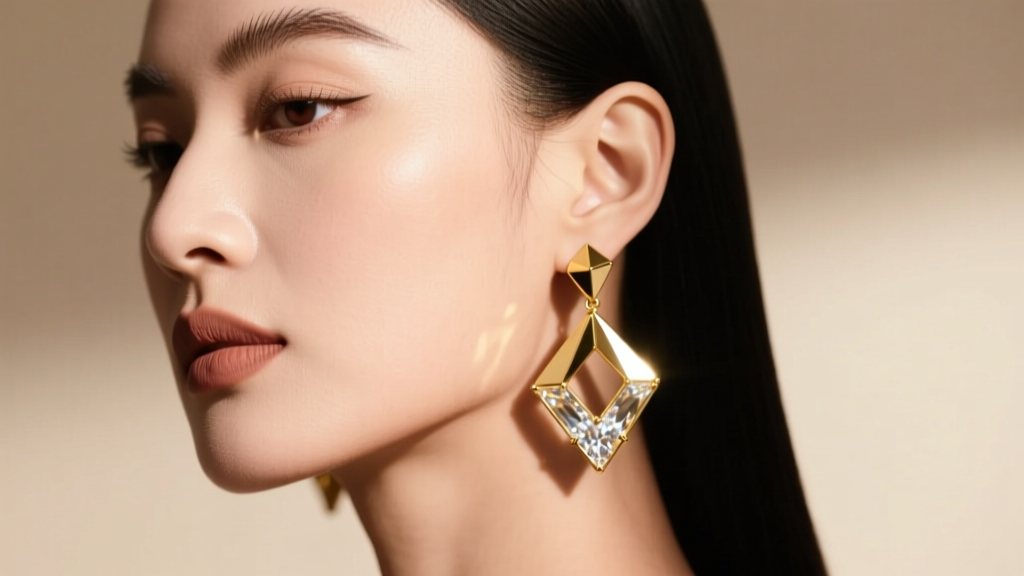
Dangle gold earrings are a timeless staple, but their structural integrity is governed by basic physics. Unlike studs that sit flush against the earlobe, dangles act as pendulums. Every time you turn your head, the kinetic energy transfers to the earlobe, creating a fulcrum effect that can stretch piercings or warp soft metals. Understanding the metallurgy and gauge thickness of your earrings is the first step in making a smart, long-lasting purchase.
Why 14K and 18K Outperform 22K in Dangle Designs
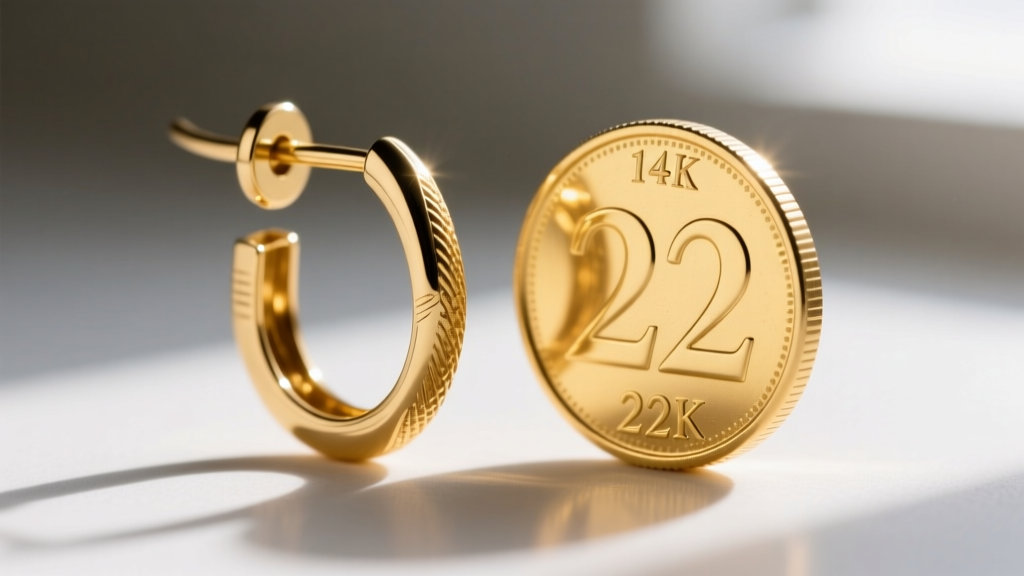
While 22K and 24K gold are highly prized for their rich, buttery color and purity, they are exceptionally soft. On the Vickers hardness scale (HV), pure 24K gold sits at roughly 25 HV, making it entirely unsuitable for the hooks, wires, and structural frames of dangle earrings. According to the Gemological Institute of America (GIA), alloying gold with metals like copper, silver, and zinc increases its durability. For dangle earrings, 14K gold (approx. 135 HV) and 18K gold (approx. 110 HV) offer the necessary tensile strength to support articulated segments without bending.
| Gold Karat | Vickers Hardness (HV) | Best Use in Dangles | Avg. Price Range (per pair) |
|---|---|---|---|
| 14K | ~135 HV | Hooks, wires, structural frames | $150 - $600 |
| 18K | ~110 HV | Main body, moderate weight dangles | $400 - $1,500 |
| 22K | ~60 HV | Solid cast pieces (requires thick gauge) | $800 - $3,000+ |
Navigating the 2026 Gold Market: Solid vs. Hollow-Form Dangles
As gold prices continue to fluctuate in 2026, jewelers are increasingly utilizing hollow-form (or electroformed) techniques to create voluminous dangle gold earrings without the prohibitive weight and cost of solid cast gold. Hollow-form earrings are created by electroplating gold over a wax or resin core, which is later melted or dissolved away. While this allows for dramatic, oversized dangles at a fraction of the price, they come with a critical caveat: they cannot be easily repaired if crushed. If you opt for hollow-form dangles, reserve them for low-impact, occasional wear rather than daily use, and store them in rigid, individual compartments to prevent accidental compression.
Step-by-Step: Matching Dangle Silhouettes to Face Shapes
Styling dangle gold earrings is an exercise in visual geometry. The goal is to create balance by contrasting the natural lines of your face with the silhouette of the earring. Here is a precise framework for selecting the right drop length and shape.
- Round Faces: Avoid circular hoops or short, chunky drops that emphasize width. Instead, opt for linear, angular dangles (like rectangular bar drops or sharp geometric chevrons) measuring between 1.5 and 2.5 inches. This creates a vertical line that visually elongates the face and sharpens the jawline.
- Square Faces: Characterized by a strong, angular jawline and broad forehead. Soften these features with curved dangle gold earrings. Teardrops, oval-shaped chandeliers, and fluid, organic molten-gold designs work best. Keep the length just below the earlobe (1 to 1.5 inches) to draw attention to the center of the face.
- Oval Faces: The most versatile face shape. You can pull off almost any dangle style, from dramatic shoulder-grazing threaders to intricate Art Deco chandeliers. To maintain natural proportions, avoid extreme lengths that stretch the face visually; stick to a 2 to 3-inch drop.
- Heart-Shaped Faces: With a wider forehead and a narrow, pointed chin, the objective is to add visual weight to the lower half of the face. Choose bottom-heavy dangle gold earrings, such as triangular drops or chandeliers that flare outward at the base. Avoid inverted triangles or top-heavy designs.
How to Prevent Earlobe Sagging and Tearing
The American Academy of Dermatology notes that chronic traction from heavy jewelry can lead to irreversible earlobe elongation and contact dermatitis if the alloys contain nickel. A standard 20-gauge (0.81mm) gold wire is sufficient for dangles weighing under 8 grams. However, if your dangle gold earrings exceed 12 grams, you must upgrade your support system.
Upgrading Your Earring Backs and Wires
For heavy dangles, a standard friction post and butterfly back will slowly slide down the ear post, causing the earring to droop forward. Instead, look for dangles equipped with leverback closures or omega backs. Leverbacks feature a hinged wire that snaps securely into a catch, distributing the weight more evenly across the upper cartilage of the piercing hole. For post-style dangles, use silicone or metal earlobe support patches (such as Lobe Wonder). These adhesive patches sit behind the earlobe, featuring a reinforced plastic disc that disperses the downward gravitational pull across a wider surface area, preventing the 'slit' effect in the piercing.

Maintenance: Cleaning and Storing Articulated Gold Jumps
The most common failure point in dangle gold earrings is not the main hook, but the tiny articulated jump rings that connect the moving segments. Over time, the friction of metal-on-metal movement can wear down these rings, or a sudden snag on a sweater can pull them open. Because gold is a relatively soft metal, an 18K jump ring can easily gap open if pulled at an angle.
The 10x Loupe Test: Once a month, examine your dangle earrings using a 10x jeweler's loupe. Check every connection point. If you see even a microscopic gap in a jump ring, the earring is at risk of snapping. Do not attempt to squeeze it shut with standard household pliers, as this will mar the gold and weaken the metal's crystalline structure through work-hardening. Take it to a professional jeweler who will use parallel-jaw pliers and, if necessary, laser-weld the seam for a permanent fix.
Ultrasonic Cleaning Warnings: While ultrasonic cleaners are excellent for removing sebum and lotion buildup from gold, they can be disastrous for dangle earrings. The high-frequency vibrations can loosen the tiny steel pins inside articulated hinges or fracture the soldered joints of delicate filigree drops. For dangle gold earrings, stick to a gentle soak in warm water with a few drops of mild, phosphate-free dish soap, agitating gently with a soft-bristled baby toothbrush, and patting dry with a lint-free microfiber cloth.
Final Thoughts on Dangle Gold Earrings
Investing in high-quality dangle gold earrings requires looking past the initial aesthetic and evaluating the engineering of the piece. By matching the karat and gauge to the weight of the design, utilizing proper earlobe support, and selecting a silhouette that complements your unique facial geometry, you ensure that your earrings remain a comfortable, striking, and structurally sound addition to your collection for decades to come.


