The Complete Buying Guide to Drop and Dangle Earrings
Discover how to choose the perfect drop and dangle earrings. Learn about weights, materials, clasps, and face-shape matching in our expert buying guide.


Understanding the Anatomy of Movement
When navigating the expansive market of fine and fashion jewelry, understanding the distinction between drop and dangle earrings is the first step toward making an informed purchase. While often used interchangeably by mass-market retailers, these two styles operate on entirely different mechanical principles. Drop earrings are stationary; they hang just below the earlobe and remain fixed in place, offering a sophisticated, elongated silhouette without the kinetic movement. Dangle earrings, conversely, are engineered with articulation points—jump rings, hinges, or delicate chains—that allow the ornament to swing and sway with the wearer's natural motion.
This kinetic difference isn't merely aesthetic; it fundamentally alters the physics of how the earring interacts with your earlobe. A dangling motion generates momentum, which can exert up to three times the static gravitational pull on the piercing tract compared to a stationary drop. Recognizing this distinction is vital for preserving your lobe health and ensuring long-term comfort, especially when investing in fine metals and gemstones.
Weight and Gauge: The Hidden Metrics of Wearability
The most common failure point in purchasing drop and dangle earrings is ignoring the physical weight of the piece. Earlobe ptosis (the stretching and sagging of the earlobe tissue) is a well-documented dermatological and cosmetic concern caused by chronic traction. As a general rule of thumb in jewelry ergonomics, any earring exceeding 7 grams per lobe will cause noticeable fatigue after four hours of wear and can lead to permanent tissue stretching over time.
The Gram Rule and Support Solutions
If you are purchasing statement dangles weighing between 8 and 12 grams, you must employ mechanical support. Silicone earring support patches (often sold under brand names like Lobe Wonder) distribute the weight across a wider surface area of the posterior lobe. For fine jewelry investments, seek out hollow-forming techniques or electroformed gold, which provide the visual volume of a large drop earring at a fraction of the solid-cast weight.
Gauge Thickness and Structural Integrity
The gauge (thickness) of the ear wire or post must correlate with the earring's total mass. The standard piercing gauge is 20G (0.81mm). However, a 20G wire supporting a 6-gram dangle will eventually bend, warp, or slice through the tissue. For drop and dangle earrings weighing over 4 grams, insist on 18G (1.02mm) or 16G (1.29mm) ear wires. According to the Gemological Institute of America (GIA), structural integrity in fine jewelry is just as critical as the quality of the stones; a warped wire can compromise the security of the gemstone settings attached to it.
Material Grades and Hypoallergenic Standards
Because drop and dangle earrings exert more leverage on the piercing tract, the metal in constant contact with the skin must be highly biocompatible. The friction and micro-tears caused by the swinging motion of a dangle earring make the ear highly susceptible to contact dermatitis if the metal contains reactive alloys.
The American Academy of Dermatology identifies nickel as the leading cause of allergic contact dermatitis. Many commercial 'surgical steel' or 'hypoallergenic' earrings still contain up to 8% nickel. When buying drop and dangle earrings, refer to this material matrix to ensure long-term biocompatibility:
| Metal Grade | Nickel Content | Best For | Price Range (Fine Jewelry) |
|---|---|---|---|
| ASTM F136 Titanium | 0% (Biocompatible) | Heavy dangles, fresh piercings, extreme sensitivities | $80 - $250 |
| 950 Platinum | 0% (Alloyed with Ruthenium) | Heirloom drops, diamond/gemstone security | $800 - $3,000+ |
| 18k Yellow Gold | Varies (Usually 0-2%) | Everyday luxury drops, warm skin tones | $400 - $1,500 |
| 14k White Gold | High (Often 5-10%) | Avoid for sensitive ears unless rhodium-plated | $200 - $800 |
| Surgical Steel (316L) | 8-10% | Fashion jewelry, non-sensitive healed lobes | $20 - $100 |
Clasp and Backing Mechanics for Kinetic Earrings
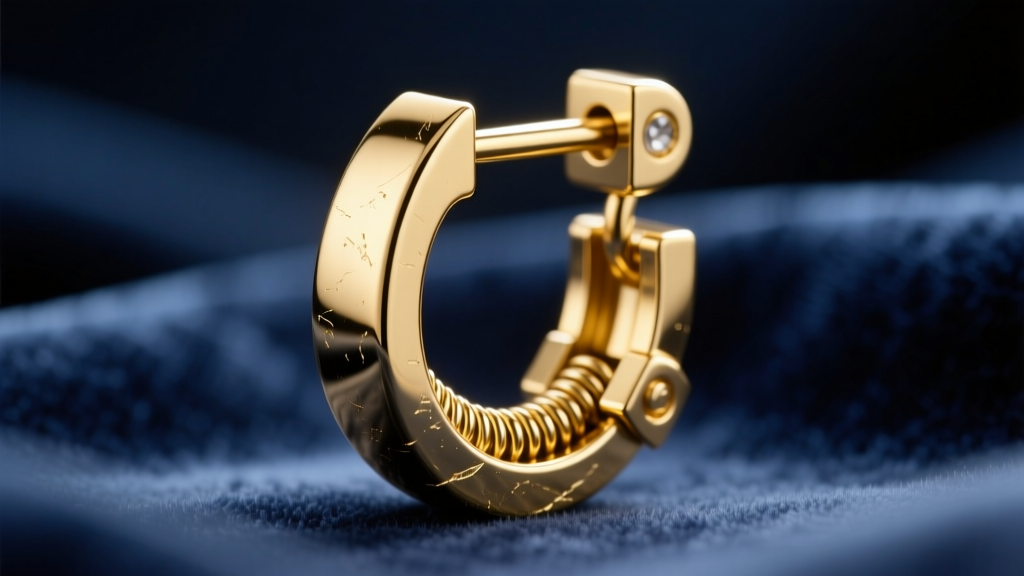
The backing mechanism is the unsung hero of the dangle earring. A standard friction post (butterfly back) is entirely inadequate for kinetic jewelry; the swinging motion creates a ratcheting effect that slowly pushes the backing off the post, leading to catastrophic loss. When evaluating drop and dangle earrings, look for these specialized securing mechanisms:
- Leverback (French Hook with Latch): Features a hinged wire that snaps securely into a catch at the front of the earlobe. This is the gold standard for dangles, allowing free movement while preventing the wire from slipping out of the piercing.
- Omega Back: Utilizes a hinged, curved paddle that clamps against the earlobe, combined with a center post. This provides immense support for heavy, stationary drop earrings, distributing the weight evenly across the lobe.
- La Pousette (Locking Clutch): A mechanical backing that functions like a camera lens cap, locking into a grooved post. Ideal for high-value diamond drop earrings where security is paramount.
- French Wire (Shepherd's Hook): An open wire that passes through the lobe. While elegant, it requires silicone stoppers or o-rings to prevent the earring from falling out during active movement.
Face Shape and Proportion Matrix
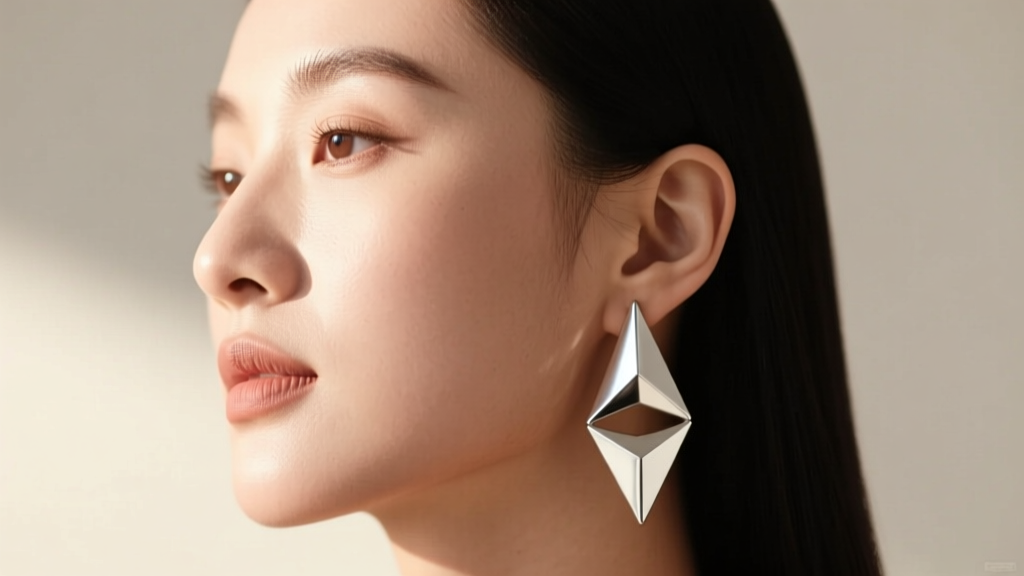
Drop and dangle earrings are powerful tools for facial contouring. Because they draw the eye vertically, they can alter the perceived geometry of the face. Additionally, consider your neck length. If you have a shorter neck, opt for dangles that terminate above the jawline to avoid visually crowding your profile. Those with longer necks can effortlessly carry dramatic, shoulder-grazing chandelier styles. Use this framework to match the silhouette of the earring to the wearer's bone structure:
Round Face Shapes
The Goal: Elongate and add angularity.
What to Look For: Long, linear drop earrings, rectangular dangles, or sharp geometric shapes that end below the jawline. Avoid circular hoops or wide chandeliers that emphasize facial width.
Square Face Shapes
The Goal: Soften the jawline and add curvature.
What to Look For: Teardrop dangles, oval drops, and curved chandelier styles. The movement of a rounded dangle contrasts beautifully with sharp mandibular angles. Avoid boxy or sharply angled geometric drops.
Heart Face Shapes
The Goal: Balance a wider forehead with a narrower chin.
What to Look For: Chandelier earrings or dangles that are wider at the bottom than the top. The volume at the base of the earring visually fills out the lower half of the face.
Oval Face Shapes
The Goal: Maintain natural balance.
What to Look For: Oval faces are the universal canvas for jewelry. Experiment with extreme lengths, avant-garde asymmetrical drops, and heavy statement dangles without fear of throwing off facial proportions.
Maintenance and Storage Protocols
The articulation points that give dangle earrings their life are also their greatest vulnerability. Over time, microscopic debris, skin oils, and cosmetics can accumulate in the jump rings and hinges, causing the earring to lose its fluid movement or, worse, snap under tension.
To maintain the kinetic integrity of your drop and dangle earrings, implement a strict storage and cleaning protocol. Never toss dangles into a communal jewelry box; the swinging components will inevitably tangle with chains and prongs, bending the ear wires and scratching soft gemstones like opals or pearls. Store them hanging from a specialized jewelry organizer or laid flat in individual microfiber pouches. Clean the articulation points monthly using a soft-bristled brush and a mild, ammonia-free jewelry cleaner, ensuring that the hinges remain completely free of residue.
Furthermore, always inspect the jump rings connecting the drop component to the ear wire. These tiny loops endure the highest degree of metal fatigue. If you notice any visible gap in the seam of a jump ring, take the earring to a professional jeweler for laser welding before the stone is lost.
Final Verdict: Investing in Motion
Purchasing drop and dangle earrings requires looking past the initial visual impact and evaluating the mechanical engineering of the piece. By prioritizing 18G or 16G wire thicknesses for heavy pieces, selecting biocompatible metals like ASTM F136 titanium or high-karat gold, and matching the clasp type to the earring's kinetic energy, you ensure that your jewelry remains both secure and comfortable. Whether you are selecting a stationary diamond drop for a black-tie event or an articulated gold dangle for daily wear, understanding these structural nuances is the hallmark of a truly informed collector.


