Circular Stud Earrings: 2026 Style Trends & Stacking Guide
Discover 2026 trends for circular stud earrings. Learn expert stacking techniques, ideal gauge sizes, and material grades for your curated ear.

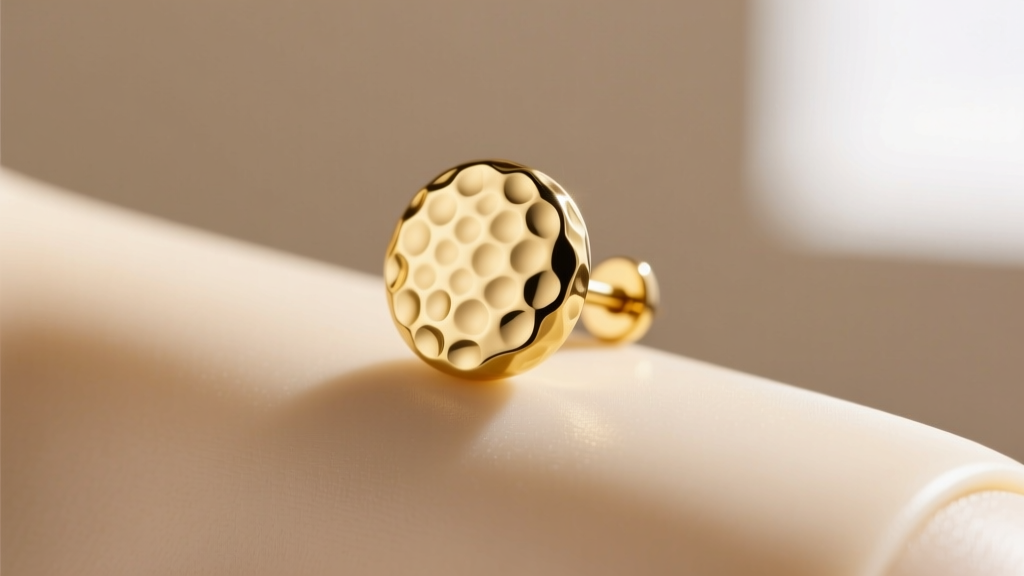
The Anatomy of the Circular Stud: Beyond the Basic Hoop
When building a curated ear, the line between a small hoop and a stud often blurs. However, circular stud earrings occupy a distinct structural category. Unlike huggies or continuous hoops that pass entirely through the piercing and rely on a hinged or clicker closure, a circular stud features a flat or domed disc face attached to a single, straight post that secures with a back clutch. This distinction is not merely semantic; it fundamentally changes how the earring sits, how it catches the light, and how it interacts with your ear's anatomy.
In 2026, the jewelry industry has moved away from the ultra-minimalist, flat-polished coin studs that dominated the early 2020s. Today's circular studs are architectural, textured, and heavily focused on light manipulation. But before diving into the aesthetics, we must address the most common mechanical failure associated with this earring type: the droop.
The Physics of the Droop: A Common Failure Mode
Many collectors purchase 8mm to 10mm solid gold circular stud earrings only to find them pointing downward, resting awkwardly against the neck. This is a physics issue, not a defect. A 10mm 18k solid gold disc can weigh between 1.5 and 2.2 grams. If this face is attached to a standard 20-gauge (0.81mm) post and secured with a standard metal butterfly clutch, the soft tissue of the earlobe cannot support the leveraged weight. The post bends slightly downward inside the piercing channel.
The Expert Fix: For any circular stud exceeding 7mm in diameter, you must insist on an 18-gauge (1.02mm) or 16-gauge (1.29mm) post. Furthermore, swap the traditional butterfly clutch for a screw-back or a jumbo silicone friction back to provide a wider surface area of support against the rear of the earlobe.
2026 Trend Forecast: How Circular Studs Are Evolving
According to trend forecasts from The Jewelry Editor, the 2026 landscape of ear styling is heavily focused on tactile surfaces and mixed metallurgy. The perfectly smooth, mirror-polished disc is being replaced by designs that offer visual depth.
1. The Martelé and Bark Texture Revival
The martelé (hammered) finish is the defining texture for circular studs this year. By hand-hammering the surface of the gold or silver disc, jewelers create hundreds of microscopic facets. This technique transforms a simple circular stud into a dynamic light reflector. Bark textures—achieved by fusing and oxidizing the metal surface to mimic organic tree bark—are also surging in popularity for upper-cartilage placements, offering a rugged contrast to delicate chain earrings.
2. Bi-Tone and Mixed-Alloy Stacking
Matching your metals is no longer the rule. The 2026 approach to circular studs involves bi-tone construction within a single piece. A popular design features a 14k white gold bezel or rim encasing an 18k yellow gold domed center. This allows the wearer to bridge the gap between silver and gold tones in a single curated stack, seamlessly tying together a diverse ear curation.
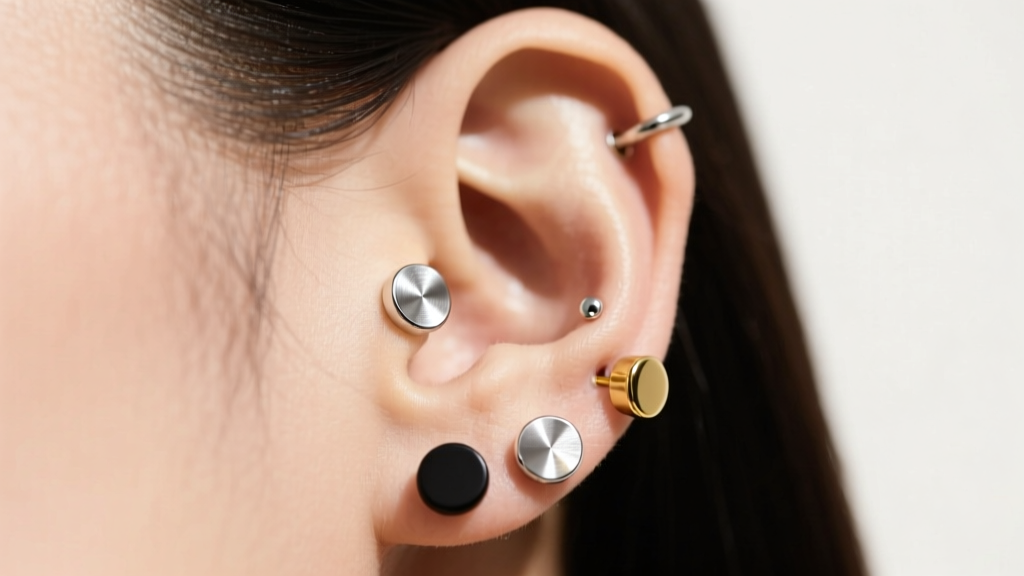
Proportions & Placement: A Data-Driven Sizing Guide
The diameter of your circular stud must be matched not only to your aesthetic preference but to the specific anatomy of the piercing. A stud that is too large for a tragus will press against the antitragus, causing irritation bumps. Conversely, a stud that is too small for a standard lobe will look lost and disproportionate.
Below is the definitive 2026 sizing matrix for circular stud earrings, factoring in tissue thickness and the critical "cheese-cutter" effect (where a post that is too thin migrates through cartilage under pressure).
| Diameter | Ideal Placement | Required Gauge (Thickness) | Optimal Post Length |
|---|---|---|---|
| 3mm - 4mm | Helix, Tragus, Rook | 16g (1.2mm) or 14g (1.6mm) | 6mm (1/4") |
| 5mm - 6mm | Upper Lobe, Conch | 18g (1.0mm) or 16g (1.2mm) | 6mm - 8mm |
| 7mm - 8mm | Standard Lobe (Primary) | 18g (1.0mm) | 8mm (5/16") |
| 9mm - 12mm | Lower Lobe (Statement) | 16g (1.2mm) with Screw-back | 8mm - 10mm |
Material Grades & Pricing: What to Expect
When investing in circular studs that sit flush against the skin, material biocompatibility is paramount. The back of the disc rests directly against the posterior of the ear, meaning poor alloys will quickly trigger contact dermatitis. According to the Gemological Institute of America (GIA), understanding the alloy composition of your gold is essential for both durability and skin health.
- Implant-Grade Titanium (ASTM F136): The absolute gold standard for fresh piercings and hyper-sensitive ears. It contains zero nickel. Expect to pay $35 to $75 for high-quality, anodized titanium circular studs. Note that titanium is difficult to cast with intricate textures, so most titanium discs are flat and machine-stamped.
- 14k Solid Gold (58.5% Pure Gold): The most practical choice for textured, martelé circular studs. The higher alloy content (mixed with copper, silver, or zinc) gives the metal the tensile strength required to hold deep hammer marks without warping over time. Pricing ranges from $120 to $280 per pair, depending on diameter.
- 18k Solid Gold (75% Pure Gold): Prized for its rich, buttery yellow hue. However, 18k gold is softer. If you buy an 18k gold circular stud with a high-dome profile, be aware that it will dent if dropped on a hard surface. Pricing sits between $250 and $550+.
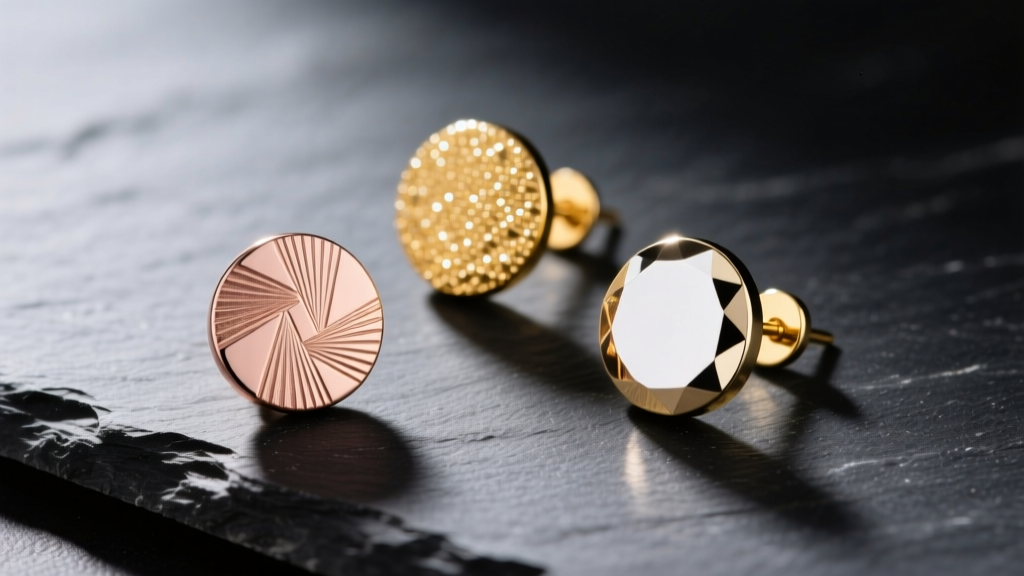
The "Curated Ear" Blueprint: Stacking Circular Studs
Stacking circular studs requires an understanding of negative space. Because circles are visually "heavy" and symmetrical, placing them too close together creates a cluttered, overlapping effect. The 2026 styling methodology relies on asymmetrical scaling.
"The secret to a modern ear stack is treating your piercings like a constellation. You need anchor stars and satellite stars. A large, textured circular stud in the primary lobe acts as the anchor, while smaller, high-polish circular studs in the helix and upper lobe serve as the satellites." — Elara Vance, Master Piercer & Ear Curator
The 3-Piercing Asymmetrical Stack
If you have a standard lobe, upper lobe, and helix piercing, try this specific configuration:
- Primary Lobe: 8mm Martelé (hammered) 18k Yellow Gold circular stud. The texture draws the eye and anchors the bottom of the ear.
- Upper Lobe: 5mm High-Polish 14k White Gold circular stud. The smooth texture and white metal provide a stark, intentional contrast to the lobe.
- Helix: 4mm Bezel-Set Black Onyx circular stud. The dark gemstone breaks up the metallic tones and adds a gothic, modern edge to the cartilage.
Care and Maintenance for Textured Discs
The shift toward martelé and bark textures introduces a new maintenance challenge. The microscopic crevices created by hammering are magnets for sebum, dead skin cells, and cosmetic products like foundation or hairspray.
Avoid Ultrasonic Cleaners: While ultrasonic cleaners are excellent for smooth gemstone settings, the high-frequency vibrations can actually accelerate the wear of delicate, hand-applied oxidation (patina) that jewelers use to highlight the grooves in textured circular studs.
The Proper Cleaning Method: Instead, use a soft-bristled baby toothbrush and a few drops of mild, phosphate-free dish soap (like Dawn) mixed with warm water. Gently brush the face of the circular stud in a circular motion, rinse thoroughly under distilled water to prevent hard water spotting, and dry immediately with a microfiber cloth. Store your circular studs individually in soft pouches; because the faces are wide and flat, they are highly susceptible to surface scratching if tossed loosely into a jewelry box with diamond-accented pieces.


