How to Choose Classic Round Hoop Earrings: A Buyer's Guide
Discover how to choose the perfect classic round hoop earrings. Learn about gauge sizes, metal grades, and face-shape pairing in our expert guide.


The geometric perfection of classic round hoop earrings makes them a foundational pillar of any curated jewelry collection. However, the market is heavily saturated with poorly constructed pieces that warp, tarnish, or cause contact dermatitis. As a buyer, navigating the nuances of wire thickness, closure mechanics, and metallurgical grades is essential to securing a pair that will last a lifetime. This comprehensive guide strips away the marketing fluff to focus on the structural and material realities of buying premium hoops.
The Anatomy of a Perfect Hoop: Gauge and Wire Thickness
When evaluating classic round hoop earrings, the wire gauge (thickness) dictates both the aesthetic weight and the structural integrity of the piece. Gauge is measured inversely; a lower number means a thicker wire.
- 20-Gauge (0.81mm): Ideal for delicate, lightweight everyday hoops. While elegant, 20G wire is susceptible to bending if subjected to pressure during sleep or when pulling clothing over the head.
- 18-Gauge (1.02mm): The industry standard for classic lobe hoops. This thickness provides an optimal balance of durability and comfort, fitting seamlessly into standard 18G or 20G lobe piercings without causing the "cheese-cutter effect" (where thin wire migrates through the tissue).
- 16-Gauge (1.29mm): Reserved for chunky, statement hoops or cartilage placements. If you are buying hoops for a healed conch or helix piercing, 16G is the recommended minimum to prevent tissue rejection and irritation.
Closure Mechanisms: What Actually Works
The closure is the most common point of mechanical failure in hoop earrings. Choosing the right mechanism depends on your dexterity and lifestyle.
Latch-Back (The Traditional Standard)
A hinged post snaps into a notched catch. While ubiquitous, latch-backs have a critical failure mode: the thin post can easily bend if snagged on a sweater or towel. If the post warps, the hoop will no longer close flush against the ear, creating a snag hazard.
Hinged Snap (The Modern Upgrade)
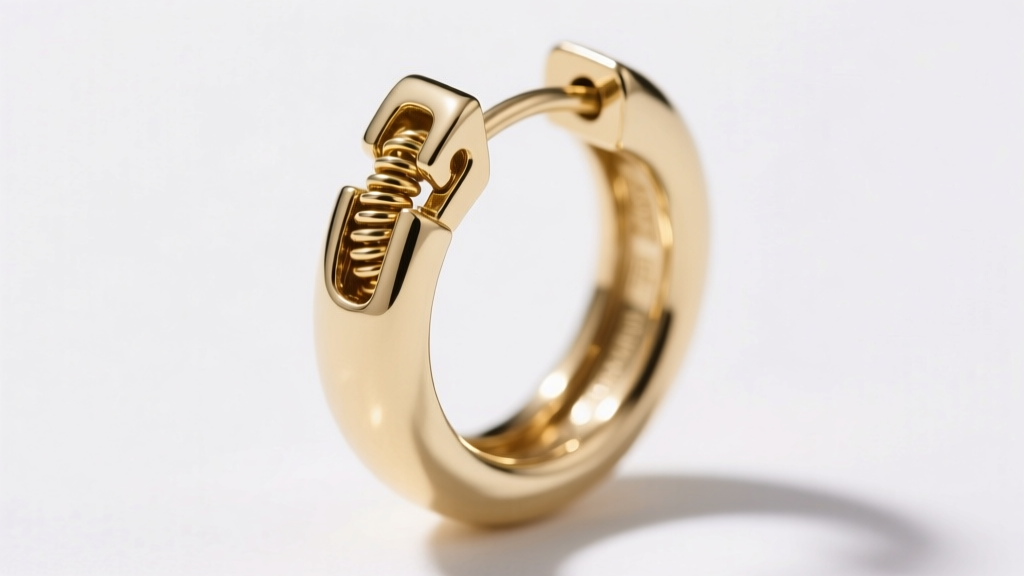
Commonly found in huggies and smaller classic round hoop earrings (10mm-20mm), the entire back half of the hoop hinges downward and clicks securely into the front tube. This mechanism is vastly superior for security, though it requires occasional cleaning with isopropyl alcohol to remove sebum buildup that can jam the hinge.
Continuous / Endless (The Minimalist Choice)
These feature a thin wire that threads through the piercing and loops into a hollow tube at the other end. They offer a seamless look but are notorious for falling out if the wire loses its tension. Always gently squeeze the wire to maintain a tight fit inside the receiving tube.
Material Grades and Hypoallergenic Standards
Metal selection is non-negotiable for sensitive ears. According to the Association of Professional Piercers (APP), only specific implant-grade materials should be worn in the body to avoid nickel-induced allergic contact dermatitis.
| Material Grade | Composition / Purity | Pros | Cons | Avg. Price Range |
|---|---|---|---|---|
| Solid 14k Gold | 58.3% Pure Gold | Excellent durability, resists warping, holds value. | White gold often contains nickel alloys. | $250 - $600 |
| Solid 18k Gold | 75% Pure Gold | Rich color, highly hypoallergenic (if nickel-free). | Softer metal; thin 18k hoops can warp easily. | $400 - $900+ |
| ASTM F-136 Titanium | Implant-Grade Ti-6Al-4V | 100% nickel-free, lightweight, biocompatible. | Limited to silver/grey tones or anodized colors. | $40 - $120 |
| Gold Vermeil | Sterling Silver base, 2.5µm Gold | Affordable luxury aesthetic. | Will eventually wear down to silver; requires careful maintenance. | $60 - $150 |
As noted by the Gemological Institute of America (GIA), the alloy metals mixed with pure gold dictate its color and durability. If you prefer white gold classic round hoop earrings, ensure they are alloyed with palladium rather than nickel, or be prepared for the rhodium plating to wear off over time, exposing the slightly yellowish underlying alloy.
Sizing Dynamics and Face Shape Geometry
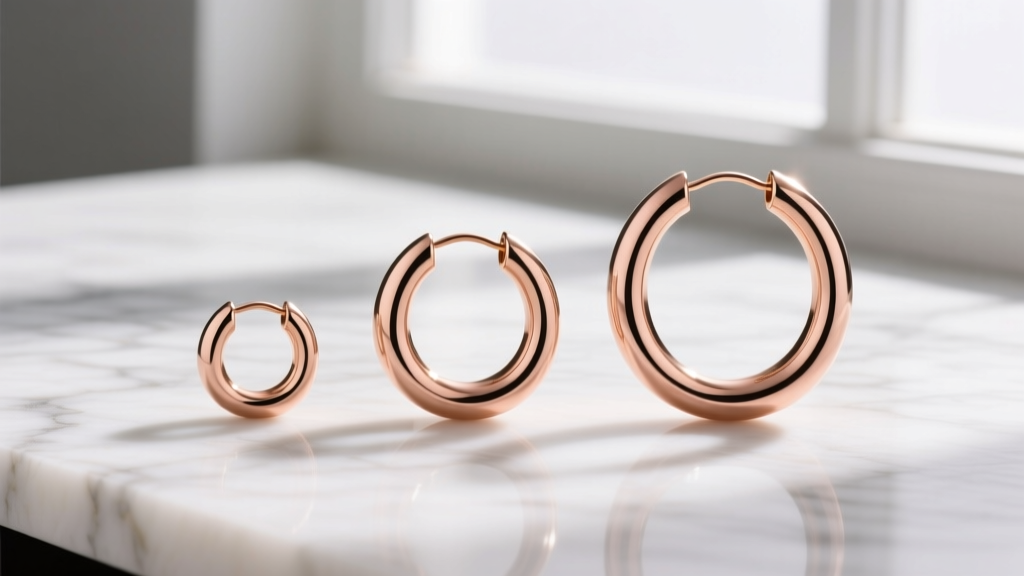
The diameter of your hoops dramatically alters your facial proportions. Because we are focusing strictly on round hoops, the diameter must be chosen to complement, rather than clash with, your natural bone structure.
- Square Faces: Opt for medium to large round hoops (40mm - 60mm). The continuous curve of a large circle softens a strong, angular jawline and draws the eye outward, balancing the width of the face.
- Heart Faces: Stick to medium-sized hoops (25mm - 35mm). Hoops that are too large will add unwanted visual weight to the lower half of the face, exaggerating a narrow chin.
- Round Faces: Avoid mid-sized circles (30mm - 40mm), which can mimic and emphasize the roundness of your face. Instead, choose very small huggies (under 15mm) or oversized statement hoops (over 65mm) that extend past the jawline to create an elongating illusion.
- Oval Faces: The universal standard. You can comfortably wear any diameter, though a classic 20mm - 30mm hoop provides the most timeless, proportional look for daily wear.
Common Failure Modes and How to Avoid Them
Even high-end jewelry can fail if subjected to the wrong environmental stressors. Here are the three most common issues buyers face with classic round hoop earrings and how to mitigate them:
- The Sleep Warp: Sleeping in hoops larger than 15mm puts lateral torque on the wire. Over months, this will pull a perfect circle into an oval. Solution: Keep a dedicated pair of 10mm huggies or flat-back studs exclusively for sleeping.
- The Snag and Tear: Latch-back hoops frequently catch on turtlenecks and hairbrushes. This not only bends the post but can tear the earlobe. Solution: Upgrade to hinged-snap closures or continuous hoops for active days.
- The Oxidation Ring: Cheaper gold-plated or gold-filled hoops often use brass or copper as a base metal. When the plating micro-cracks, sweat reacts with the copper, leaving a green residue on the neck and ear. Solution: Invest in solid 14k gold or solid sterling silver; avoid brass bases entirely.
Expert Sourcing and Price Expectations
When shopping for classic round hoop earrings in 2026, be highly skeptical of pricing anomalies. Solid 14k gold is a commodity; if a pair of 30mm, 18-gauge solid gold hoops is priced under $150, they are almost certainly hollow-core (electroformed) or heavily plated. Hollow-core hoops dent easily and cannot be repaired by a jeweler once crushed.
Expert Tip: When buying online, always check the product specifications for the exact metal weight in grams. A standard 30mm solid 14k gold hoop (18G) should weigh approximately 1.2 to 1.5 grams per earring. If the weight is unlisted, assume the piece is hollow or plated.
By prioritizing structural gauge, secure closures, and verifiable metal grades, you can invest in a pair of classic round hoop earrings that transcend seasonal trends and remain a reliable staple in your wardrobe for decades.


