Cluster Stud Earrings: 2026 Budget & Value Buying Guide
Discover how to evaluate cluster stud earrings in 2026. We break down pricing, metal grades, stone quality, and hidden costs to maximize your jewelry budget.

The Anatomy of Cluster Stud Earrings: What Are You Paying For?
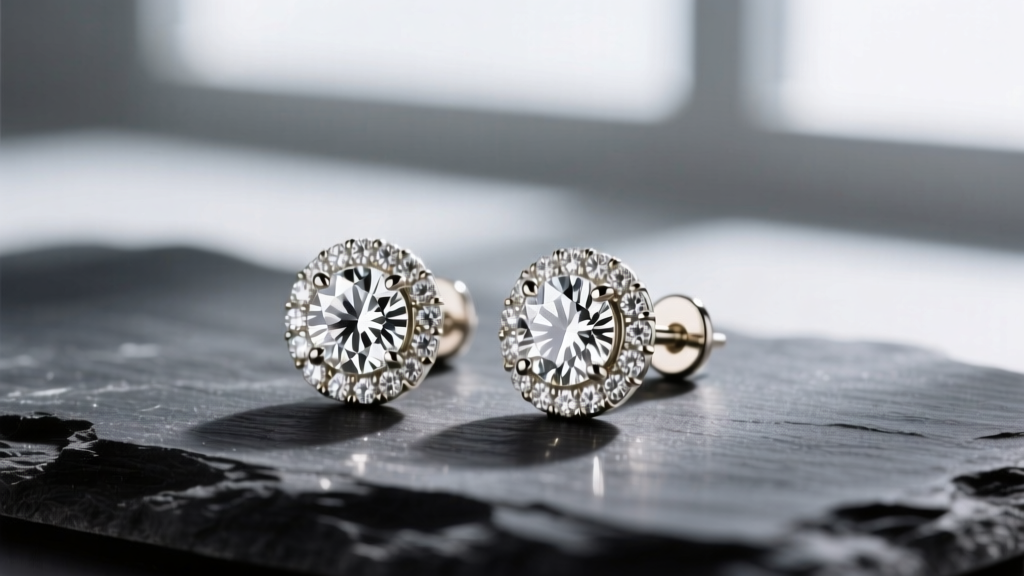
Cluster stud earrings have long been the jewelry industry's best-kept secret for maximizing visual impact on a constrained budget. By grouping multiple smaller diamonds—known in the trade as melee—into a single cohesive face-up silhouette, jewelers can replicate the footprint of a massive solitaire at a fraction of the cost. However, as we navigate the 2026 market, the value proposition of cluster studs has shifted dramatically. With the stabilization of lab-grown diamond pricing and evolving consumer awareness regarding metal alloys, buying cluster earrings requires a highly analytical approach.
To accurately assess value, you must first understand Carat Total Weight (CTTW). According to the Federal Trade Commission Jewelry Guides, jewelers must clearly disclose when a carat weight represents the combined total of multiple stones rather than a single diamond. A 1.50 CTTW cluster earring might feature a 0.20ct center stone surrounded by fourteen 0.09ct melee stones. While the total carat weight is impressive on paper, the per-carat cost of melee diamonds is exponentially lower than that of large, single solitaires. Therefore, you should never pay solitaire premiums for cluster configurations.
Optical Physics: Solitaire vs. Cluster Light Return
When evaluating cluster stud earrings, it is vital to understand how light behaves differently across multiple small tables versus one large table. A single 6.5mm (1.00ct) diamond acts as a unified optical prism, returning broad, sweeping flashes of white and colored light. Conversely, a cluster of smaller stones creates a "crushed ice" or high-frequency scintillation effect. Because the light is fragmented across dozens of tiny facets, clusters sparkle intensely in direct, pinpoint lighting (like sunlight or spotlights) but can appear flat or grayish in diffuse, overcast lighting. If your daily environment involves bright, direct lighting, clusters offer superior visual performance per dollar.
Value Assessment Matrix: 2026 Pricing Tiers
The table below illustrates the current market realities for 1.00 Carat Total Weight (CTTW) earrings, comparing natural diamonds, lab-grown alternatives, and solitaire equivalents.
| Configuration | Material / Stone Type | Average 2026 Retail Price | Visual Footprint (Diameter) | Value Rating |
|---|---|---|---|---|
| 1.00ct Solitaire | Natural Earth-Mined | $4,500 - $7,500 | ~6.5mm | Poor (High Cost/mm) |
| 1.00 CTTW Cluster | Natural Earth-Mined | $1,200 - $2,200 | ~8.5mm - 9.5mm | Good |
| 1.00 CTTW Cluster | Lab-Grown Diamond | $450 - $850 | ~8.5mm - 9.5mm | Exceptional |
| 2.00 CTTW Cluster | Lab-Grown Diamond | $900 - $1,600 | ~11.0mm - 12.5mm | Exceptional |
The Prong Problem: Hidden Costs and Failure Modes
The most significant vulnerability of cluster stud earrings lies in their setting mechanics. To hold dozens of tiny melee stones securely, jewelers utilize either individual basket prongs or shared prongs. Shared prongs—where a single metal bead secures the girdles of two adjacent stones—are the industry standard for clusters because they minimize metal visibility and maximize stone exposure.
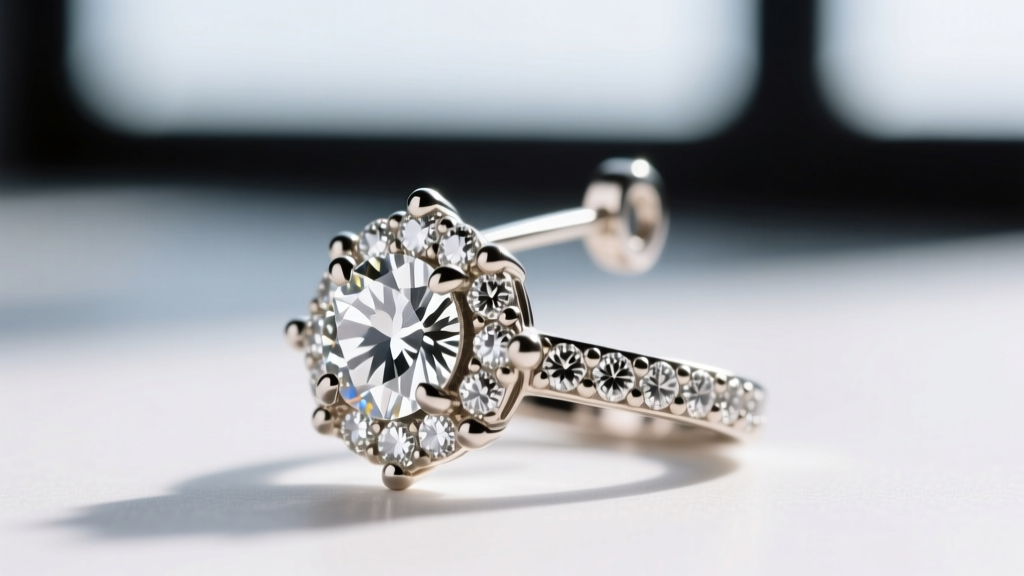
However, shared prongs are notorious failure points. The tiny metal beads are prone to catching on hair, sweaters, and towels. Over time, this micro-tension lifts the prong, leading to stone loss. According to gemological standards outlined by the Gemological Institute of America (GIA), melee stones are rarely laser-inscribed, making replacements a matter of visual color-matching rather than exact certification swapping. If you purchase a natural diamond cluster, factor in a maintenance budget of $50 to $150 every three to five years for professional prong retipping and stone replacement. If you want to avoid this maintenance tax entirely, opt for bezel-set cluster studs or channel-set configurations, which sacrifice a fraction of a millimeter in visible stone size for absolute structural security.
Structural Integrity: Post Gauge and Backing Mechanics
A frequently overlooked aspect of budget assessment is the hardware that actually holds the earring to your earlobe. Standard earring posts are manufactured at 20-gauge (0.81mm thickness). While this is perfectly adequate for lightweight solitaires, a 9.5mm cluster head cast in solid 14k gold can weigh upwards of 2.8 grams per earring.
The Forward Droop Phenomenon
When a heavy cluster head is mounted on a flimsy 20-gauge post, gravity takes over. The post bends slightly under the weight, causing the earring to "droop" forward, pointing at the floor rather than facing outward. This completely negates the visual impact of the stones. When shopping for large cluster studs, you must verify the post gauge. Insist on 18-gauge (1.02mm) or even 16-gauge (1.29mm) posts for clusters exceeding 1.50 CTTW.
Furthermore, standard butterfly friction backs are insufficient for heavy clusters. The narrow friction notches on a standard post will wear down, and the lightweight backs will slip off, risking the loss of your investment. Upgrade to La Pousette backs (which use a spring-loaded mechanical lock) or threaded screw-backs. Jewelers of America consistently recommends mechanical locking backs for any diamond earring valued over $1,000 or weighing more than 2 grams per side.
Material Breakdown: The Rhodium Maintenance Tax
The metal alloy you choose drastically alters the long-term value of your cluster earrings. White gold is the most popular choice for diamond clusters because its bright white rhodium plating blends seamlessly with the colorless stones, creating an illusion of a continuous diamond surface.
However, white gold is inherently a yellowish alloy (mixed with nickel, palladium, or silver). The rhodium plating wears off over time, particularly on the high-friction prongs of a cluster setting. When the yellowish alloy shows through the tiny prongs, it creates a "dirty" or dark ring effect around each melee stone, severely diminishing the earring's brilliance. Re-rhodium plating costs between $40 and $80 annually. For a true "buy it for life" value proposition, consider 14k or 18k yellow gold, which requires zero plating maintenance, or platinum, which is naturally white and highly resistant to the prong-wear that plagues white gold.
Red Flags and Deceptive Marketing
Expert Warning: Beware of "Illusion Settings" or "Diamond Accent" clusters. In these designs, the metal surrounding the melee stones is stamped with a reflective, faceted pattern and plated in bright rhodium to mimic the look of additional diamonds. While this creates a massive visual footprint for under $300, the metal patterns will scratch and dull within months, revealing the cheap base metal underneath. True value relies on actual stone faceting, not stamped metal tricks.
Final Verdict: Maximizing Visual Impact Per Dollar
As of 2026, cluster stud earrings remain an unparalleled tool for budget-conscious buyers who prioritize sheer size and high-frequency sparkle over the deep, mirror-like optics of a solitaire. To maximize your value, pivot toward lab-grown diamond clusters set in 18k yellow gold or platinum on an 18-gauge post with mechanical locking backs. This specific configuration eliminates the rhodium maintenance tax, prevents forward droop, secures your investment against loss, and leverages the current plummeting costs of lab-grown melee to deliver a 10mm+ visual footprint for under $1,000. By focusing on structural integrity and optical environment rather than just the CTTW number on the tag, you can secure a pair of cluster studs that deliver lifelong luxury without the solitaire markup.


