Cross Dangle Earrings: Technical Guide to Weight, Gauge & Metals
Master the technical specs of cross dangle earrings. Learn about weight distribution, optimal gauge sizes, clasp mechanics, and hypoallergenic metals.

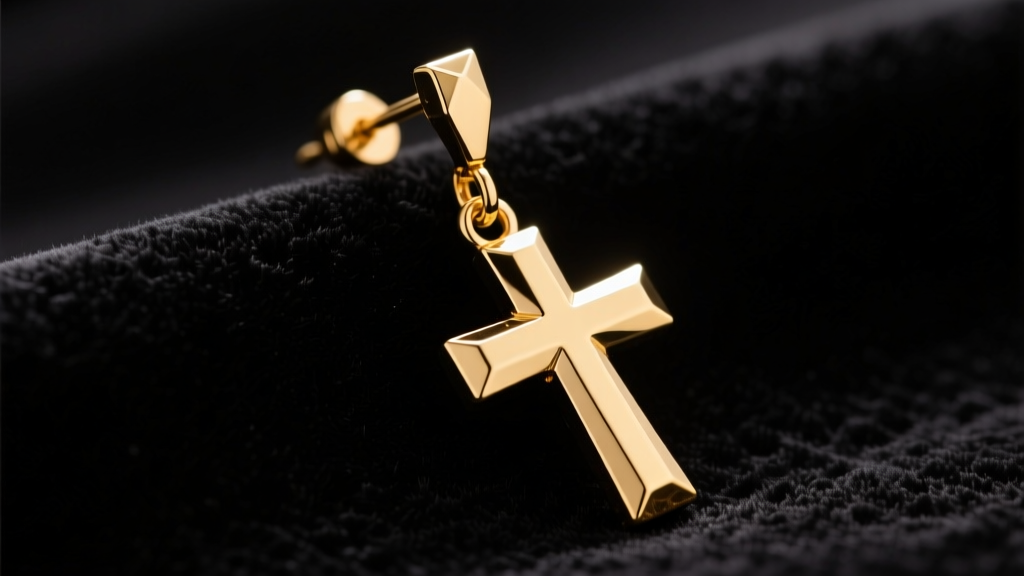
When selecting cross dangle earrings, most consumers focus purely on the aesthetic silhouette, the gemstone accents, or the symbolic meaning of the motif. However, from a jewelry engineering perspective, a dangle earring is a complex mechanical system suspended from a highly delicate tissue matrix: the human earlobe. The elongated vertical geometry of a cross pendant introduces unique physics, specifically regarding pendulum momentum, center of gravity, and localized shear stress. In this expert deep dive, we bypass the superficial style advice and examine the exact metallurgical specifications, gauge tolerances, and structural failure modes that dictate the quality, comfort, and longevity of cross dangle earrings.
The Physics of the Dangle: Weight Distribution and Lobe Stress
The primary enemy of any dangle earring is the "cheese-cutter effect." This phenomenon occurs when a heavy earring pulls downward and forward on the piercing fistula, gradually stretching the tissue and causing the hole to migrate or tear. A standard, healthy earlobe can comfortably support between 7 and 12 grams of static weight. However, cross dangles are notoriously bottom-heavy. When a solid-cast metal cross swings, it generates kinetic energy that multiplies the effective downward force on the lobe during movement.
To mitigate this, high-end jewelry manufacturers utilize specific structural engineering techniques:
- Hollow-Cast Electroforming: This technique creates a voluminous, three-dimensional cross that appears solid but is essentially a microscopic shell of metal, reducing the weight by up to 70% compared to traditional lost-wax casting.
- Skeletonized Filigree: By removing the interior mass of the cross and replacing it with structural lattice work, the earring maintains its visual footprint while drastically lowering the gram weight.
- Counter-Balancing: Some designers incorporate a heavier decorative bead or cluster at the top of the dangle (near the clasp) to shift the center of gravity upward, reducing the pendulum swing and the resulting torque on the earlobe.
As a strict purchasing rule, always request the exact gram weight from the jeweler. For daily wear, a cross dangle should never exceed 8 grams per earring. For occasional evening wear, you can push this limit to 14 grams, provided the wire gauge and clasp are appropriately upgraded.
Metallurgy Matters: Choosing the Right Alloy for Cross Motifs
The base metal of your cross dangle earrings dictates not only the price but the biocompatibility and structural integrity of the piece. The market is flooded with misleading terminology like "Tibetan Silver" or "Alpaca," which contain zero actual silver and are instead zinc-copper-nickel alloys. These cheap alloys are highly prone to galvanic corrosion when exposed to the natural pH and sebum of human skin, resulting in rapid tarnishing and severe contact dermatitis. According to the American Academy of Dermatology, nickel is one of the most common causes of allergic contact dermatitis, making nickel-laced base metals a definitive hazard for sensitive piercings.
The Tarnish and Allergy Matrix
| Metal / Alloy | Weight Profile | Tarnish Resistance | Biocompatibility | Best Use Case |
|---|---|---|---|---|
| ASTM F136 Titanium | Ultra-Lightweight | Exceptional | 100% Hypoallergenic | Heavy, oversized crosses for daily wear |
| 14k / 18k Yellow Gold | Moderate | High | Excellent (if nickel-free) | Heirloom pieces, intricate detailing |
| 925 Sterling Silver | Moderate | Low (Requires polishing) | Good (Copper allergy risk) | Budget-friendly, lightweight filigree |
| 316L Surgical Steel | Heavy | High | Moderate (Contains trace nickel) | Industrial or gothic aesthetic styles |
| "Tibetan" Zinc Alloy | Variable | Very Poor | Poor (High allergy risk) | Avoid entirely for pierced ears |
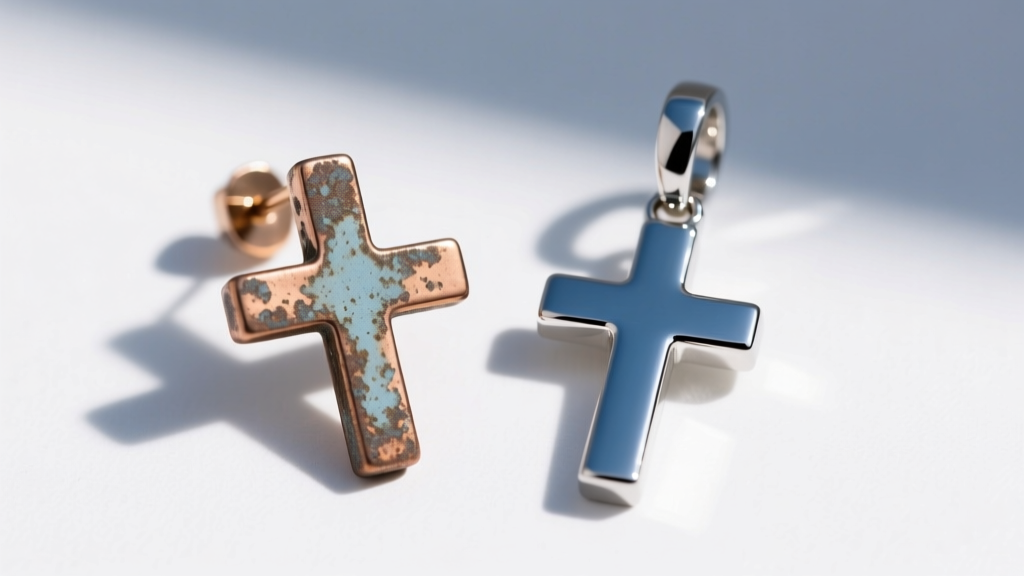
For the ultimate combination of low weight and high tensile strength, ASTM F136 implant-grade titanium is the undisputed champion. It allows jewelers to create larger, more dramatic cross silhouettes without crossing the dangerous weight thresholds that damage earlobes. If you prefer the warmth of precious metals, the Gemological Institute of America (GIA) notes that 14k and 18k gold offer the best balance of purity and durability, provided the alloying metals (like copper or silver) are disclosed and nickel is strictly avoided.
Gauge Thickness and Wire Mechanics
The "gauge" refers to the thickness of the wire that actually passes through your piercing. The standard lobe piercing is typically done at 20-gauge (0.81mm) or 18-gauge (1.02mm). When dealing with the kinetic swing of a cross dangle, the wire thickness is a critical point of failure.
If a heavy cross pendant is suspended from a thin 20-gauge wire, the repetitive swinging motion will cause "work hardening" at the stress points—specifically where the wire bends to form the hook. Over time, the metal becomes brittle at this microscopic level and will eventually snap, resulting in the loss of the earring. For any cross dangle exceeding 6 grams, an 18-gauge (1.02mm) or even 16-gauge (1.29mm) wire is mandatory to provide the necessary shear strength. Always verify that your earlobe fistulas can comfortably accommodate thicker gauges before purchasing heavy-duty dangles; forcing a 16-gauge wire into a tight 20-gauge piercing will cause micro-tears and inflammation.
Clasp and Finding Engineering: Preventing Loss
The finding—the mechanism that secures the earring to the ear—is the final line of defense against losing an expensive piece of jewelry. Cross dangles interact poorly with standard friction backs or open French wires (fishhooks).
Expert Insight: An open French wire relies entirely on gravity and the natural forward tilt of the earlobe to stay in place. The pendulum motion of a swinging cross easily generates enough upward momentum to slide the wire right out of the piercing during activities like walking, dancing, or taking off a sweater.
Instead, demand mechanical locking findings. The leverback clasp features a hinged wire that snaps securely into a catching notch, creating a closed loop that physically cannot slip out of the ear without manual intervention. For even greater security, particularly for high-carat gold or diamond-encrusted crosses, look for locking French wires, which feature a tiny secondary latch that secures the back of the wire to the front loop, effectively transforming the hook into a continuous, unbroken circle.
Troubleshooting Common Failure Modes
Even well-crafted cross dangle earrings can exhibit mechanical quirks. Here is a diagnostic guide to troubleshooting the most common issues encountered by collectors and daily wearers:
1. The Earring Leans Awkwardly Forward
The Cause: The center of gravity is misaligned, or the connecting jump ring is too rigid. If the bail (the loop at the top of the cross) is soldered directly to the wire without a free-moving jump ring, the cross cannot hang plumb. The Fix: A jeweler can easily snip the rigid connection and solder in a micro-jump ring, allowing the cross to pivot freely and hang flush against the neck.
2. The Wire Bends into an Oval Shape
The Cause: The metal is too soft for the weight of the dangle. This is incredibly common with 999 Fine Silver or 24k Gold, which lack the structural alloys necessary to resist deformation. The Fix: The earring must be remade in a harder alloy, such as 925 Sterling Silver or 14k Gold. Alternatively, the jeweler can swap the soft wire for a spring-hardened 18k white gold or titanium wire, which possesses a much higher yield strength.
3. The Skin Behind the Ear Turns Green or Black
The Cause: This is not an infection, but a chemical reaction. The copper content in sterling silver or low-karat gold is reacting to the acidity of your skin, sweat, or lotions, creating copper chloride. The Fix: Clean the earring posts with isopropyl alcohol before wearing. If the reaction persists, the piece must be rhodium-plated or upgraded to a non-reactive metal like titanium or platinum.
Conclusion
Treating cross dangle earrings as mere accessories ignores the complex interplay of physics, metallurgy, and anatomy required to make them functional. By prioritizing hollow-cast or filigree constructions to manage weight, insisting on 18-gauge wires for structural integrity, and selecting biocompatible metals like ASTM F136 titanium or nickel-free 14k gold, you ensure that your jewelry remains as comfortable and secure as it is visually striking. True luxury in jewelry design is found not just in the brilliance of the finish, but in the invisible engineering that allows a piece to be worn effortlessly.


