The Engineering of Dangling Gold Earrings: Weight, Karats & Clasps
Discover the metallurgy and mechanics of dangling gold earrings. Learn how karat weight, clasp engineering, and gauge thickness impact lobe health.
The Metallurgy of Movement: 14K vs. 18K vs. 22K Gold
When evaluating dangling gold earrings, most consumers focus exclusively on aesthetic design, ignoring the fundamental physics and metallurgy that dictate how the piece will perform over time. Gold in its pure state (24K) is highly malleable, possessing a Vickers Hardness (HV) of roughly 25. To create functional jewelry, gold must be alloyed with metals like copper, silver, and zinc. This alloying process dramatically alters the tensile strength and deformation resistance of the final piece.
For kinetic jewelry that swings and pulls against the earlobe, the choice of karat is a structural decision, not just a color preference. According to the World Gold Council, the specific alloy mix determines the earring's ability to withstand cyclic loading without permanent deformation.
Vickers Hardness and Deformation Risks
- 14K Gold (58.5% Gold): With an HV of approximately 140-160 (depending on the copper/silver ratio), 14K gold offers the highest tensile strength. It is the optimal choice for heavy, elongated dangles where the post and jump rings are subjected to high mechanical stress.
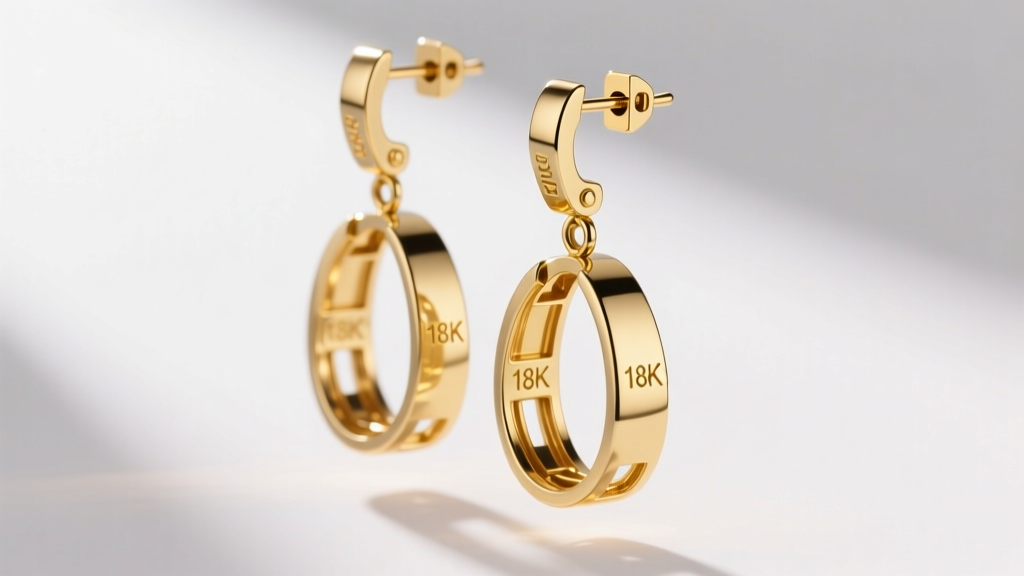
- 18K Gold (75% Gold): Sitting at an HV of 110-130, 18K gold provides a richer yellow hue but is notably softer. Articulated 18K dangles require thicker wire gauges to prevent the links from warping under their own pendulum weight.
- 22K Gold (91.6% Gold): At an HV of 70-80, 22K gold is exceptionally soft. While prized in heritage and bridal jewelry, it is fundamentally unsuited for long dangling gold earrings. The continuous kinetic movement will cause "creep deformation," slowly stretching the jump rings and thinning the ear wires until structural failure occurs.
Ergonomic Engineering: Weight Distribution and Lobe Stress
The human earlobe is composed of fibrofatty tissue with no cartilage framework, making it highly susceptible to mechanical stretching. When you wear dangling gold earrings, the center of mass shifts away from the piercing axis, creating a torque effect. This pendulum effect amplifies the perceived weight of the earring during movement, such as walking or turning the head.

To mitigate lobe tearing and the notorious "forward droop" (where the earring hangs horizontally rather than vertically), jewelers must engineer the earring's center of gravity as close to the ear wire as possible. Below is a technical breakdown of weight thresholds and their corresponding structural requirements.
| Weight Category | Mass (per ear) | Recommended Karat | Required Post Gauge | Lobe Impact & Engineering Solution |
|---|---|---|---|---|
| Lightweight | < 4g | 14K, 18K, 22K | 20G (0.81mm) | Negligible stress. Standard friction backs are sufficient. |
| Mid-Weight | 4g - 8g | 14K, 18K | 18G (1.02mm) | Mild stretching over time. Requires silicone ear supports or heavier clasp counterweights. |
| Heavy | 8g - 15g | 14K (Alloyed) | 16G (1.29mm) | High risk of tearing. Requires French wires with a secure latch or an over-ear cuff support system. |
Clasp and Post Mechanics: Preventing the Forward Droop
The interface between the earring and the earlobe is the most critical point of failure. The "forward droop" occurs when the mass of the dangle exceeds the counter-leverage provided by the earring back. To solve this, the Gemological Institute of America (GIA) and master jewelers recommend specific clasp architectures based on the earring's mass.
Wire Gauge Specifications for Dangles
The American Wire Gauge (AWG) system dictates the thickness of the ear wire. Standard stud earrings use 20G (0.81mm) or 22G (0.64mm) posts. However, for dangling gold earrings exceeding 5 grams, a 20G post will eventually bend under cyclic stress. Upgrading to an 18G (1.02mm) or 16G (1.29mm) wire increases the cross-sectional area, exponentially increasing the wire's resistance to bending moments.

- Friction Backs (Push Backs): Only viable for dangles under 4g. The small surface area of the butterfly clutch creates a localized pressure point on the back of the lobe, leading to tissue necrosis if the earring is too heavy.
- Screw Backs: Offer superior security but do not solve the forward droop issue. The threaded post is typically limited to 18G or 20G due to manufacturing constraints.
- French Wires (Fishhooks): The gold standard for heavy dangles. The long, curved hook distributes the weight across a larger surface area of the piercing channel. When paired with a silicone "earring lifter" disc, it completely neutralizes the forward droop.
- Leverbacks: Provide excellent security via a hinged, locking mechanism. However, the hinge joint introduces a secondary point of mechanical failure and requires precise calibration to ensure it does not pinch the earlobe.
Maintenance and Failure Mode Troubleshooting
Even perfectly engineered dangling gold earrings are subject to metal fatigue. The most common failure point in articulated dangles is the jump ring—the small circular link connecting the ear wire to the main body of the earring. Every step you take induces a micro-oscillation in the earring. Over thousands of cycles, this kinetic energy causes cyclic loading at the solder joint of the jump ring.
"The majority of lost dangle earrings are not due to faulty clasps, but rather the catastrophic failure of poorly soldered jump rings. We exclusively use laser-welded, continuous jump rings for any kinetic piece exceeding 3 grams to eliminate the solder seam vulnerability."
— Master Bench Jeweler, Jewelers of America Symposium Notes
Troubleshooting Common Issues
Issue: The earring constantly turns sideways in the ear.
Diagnosis: The center of gravity is misaligned, or the piercing channel has stretched into an oval shape, allowing the post to rotate.
Solution: Switch to a flat-back labret post with a secure front bezel, or use an anti-slip silicone friction back with a wider flange to stabilize the axis.
Issue: The ear wire is irritating the piercing channel.
Diagnosis: The French wire was polished with abrasive compounds that left microscopic burrs, or the alloy contains high nickel content causing contact dermatitis.
Solution: Ensure the ear wire is electropolished. For sensitive ears, mandate 14K or 18K nickel-free gold alloys (alloyed with palladium or silver instead of nickel-copper mixes).
Final Verdict on Selecting Engineered Dangles
Investing in high-quality dangling gold earrings requires looking past the gemstone and evaluating the structural integrity of the piece. Opt for 14K or 18K gold for articulated designs to ensure adequate Vickers Hardness. Demand 18G or 16G wire thicknesses for mid-to-heavy weights, and always verify that the connecting jump rings are laser-welded or seamless. By prioritizing metallurgical and ergonomic engineering, you ensure that your earrings remain both structurally sound and comfortable for decades of wear.