How to Design, Order, and Style Cartouche Earrings
Learn how to design, order, and style custom cartouche earrings. Discover expert tips on metal gauges, engraving depths, and face-shape proportions.

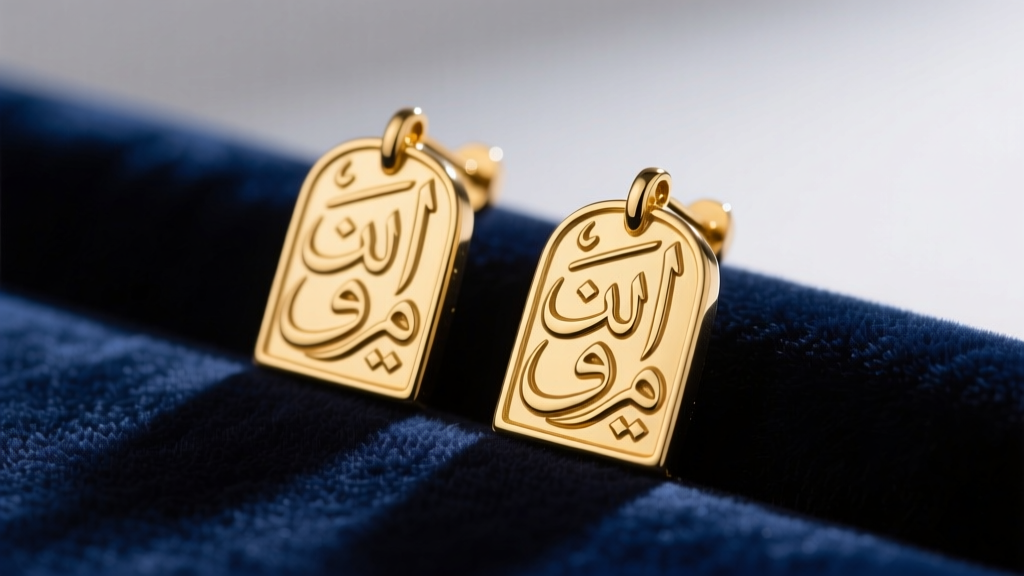
Cartouche earrings represent a masterful intersection of ancient symbolism and modern personalization. Historically, the cartouche—an oval or oblong frame with a horizontal line at one end—was reserved for Egyptian royalty, enclosing their names to protect them from evil spirits in life and the afterlife. Today, this iconic silhouette has been reimagined into a highly sought-after jewelry staple, functioning as a sophisticated alternative to standard nameplate necklaces or initial studs. Whether you are looking to enclose your own name, a meaningful date, or a protective hieroglyph, designing a custom pair requires a nuanced understanding of metallurgy, structural physics, and aesthetic proportion.
In this comprehensive guide, we will walk you through the exact steps to design, order, and style cartouche earrings, ensuring your final piece is not only visually striking but structurally sound for everyday wear.
Understanding the Cartouche Silhouette
Unlike standard oval hoops or solid stud earrings, a cartouche features a distinct border that encapsulates an interior negative space or solid plate. This frame can be hollow (reducing weight) or solid (providing a canvas for deep engraving). The defining characteristic is the horizontal base line, often referred to as the 'tie' or 'shen' ring base, which grounds the design. When transitioning this historical artifact into a modern earring, jewelers must balance the visual weight of the bottom-heavy frame against the delicate nature of the earlobe.
Step 1: Selecting the Optimal Metal Alloy and Post Gauge
The longevity of your cartouche earrings depends heavily on the metal alloy and the thickness of the earring post. Because cartouches are elongated, they are prone to bending if the metal is too soft or the borders are too thin.
Metal Hardness and Alloy Selection
According to the Gemological Institute of America (GIA), the purity of gold directly impacts its structural integrity. For cartouche earrings, 14k gold (58.5% pure gold) is generally superior to 18k gold. 14k gold boasts a higher Vickers hardness (typically around 140-160 HV) due to its higher concentration of alloying metals like copper, silver, and zinc. This rigidity prevents the thin outer borders of the cartouche (often just 1.2mm to 1.5mm thick) from warping when caught on clothing. If you prefer the richer, deeper yellow of 18k gold (75% pure, ~120-130 HV), you must instruct your jeweler to increase the border thickness to at least 1.8mm to compensate for the softer metal.
The Physics of Earring Droop and Post Gauges
A solid cartouche measuring 30mm in length and 12mm in width can easily weigh between 3.5 and 5 grams. A standard 20-gauge (0.81mm) post paired with a traditional butterfly clutch will inevitably cause the earring to tilt forward, a phenomenon known as 'earring droop.' To counteract this center-of-gravity shift:
- Upgrade to an 18-Gauge Post (1.02mm): This provides a thicker, more rigid anchor that resists bending under the weight of the elongated frame.
- Use a La Pousette or Screw-Back Clutch: These locking mechanisms grip the post securely and feature a wider, heavier backing plate that acts as a counterweight behind the earlobe, keeping the cartouche perfectly vertical.
Step 2: Customizing Engraving Depth and Technique

The soul of a cartouche earring lies in its engraving. When ordering custom pieces, you will typically be presented with two primary engraving methods, each yielding vastly different aesthetic and tactile results.
Laser Engraving vs. Diamond Drag Engraving
Laser Engraving: Utilizing a focused beam of light, laser engraving vaporizes the metal to create marks. This method allows for extreme precision (down to 0.1mm line widths), making it ideal for micro-text, intricate Arabic calligraphy, or highly detailed Egyptian hieroglyphs. The depth is usually shallow (around 0.05mm to 0.1mm), resulting in a crisp, high-contrast finish, especially when the laser oxidizes the metal inside the grooves to create a dark, legible contrast against polished gold.
Diamond Drag Engraving: This traditional method uses a diamond-tipped stylus to physically carve into the metal. It creates a deeper groove (0.2mm to 0.5mm) with a brilliant, faceted interior that catches the light. Diamond drag is best suited for classic serif fonts, cursive scripts, and single monograms. However, it lacks the microscopic precision required for complex pictograms.
Expert Tip: If you are engraving a solid 14k gold cartouche, request a 'V-cut' diamond drag engraving with a 90-degree angle. This specific cut maximizes light reflection within the grooves, ensuring your text remains readable even in low-light environments.
Step 3: Proportion Mapping for Face Shapes
Because cartouche earrings are inherently elongated, they act as vertical lines that draw the eye up and down. Selecting the correct millimeter dimensions is crucial for harmonizing with your natural facial structure. The International Gem Society frequently highlights how jewelry proportions can alter visual perception. Use the data table below to determine your ideal cartouche dimensions.
| Face Shape | Ideal Cartouche Dimensions (L x W) | Design Recommendations |
|---|---|---|
| Round | 35mm x 10mm (Elongated) | Opt for narrow, extended frames to create a visual lengthening effect. Avoid wide, stubby cartouches. |
| Oval | 25mm x 12mm (Balanced) | Standard proportions work beautifully. Focus on intricate interior engraving rather than extreme silhouettes. |
| Square | 28mm x 14mm (Softened) | Choose cartouches with heavily rounded, pill-shaped ends to soften a strong jawline. Avoid sharp, geometric borders. |
| Heart | 30mm x 15mm (Bottom-Heavy) | Look for 'teardrop' cartouches that are slightly wider at the base to add visual weight to the lower half of the face. |
Step 4: Curating the Ear Stack
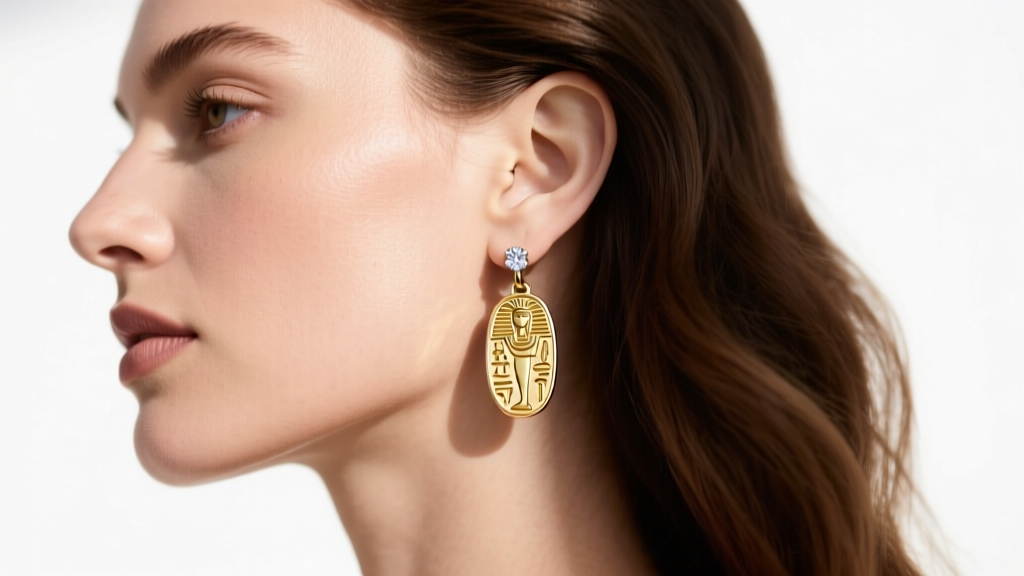
Cartouche earrings are statement pieces that command attention. When building an ear stack, the goal is to support the cartouche without competing with it. Because the cartouche occupies significant vertical real estate on the lower lobe, your secondary piercings should feature minimalist, low-profile designs.
- Upper Lobe Pairing: A 16-gauge (1.29mm) diamond or plain gold huggie hoop (10mm to 12mm diameter) sits snugly against the upper lobe, providing a subtle sparkle that frames the face without crowding the cartouche below.
- Helix/Cartilage Balancing: If you have a helix piercing, a simple bezel-set stud (e.g., a 3mm sapphire or diamond) draws the eye upward, balancing the bottom-heavy nature of the cartouche.
- Threadless Ends: For cartilage piercings, consider using 14k gold threadless ends with a flush-set stone. They offer a seamless look that complements the clean, unbroken lines of the cartouche frame.
Troubleshooting Common Cartouche Failures
Even well-designed cartouche earrings can suffer from specific structural or maintenance issues over time. Here is how to identify and resolve the most common failure modes:
1. Border Warping and Snapping
The Issue: Hollow cartouches made from thin sheet metal (under 0.8mm thickness) are highly susceptible to crushing if slept on, which can lead to stress fractures at the solder joints where the post meets the frame.
The Fix: Always remove elongated earrings before sleeping. If ordering hollow designs, ensure the jeweler uses a reinforced internal ribbing structure or opts for a semi-solid cast design that reduces weight without sacrificing crush resistance.
2. Engraving Discoloration
The Issue: Over time, lotions, perfumes, and natural skin oils accumulate in the deep grooves of diamond-drag engravings, creating a dull, murky appearance that standard polishing cloths cannot reach.
The Fix: Clean your cartouche earrings bi-weekly using a soft-bristled baby toothbrush and a mild solution of warm water and phosphate-free dish soap. Gently agitate the bristles inside the grooves. Avoid ultrasonic cleaners if your cartouche features any micro-pave diamonds along the border, as the high-frequency vibrations can loosen the delicate prongs.
3. Post Solder Failure
The Issue: The horizontal base line of the cartouche is typically where the earring post is soldered. If the solder joint is too small, the leverage exerted by the long frame can cause the post to snap off at the base.
The Fix: Request a 'pad solder' or 'laser weld' attachment from your jeweler. This creates a wider, flattened surface area of contact between the post and the cartouche base, distributing the mechanical stress and virtually eliminating the risk of post detachment.
By understanding the intricate balance of metallurgy, precise dimensions, and structural engineering, you can design a pair of cartouche earrings that are not only deeply personal but engineered to last a lifetime. Whether you choose the rich warmth of 14k yellow gold or the crisp elegance of platinum, your custom cartouche will serve as a modern amulet, carrying your unique story with timeless sophistication.


