Diamond Horseshoe Earrings: Anatomy, Gauges & Fit Guide
Master the technical specs of diamond horseshoe earrings. Expert insights on gauge sizes, internal threading, diamond grades, and cartilage fit.

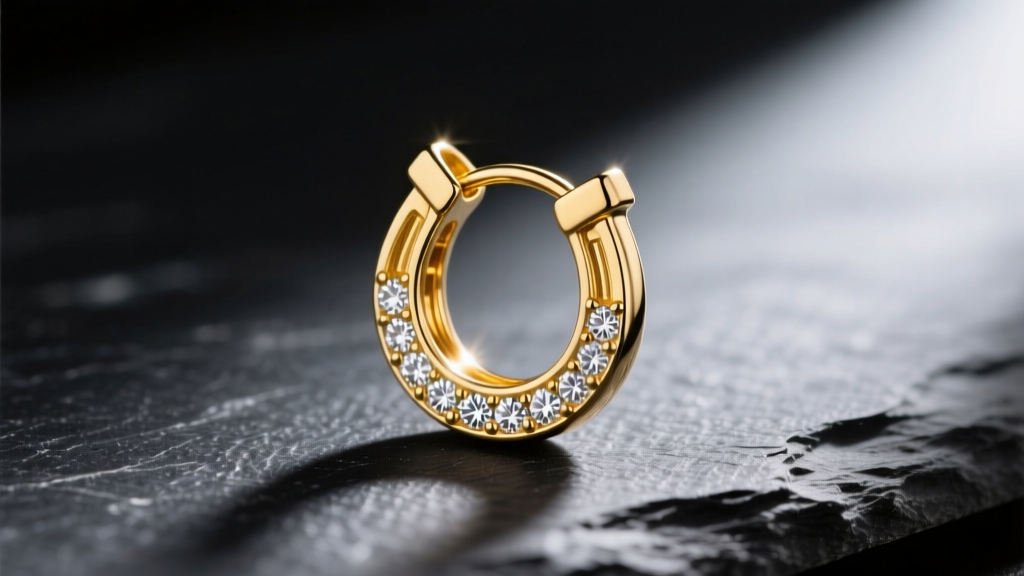
The Anatomy of a Diamond Horseshoe Earring
When jewelry enthusiasts and professional piercers refer to 'horseshoe' earrings, they are technically describing a circular barbell. Unlike a captive bead ring (CBR) which relies on tension to hold a sphere, or a seamless segment ring, the horseshoe features a 270-degree to 300-degree curved bar with two independent ends. In the context of diamond horseshoe earrings, these ends are typically adorned with precision-set gemstones, though a hybrid configuration (one diamond end, one plain titanium or gold sphere) is frequently utilized to reduce weight on delicate cartilage fistulas.
The structural integrity of a horseshoe earring relies heavily on the transition zone where the straight threaded pin meets the curved bar. In low-quality mass-produced jewelry, this junction is a common failure point, prone to micro-fractures under the torsional stress of daily wear. High-end body jewelry manufacturers utilize CNC-machined transitions, ensuring a seamless, polished gradient that prevents tissue irritation during insertion and removal.
Barbell Diameter vs. Inner Circumference
A critical mistake consumers make is confusing the overall width of the jewelry with the inner diameter (ID). The inner diameter is measured strictly from the inside edge of the bar across the center point. For a standard helix piercing, an 8mm ID provides a snug, 'huggie' fit, while a 10mm ID offers a relaxed drape. Selecting the incorrect ID not only ruins the aesthetic profile but can create pressure necrosis if the bar is too tight, or excessive migration risks if the bar is too loose and catches on hair.
Diamond Specifications: What 'Fine Jewelry' Really Means
The diamonds used in horseshoe cartilage earrings almost exclusively fall into the 'melee' category, defined by the Gemological Institute of America (GIA) as stones weighing less than 0.15 carats (typically ranging from 1.5mm to 3.5mm in diameter). At this microscopic scale, the traditional 4 Cs undergo a radical shift in priority.
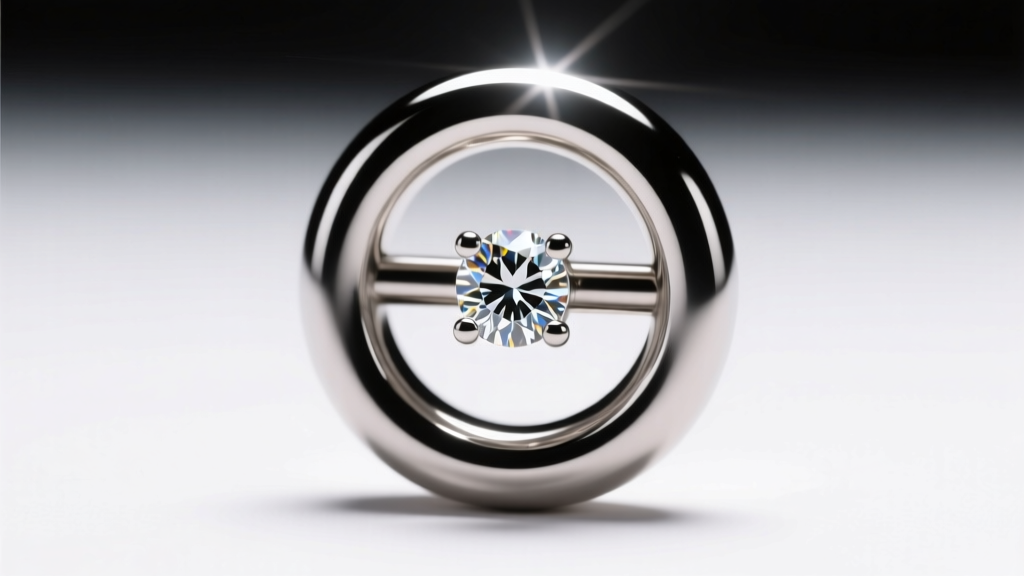
Cut quality is the absolute paramount factor. A poorly cut 2mm diamond will appear as a dead, glassy window, completely failing to refract light. Premium body jewelry brands utilize Ideal or Excellent cut melee diamonds to ensure maximum scintillation, even in low-light environments. Color is the second priority; F-G (colorless to near-colorless) grades are standard for white gold and platinum settings to prevent a yellowish tint against the bright metal. Clarity, conversely, is heavily deprioritized. Because melee diamonds are so small, inclusions characteristic of SI1 or SI2 grades are entirely invisible to the naked eye, making VVS or IF clarity grades an unnecessary financial premium.
Lab-Grown vs. Natural: The 2026 Market Reality
As of 2026, Chemical Vapor Deposition (CVD) lab-grown diamonds dominate the fine body jewelry market. CVD stones offer superior purity for melee sizes compared to High Pressure High Temperature (HPHT) methods, which can sometimes leave metallic flux inclusions that interfere with the structural integrity of the stone during the setting process. From an ethical and economic standpoint, CVD diamonds allow jewelers to offer 3mm (0.10ct) diamond horseshoe ends at a fraction of the historical cost, without compromising on the optical physics of the gemstone.
Threading & Metallurgy: Avoiding Cartilage Rejection
The interface between the jewelry and the piercing channel is where complications arise. The Association of Professional Piercers (APP) strictly mandates internally threaded or threadless (push-pin) jewelry for all cartilage piercings. External threading, where the screw-like ridges are on the bar itself, acts as a cheese grater against the delicate epithelial lining of the fistula during every insertion.
| Gauge Size | Millimeter (mm) | Standard Thread Pitch | Primary Use Case |
|---|---|---|---|
| 18 Gauge | 1.0mm | M0.9 | Standard lobe, delicate tragus |
| 16 Gauge | 1.2mm | M1.0 | Helix, conch, daith, rook |
| 14 Gauge | 1.6mm | M1.2 | Industrial, heavy daith, snug |
Regarding metallurgy, implant-grade titanium (ASTM F136) remains the gold standard for initial piercings and highly reactive tissue due to its complete lack of nickel and biocompatible oxide layer. However, for healed piercings seeking the prestige of gold, 14k solid gold is technically superior to 18k for horseshoe barbells. While 18k gold boasts a richer yellow hue, its higher pure gold content makes it softer and more susceptible to bending if the horseshoe is accidentally snagged. 14k gold, alloyed with palladium or silver (strictly avoiding nickel and cadmium), provides the necessary tensile strength to maintain the precise 280-degree curve of the barbell over years of daily wear.
Piercing Placement & Sizing Matrix
Diamond horseshoe earrings are remarkably versatile, but their geometry dictates specific placement suitability. The gap between the two diamond ends must align perfectly with the anatomy of the piercing channel to avoid 'cheese-cutter' migration effects.

Helix and Forward Helix
The outer helix is the most common home for the diamond horseshoe. An 8mm or 10mm diameter in 16-gauge is standard. The primary risk here is hair snagging on the bottom diamond end. Opting for a bezel setting rather than a traditional 4-prong setting drastically reduces the profile and eliminates the microscopic hooks that catch stray hairs.
Daith Piercing
The daith requires a highly specific curvature. A standard horseshoe often protrudes too far outward, ruining the flush aesthetic of the inner ear fold. For daith placements, specialized 'clicker' segments or ultra-tight 8mm circular barbells with low-profile diamond ends are required. 14-gauge is heavily preferred here to support the structural load of the inner cartilage fold.
Tragus
While labret studs are the traditional tragus standard, a small 6mm or 8mm diamond horseshoe can create a unique 'double stud' illusion if the ends are aligned horizontally. This requires a perfectly straight piercing channel; if the tragus was pierced at an angle, the horseshoe will sit crookedly, causing persistent irritation.
Maintenance & Prong Failure Troubleshooting
Cartilage piercings endure significant environmental abuse. Sleeping on a diamond horseshoe earring applies lateral torque to the gemstone settings. Over time, this micro-abrasion weakens the metal prongs holding the melee diamonds. A common failure mode is the loss of a single diamond, often unnoticed by the wearer until the empty setting begins to scratch the skin.
Expert Protocol: Never use ultrasonic cleaners on older or heavily worn prong-set diamond horseshoe earrings. The high-frequency vibrations can easily dislodge a diamond that is already sitting loosely in a fatigued setting. Instead, use a soft-bristled infant toothbrush with warm water and a drop of mild, non-lotion dish soap to gently clear sebum and dead skin cells from beneath the gemstone.
To preempt prong failure, implement a bi-annual tactile inspection. Run a piece of fine silk or a microfiber cloth over the diamond ends; if the fabric catches, a prong has lifted and requires immediate professional burnishing by a bench jeweler. Furthermore, always ensure that when screwing in the diamond ends, you are turning the gem-setting head itself, not twisting the entire curved bar, which can warp the metal and misalign the internal threading.


